SaaS Startup Hire vs Outsource vs AI: How to Decide
If you don’t want to read the whole guide or have difficulty reading, you can listen to this guide instead.
The old startup playbook was simple. Raise money, hire a team, build the product, then find out if anyone wants it. Founders now ask a different question first: how much can we learn before we hire anyone at all?
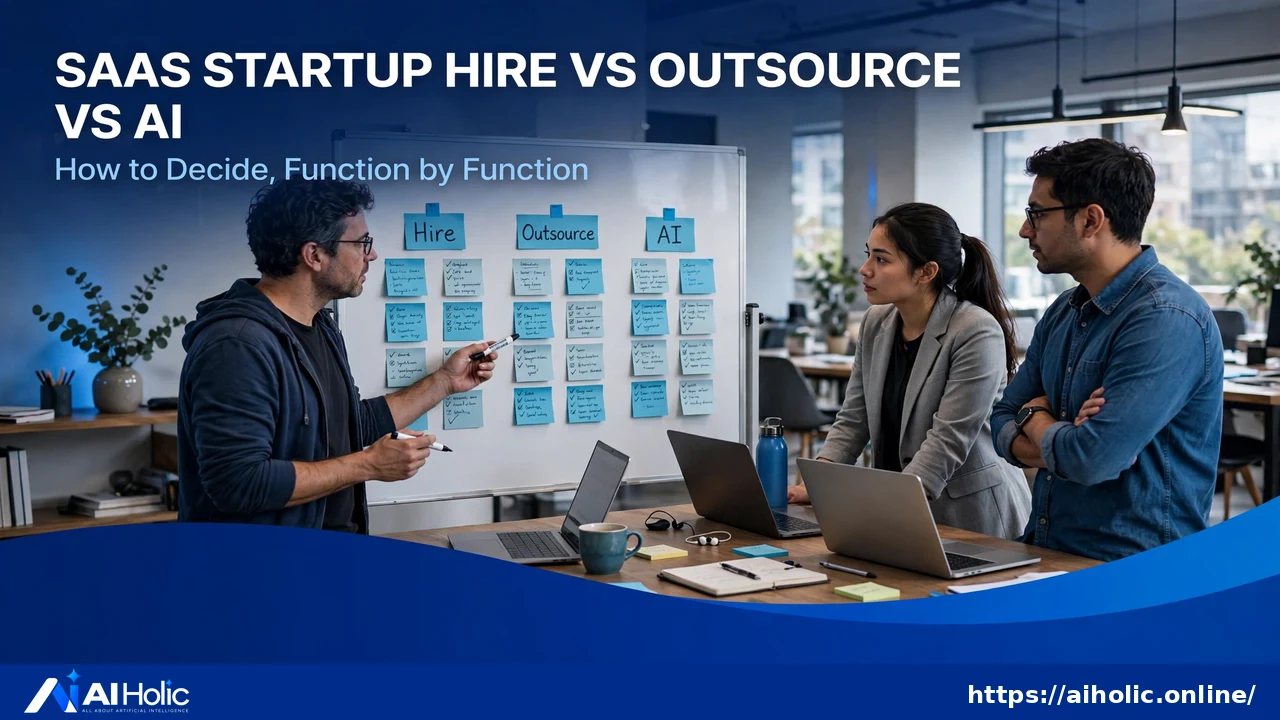
That is the saas startup hire vs outsource vs ai question, and it has no single right answer. It has a right answer per function, and per stage of your company.
At AI Holic we compared the three options on time, cost shape, control and risk. This guide gives you the trade-offs plainly, then a way to decide function by function.
The Three Options, in Plain Terms
Hiring means employees on your payroll. You gain control, product knowledge that stays in the building, and a team that compounds in skill. You also take on fixed costs and a slow start.
Outsourcing means an agency, a development company or freelancers do defined work for a fee. A software as a service product still gets built, but the hands belong to someone else, and they leave when the contract ends.
The third option is newer. AI tools and agents now do real pieces of the work itself: drafting, specifications, first-pass code, test generation, support triage and research. The saas startup hire vs outsource vs ai choice is really about which pieces go where.
What Hiring Really Costs: Time Before Money
The obvious cost of hiring is salary. The hidden cost is the calendar. As Martech Zone noted in its coverage of the shift, one role can take two or three months to fill once you count the job description, screening, interviews, negotiation and onboarding.
Hiring before product-market fit is the expensive version of this mistake. Payroll runs every month whether or not the product has found buyers, and a team hired for one product direction is hard to reshape when the direction changes.
None of that makes hiring wrong. It makes hiring a commitment to make late, for roles you are sure will still matter in a year. Core product knowledge, customer relationships and technical leadership are the usual candidates.
What Outsourcing Buys: Speed and Elasticity
An established team starts in days, not months, and it can grow during a build phase and shrink after launch. One development company, Spaculus, publishes this comparison of MVP timelines from its own project experience:
| MVP phase | In-house team | Development company |
|---|---|---|
| Product scoping and wireframes | 3 to 4 weeks | 1 to 2 weeks |
| UI and UX design | 2 to 3 weeks | 1 to 2 weeks |
| Backend and frontend build | 12 to 16 weeks | 6 to 10 weeks |
| Total | About 22 to 30 weeks | About 10 to 16 weeks |
Treat those numbers as one vendor’s framing, not a law. The direction is hard to argue with, though. A team that has shipped similar products before does not spend your runway learning the basics.
The costs show up later. Knowledge of your codebase sits outside your company. The first build is a first draft whoever builds it, as Spaculus itself points out, and an outside team has less reason to care about the third year of a product than the third month.

What AI Can and Cannot Take Off Your Plate
AI is strongest on work that is structured, repeatable and easy to check. Founders already use it to clarify scope, write specifications and user stories, draft content, generate tests and produce the deployment files that small teams used to defer or outsource.
It is weakest where judgment and accountability live. An AI agent can resolve a routine support ticket. It cannot own the angry enterprise customer, the pricing decision, or the call about which feature gets cut.
One widely shared essay on the SaaS model argues the value is shifting from tools to completed outcomes, with software priced per result instead of per seat. Whether or not that future arrives in full, it explains why the saas startup hire vs outsource vs ai question now includes software as a genuine third option, not just a helper for the other two.
Decide by Function, Not by Fashion
The useful unit of decision is the function, not the company. A sensible default for each looks like this:
| Function | Sensible default | Why |
|---|---|---|
| Core product engineering | Hire, once the product is validated | This knowledge is the company. Outsourcing it rents out your main asset. |
| MVP build before validation | Outsource, with a technical lead of your own | Speed matters more than ownership while you are still testing whether the product should exist. |
| Product design | Outsource or part-time, then hire | Design demand comes in bursts early on. A partner covers the bursts. |
| Customer support | AI first, humans for exceptions | Routine questions are structured and checkable. Difficult customers need a person who can decide. |
| Content and marketing operations | AI drafting, human editing, hire late | Volume work suits AI. Voice and judgment stay with people who know the customers. |
| Testing and QA | AI generation plus outsourced passes | Tests can be generated with the code. Independent passes before a release catch what the builders miss. |
Decide by Stage, Too
Before product-market fit, learning speed is the whole game. A startup that launches in four weeks learns in week five. One that spends four months assembling a team learns the same lesson later, at far higher cost. At this stage, outsource the build, lean on AI for operations, and hire only the technical lead who will judge everyone else’s work.
After fit, the maths flips. You are paying agency rates for work that never ends, on a product you now know customers want. This is when core engineering and product roles come in-house, one at a time, starting with the knowledge you can least afford to rent.
At scale, the question stops being which option and becomes which proportion. Most established SaaS companies run all three: employees for the core, partners for specialist or overflow work, and AI across the routine layer of everything.

The Hybrid Most Startups Land On
Even the vendors selling outsourcing describe a hybrid as the answer for many teams. Spaculus’s own decision framework says that where core intellectual property is tied to AI or machine learning, the sensible split is to outsource the base and build the core yourself.
The lean version described by Martech Zone looks similar from the other side: a founder or two, a technical lead, a design partner, an outsourced development team, AI-powered workflows, and specialists brought in only when needed.
So treat the saas startup hire vs outsource vs ai framing as a portfolio, not a vote. The founders who get this wrong usually picked one answer for every function, at every stage, and kept it long after it stopped fitting.
For more on how AI changes small-company operations, see our AI for Business coverage, including the economics of the AI vending machine business and how AI in publishing workflows is reshaping a whole trade.
Frequently Asked Questions
Should a SaaS startup outsource its MVP?
Often, yes, provided someone on your side can judge the work. Before validation, speed of learning matters more than owning every line of code. Keep a technical lead of your own, even part-time, so decisions about architecture and quality are not left entirely to the vendor.
What work should a SaaS startup never outsource?
The work that is your competitive advantage. If your product’s edge is a particular algorithm, dataset or workflow, that core belongs in-house. Customer relationships and product direction also stay inside, because they are the knowledge every other decision depends on.
Can AI replace a startup’s first hires?
It can delay them, which is nearly as valuable. AI now covers much of the drafting, specification, testing and routine support work that once forced early hires. It does not replace judgment, accountability or customer trust, so the first hires still happen. They just happen later, and for better reasons.
Is it cheaper to outsource or to hire?
They are different shapes of cost. Hiring is a fixed monthly commitment that continues between projects, but the knowledge stays. Outsourcing is a project fee that stops when the work stops, but you pay again whenever you need the knowledge back. Early on, the second shape usually fits better. At steady scale, the first often wins.
When should a SaaS startup make its first engineering hire?
When the product is validated and the roadmap has become continuous rather than experimental. A practical trigger: you are paying outsiders month after month to build the thing customers already pay for. At that point, the senior engineer who owns it belongs on your team.
Conclusion
Answer the saas startup hire vs outsource vs ai question per function and per stage, not once for the whole company. Outsource for speed before validation, let AI carry the routine layer, and hire the core once the product has earned it.