AI College Essay Reviewer: What It Checks, How Accurate It Is, and Which Tool Fits You
If you don’t want to read the whole guide or have difficulty reading, you can listen to this guide instead.
You have a draft, a deadline, and no idea whether the essay is actually any good. An ai college essay reviewer reads the draft against a scoring rubric and hands back grades and comments in minutes. This guide explains what these tools check, how far you should trust the score, and which ones fit students and teachers.
At AI Holic, we compared the main tools by who they serve and what they cost. You will see the exact criteria they score, the honest limits in their own small print, and a simple way to use the feedback between drafts without handing over your voice.
What an AI College Essay Reviewer Does
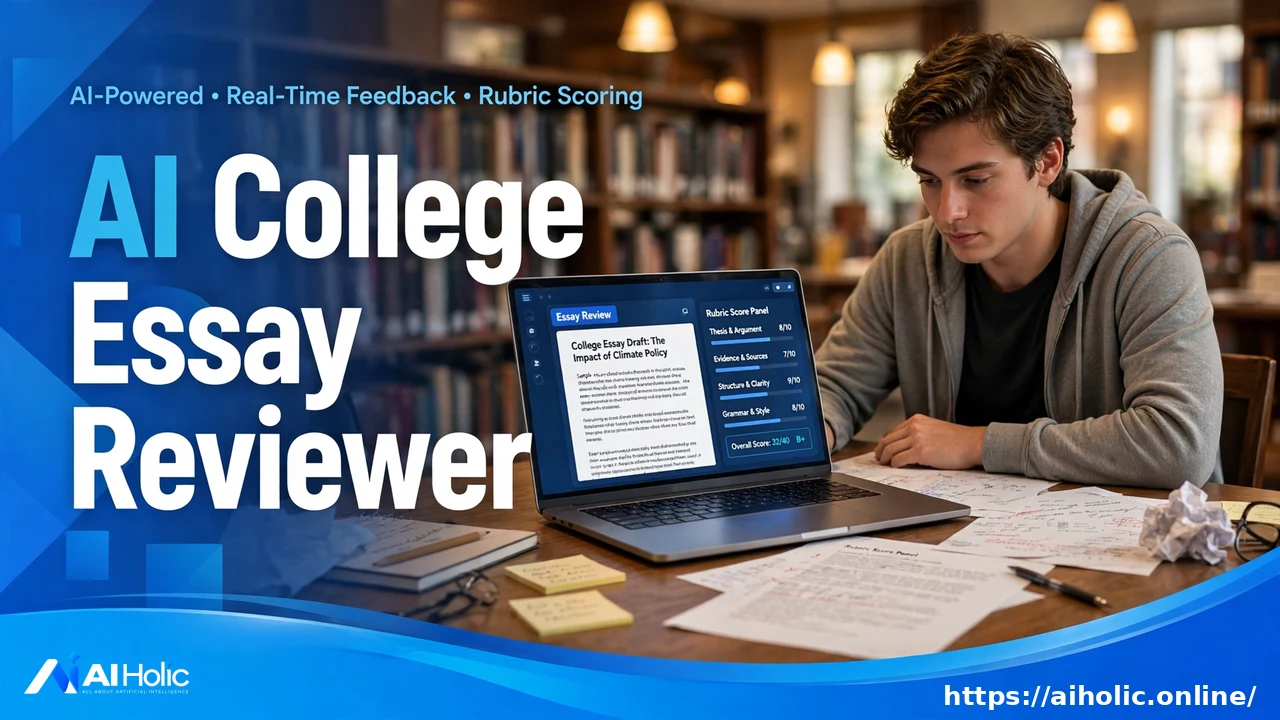
An ai college essay reviewer is software that scores a written essay against a set of criteria and explains the score. You paste the text or upload the file, pick the essay type or rubric, and get back marks per criterion plus written feedback. The whole run usually takes seconds to a few minutes.
Two groups use these tools for opposite reasons. Students run a draft through a reviewer before submitting, to catch a weak thesis or a messy structure while there is still time to fix it. Teachers run a whole class set through a grader to get a first pass done fast, then adjust the scores themselves.
That second point is built into the honest tools. CoGrader, for example, produces a first pass score and feedback by criterion, and its own FAQ states that the teacher is solely responsible for the final grade. The software drafts the judgment. A human signs it.
What It Checks: The Rubric
Almost every score in this guide comes from a rubric, the scoring guide teachers use to judge work against set criteria. The tool reads your essay criterion by criterion instead of giving one vague opinion. That is why the feedback arrives as separate marks rather than a single grade.
Yomu’s reviewer shows the pattern clearly, with six dimensions scored from 0 to 100. Your rubric will differ by tool and assignment, but the checks below cover most of what these systems measure.
- Thesis. Is there one clear central claim, and does the essay actually argue it?
- Structure. Do the paragraphs follow a logical order, with an introduction that sets up the claim and a conclusion that lands it?
- Evidence. Are the claims backed by examples, data or reasoning, or left as bare opinion?
- Clarity. Can a reader follow each idea without rereading sentences?
- Grammar. Are the mechanics clean: spelling, punctuation and sentence control?
- Flow. Do transitions connect the paragraphs into one argument instead of a list of points?
Teacher tools go further and let you bring your own rubric. CoGrader and EssayGrader both accept uploaded or ready made rubrics tied to standards such as Common Core, state standards and AP or IB frameworks. The AI then scores every essay in the class against the same criteria, in the same order.
Exam practice works the same way with fixed scales. The detecting-ai grader lets you pick an SAT style, GRE, IELTS or TOEFL frame before you submit, and each frame scores on its own scale. That makes it the natural pick when the essay in front of you is really test preparation.
The Main Tools, Compared
The five tools below are the ones ranking for this search today. Student tools are free or nearly free, while teacher tools charge for volume, integrations and saved grading time.
| Tool | Best for | What you get | Price |
|---|---|---|---|
| Yomu | Students | Six scores from 0 to 100, a letter grade and fixes in priority order | Free, no signup |
| Grammarly AI Grader | Students | A predicted grade with feedback that updates as you revise | Free once a day, Pro for unlimited |
| detecting-ai essay grader | Exam practice | Rubric review on SAT style, GRE, IELTS or TOEFL scales | Free account required |
| CoGrader | Teachers | Rubric first pass with feedback per criterion, teacher approves | Free Starter with 100 submissions a month, Standard $19 a month |
| EssayGrader | Teachers | 800 plus rubrics, whole class grading, LMS sync | Free plan grades 100 essays |
Two details are worth knowing. CoGrader’s Standard plan drops to $15 a month when billed annually, and the company estimates a class of 30 essays takes about 8 minutes from import to export. EssayGrader says its teachers save an average of 6 to 10 hours a week, though that figure comes from its own survey of active users.

How Accurate Is an AI College Essay Grader?
Here is the honest answer, and it comes from the tools themselves. Every serious ai college essay grader describes its score as an estimate, a prediction or a first pass. None of them claims its mark will match your instructor’s mark.
Yomu says it plainly in its own FAQ: no tool can guarantee the same grade as your instructor. Grammarly says its predicted grade should not be taken as your actual grade. The detecting-ai grader adds that its scores are for revision only and carry no endorsement from any exam board or school.
The tools are also blind to context a human grader has. They see the text and the rubric, not the assignment brief your teacher discussed in class, the sources you were told to use, or the timed conditions of an exam. A score is a revision signal, useful for finding weak spots, and it should be read that way.
Used that way, the scores earn their keep. A thesis marked 40 out of 100 while grammar sits at 90 tells you exactly where the next hour of work belongs. Treat the number as a map of what to fix, not as a verdict on the essay.
One strength is real, though: consistency. The tool applies the same rubric the same way to the first essay and the thirtieth, at midnight as happily as at noon. Human graders tire and drift, so students often trust an even handed first pass even while they doubt its final number.

How to Use the Feedback Between Drafts
- Review a complete draft, not fragments. The rubric needs your whole argument before its scores mean anything.
- Fix the weakest criterion first. One low dimension usually drags the whole grade down more than five small ones.
- Rewrite in your own words. Take the point the feedback makes, then write the fix yourself so the essay keeps your voice.
- Run the review again. A second pass shows whether the fix landed and what weakened elsewhere.
- Keep every draft. Saved versions are your own record that the work is yours, from first draft to final.
The voice point deserves stress. Feedback makes an essay clearer. Wholesale AI rewriting makes it sound like everyone else’s. Admissions readers and teachers both reward a draft that sounds like a person, so accept the diagnosis and write the cure yourself.
The Rules: Feedback Is Fine, Authorship Is Yours
Schools draw their own lines on AI help, and the lines move. Grammarly itself advises students to check their school’s AI policy before using AI features in any product. That check takes two minutes and protects everything else in this guide.
The safe pattern is consistent across most policies. Using a reviewer for feedback, structure checks and proofreading sits on the accepted side, much like the chatbots we covered in our guide to the school ai chatbot. Submitting text the tool wrote for you sits on the other side, and no score is worth that risk.
One more boundary: a reviewer is not a plagiarism checker. Grammarly states that its AI Grader does not check for plagiarism and points students to a separate tool for that job. Run both checks if your assignment needs both.
Frequently Asked Questions
Is using an ai college essay reviewer cheating?
Getting feedback on your own draft is the same category as asking a tutor to read it, and most policies treat it that way. Letting the tool write or rewrite your essay crosses the line. Check your school’s AI policy first, because the final word is always local.
Can an ai college essay reviewer predict my real grade?
Only roughly. The tools call their marks estimates and predictions, and none can see your assignment brief or your teacher’s standards in the room. Expect the score to point at your weak spots accurately and your final grade approximately.
How much does it cost?
Students can start at zero: Yomu is free with no signup, and Grammarly’s grader is free once a day. Teachers pay for volume: CoGrader’s Standard plan is $19 a month or $15 billed annually, after a free Starter tier of 100 submissions a month.
Which tool is best for teachers?
CoGrader fits teachers who want their own rubric applied with a human approval step before students see anything. EssayGrader fits teachers who want a large ready made rubric library and direct sync with Google Classroom, Canvas or Schoology. Both offer a free tier large enough to test on one real class.
How fast is an ai college essay reviewer?
Student tools answer in seconds to a couple of minutes for one essay. Teacher tools work at class speed: CoGrader estimates about 8 minutes to import, grade and export a class of 30 essays. Either way, the slow part is no longer the scoring. It is reading the feedback and deciding what to change.
Does it check for plagiarism or AI writing?
Review and detection are separate jobs. Grammarly’s grader does not check plagiarism, and CoGrader lists an AI detection signal only as a possible flag on some plans, not as proof of anything. Use a dedicated checker when you need one, and treat any flag as a prompt to look closer, not a verdict.
More guides like this one live in our AI in Education section.
Conclusion
An ai college essay reviewer is best used as a fast, honest first reader. Let it score your draft against the rubric, fix the weakest criterion in your own words, and keep every draft as your record. Trust its diagnosis, question its grade, and let a human, your teacher or you, make the final call.