
What Purpose Do Fairness Measures Serve in AI Product Development?
If you don’t want to read the whole guide or have difficulty reading, you can listen to this guide instead.
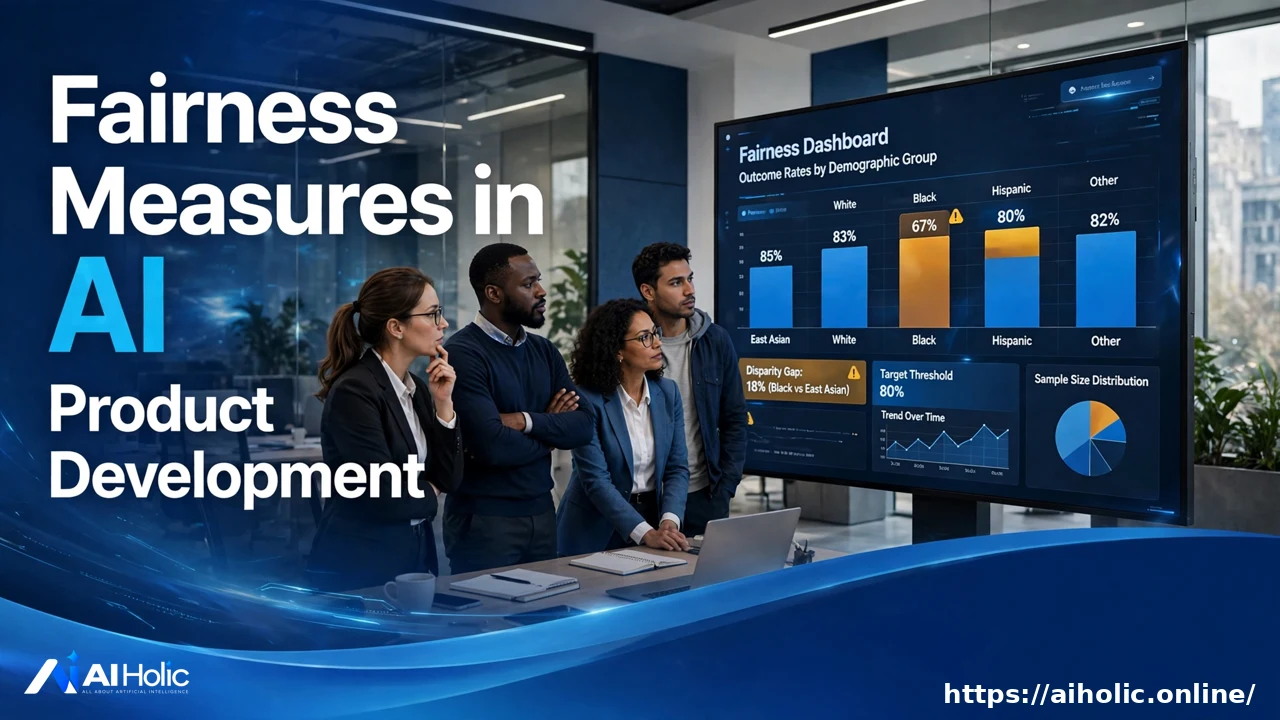
If you are asking what purpose do fairness measures serve in ai product development, here is the short version. They turn fairness from a good intention into numbers a team can check, so a product can be tested for discrimination before it ships, and monitored after it does.
At AI Holic, we explain governance topics in plain words, with the homework-style question answered first and the working detail after it. This guide covers the five jobs fairness measures do, where the bias they catch actually comes from, the main measures in simple terms, and the honest limit every team runs into: the measures disagree with each other.
The Short Answer: Five Jobs Fairness Measures Do
A fairness measure is a calculation that compares how an AI system treats different groups of people. The groups are usually defined by protected characteristics such as race, gender, religion or socioeconomic status.
Without the calculation, “our product is fair” is just a claim. With it, the claim can be tested.
- Find bias. The measure shows whether outcomes differ across groups in the first place, which human review alone often misses.
- Size the gap. It puts a number on the disparity, so the team can judge whether it is a rounding difference or a real problem.
- Create accountability. A recorded metric gives the team, and anyone auditing them, something concrete to answer for.
- Build trust. Users and buyers can see evidence that the product was checked, not just good intentions.
- Support compliance. Anti-discrimination rules are hard to answer without measurements. The metrics are the evidence.
Notice what holds the list together. Every job is about proof. Fairness measures exist because discrimination inside a model is invisible until someone measures outcomes group by group.
Where the Bias They Catch Comes From
Models learn from data, and data carries the world as it was, not as it should be. The best documented sources of trouble are skewed or under-representative training data, human labeling errors, proxy variables, and feedback loops. Each one produces algorithmic bias that a fairness measure is then asked to catch.
Proxy variables are the sneaky case. A model may never see race or gender, yet lean on a postcode or a purchase history that tracks them closely. The output still lands unevenly, and only a group-by-group measure shows it.
The famous cautionary tale is Amazon’s experimental recruiting tool, scrapped after it learned from past hiring patterns and started penalizing resumes that contained the word “women’s.” Nothing in the tool was designed to discriminate. The training data taught it to, and measurement is how such a pattern gets caught.
Feedback loops are the fourth source, and the quietest. A model that slightly favors one group gives that group more exposure, more clicks or more approvals. That new data then trains the next version, and the small tilt grows.
Nothing was wrong on day one. The loop manufactures the gap over time.
The Main Measures, in Plain Words
Different measures define fairness differently, and the differences matter. These five are the ones product teams reach for most.
| Measure | What it checks | In plain words |
|---|---|---|
| Demographic parity | Positive outcome rates per group | Each group gets approved, hired or flagged at roughly the same rate |
| Equal opportunity | Positive outcomes among people who qualify | Qualified people in every group get a genuinely equal chance |
| Equalized odds | Both correct approvals and false alarms, per group | The model is right, and wrong, at similar rates for everyone |
| Predictive parity | Accuracy of a positive prediction per group | When the model says yes, it means the same thing for every group |
| Disparate impact | Outcome ratio between groups | The four-fifths rule: a group should receive at least 80 percent of the best group’s rate |
The four-fifths rule deserves a line of its own because it is older than AI. It comes from US employment screening practice: if one group is selected at less than 80 percent of the highest group’s rate, the process is treated as having an adverse impact. AI teams borrowed it because it is simple, explainable and hard to argue with.
A quick example shows how a team reads a result. Say a lending model approves 60 percent of one group and 42 percent of another. The ratio is 0.7, below the 0.8 line, so the check fails and the team digs into why before anything ships.
The measure did not fix anything by itself. It told the team exactly where to look.
The Catch: The Measures Disagree
Here is the part marketing pages skip. When groups genuinely differ in their underlying rates, research has shown that several of these definitions cannot all be satisfied at the same time. A model tuned to pass demographic parity can fail equalized odds on the same data.
That is not a flaw in the measures. It is the measures doing their real job: forcing the team to say out loud which definition of fair fits this product, and to accept the trade that comes with it. Fairness work also trades against raw accuracy, and the measures make that cost visible instead of hiding it.
So the honest expectation is reduction, not removal. Measures cut bias down and keep it watched. No serious practitioner claims a metric makes a product bias-free.
The accuracy trade deserves the same honesty. Tightening a fairness constraint can cost a little overall accuracy, because the model is no longer free to squeeze every pattern out of skewed data. Teams that publish both numbers, fairness and accuracy together, are the ones whose fairness claims hold up.
Choosing between the definitions comes down to the harm you fear most. A hiring tool worries about qualified candidates being screened out unevenly, so equal opportunity leads. A risk tool worries about false alarms landing on one group, so equalized odds leads.
The measures do not make that judgment for you. They make the consequences of the judgment visible.

How Teams Use Them Across the Product Lifecycle
- Audit the data first. Check who is represented, who is missing, and which variables could act as proxies before training starts.
- Mitigate during the build. Common techniques include re-weighting under-represented examples, resampling the data, and adversarial debiasing, where a second model tries to guess the protected attribute and the main model is penalized when it can.
- Evaluate before release. Run the chosen measures on the finished model and record the numbers, group by group.
- Monitor after release. Real users shift over time, and feedback loops can pull a fair model off course, so the checks repeat in production.
Teams rarely build this tooling from scratch. IBM’s AI Fairness 360, Microsoft’s Fairlearn and Google’s What-If Tool are the names that come up most, alongside open tools such as Aequitas. They compute the measures above and chart the gaps so a team can see them.
Ownership matters as much as tooling. The data team can compute the measures, but choosing the fairness definition is a product and policy decision, and defending it is a leadership one. Teams that assign all three roles early argue less later.
Small teams can run a light version of the same loop. Pick one protected attribute that matters for your users, run the four-fifths check on your main outcome, and write down what you found. That single page of evidence puts you ahead of most products, and it gives you a baseline to improve against.
This measurement habit is also the foundation under any wider governance program. Our guide to ai governance quick wins policy intake risk tiering registry shows how checks like these plug into a starter governance system.
Frequently Asked Questions
What purpose do fairness measures serve in ai product development, in one line?
They convert fairness from a principle into testable numbers, so a team can find discrimination in its product, size it, fix what it can, and prove the work to users and auditors. Without them, fairness is an opinion. With them, it is a measurement.
What is the four-fifths rule?
A rule of thumb from US employment screening. If a group’s selection rate falls below 80 percent of the highest group’s rate, the process is flagged as having an adverse impact. AI teams use it as a quick disparate impact check before running finer measures.
Can a product pass every fairness measure at once?
Usually not. When the groups being compared have different underlying rates, several fairness definitions pull against each other mathematically. Teams pick the definition that matches the harm they most need to prevent, document the choice, and watch the others as warning lights.
Which toolkit should a team start with?
Any of the established open toolkits covers the core measures: IBM AI Fairness 360 and Microsoft Fairlearn are common starting points, and Google’s What-If Tool suits teams that want to explore model behaviour visually. The toolkit matters less than picking your fairness definition first.
When should fairness be measured, before or after launch?
Both, and during the build as well. A data audit catches skewed inputs early, pre-release evaluation catches what training produced, and production monitoring catches drift and feedback loops.
Fairness treated as a launch-day checkbox decays. Fairness treated as a repeating check holds.
Do fairness measures remove bias completely?
No, and any tool or vendor promising that should worry you. Measures reduce bias, expose where it remains, and keep it under watch as data and users change. The goal is a product whose unfairness is measured, shrinking and documented, not a claim of perfection.
More explainers like this one live in our AI Governance, Ethics & Compliance section.
Conclusion
So, what purpose do fairness measures serve in ai product development? They make fairness checkable. They find the gaps between groups, size them, guide the fixes, and leave a record that the work was done.
Used honestly, with their disagreements understood, they are the difference between hoping a product is fair and knowing where it stands.