AI Detection Tool: How AI Checkers Work, What They Cost, and How Much to Trust Them
If you don’t want to read the whole guide or have difficulty reading, you can listen to this guide instead.
Every detector on the first page of Google claims accuracy above 98 percent. Yet in one published test after another, the same tools miss obvious AI text or flag writing that a person produced alone. Both things are true at once, and that gap is where most of the confusion lives.
At AI Holic, this guide explains what an ai detection tool really measures, which names are worth your time, and what independent testing says about trusting a score. You will see how the tools read text, what they cost, and where they fail. By the end you can pick a checker for your situation and read its result with the right level of doubt.
What an AI Detection Tool Actually Does
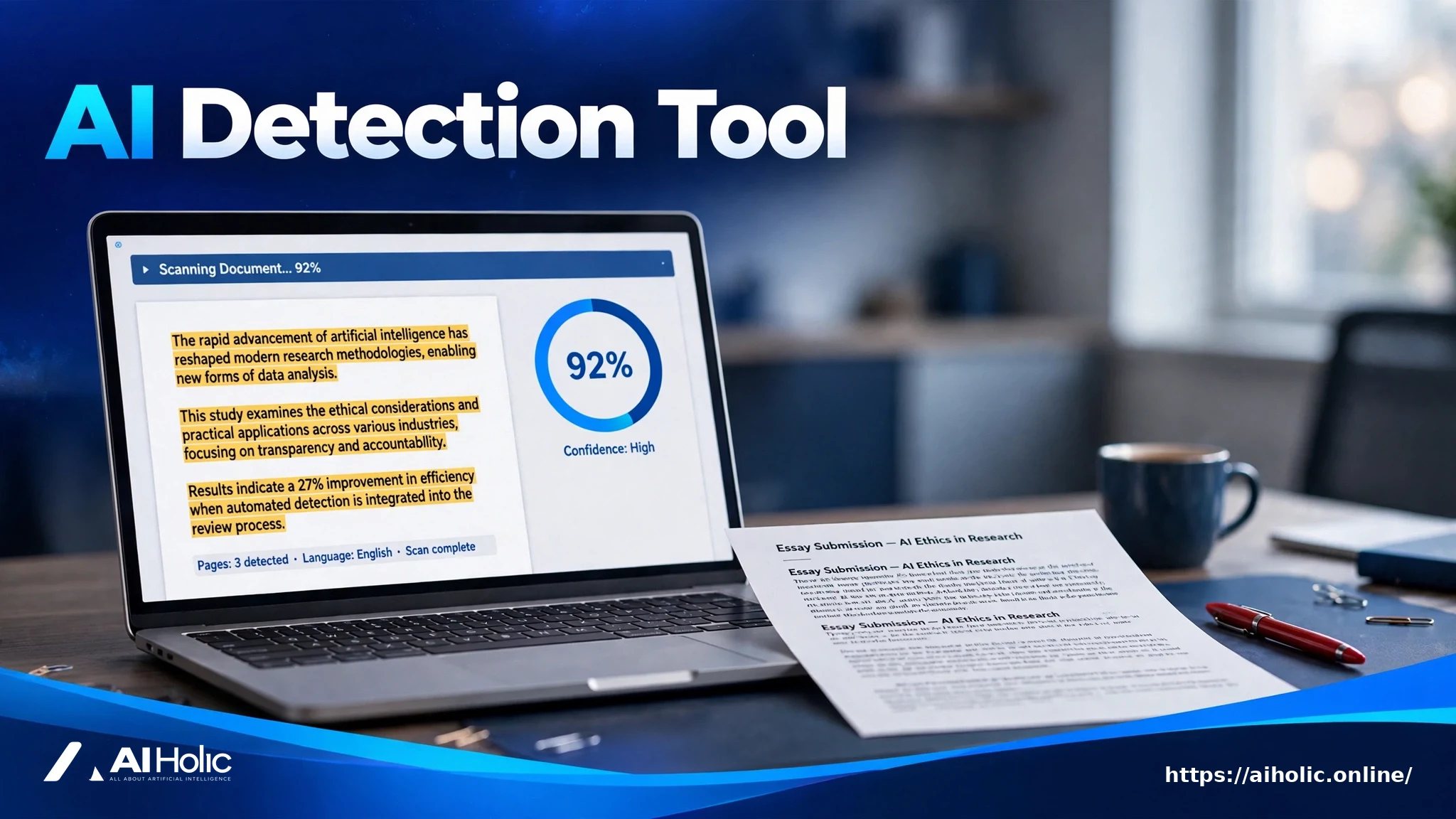
An ai detection tool takes a piece of text and returns a score. The score is an estimate of how likely the text is to have been produced by a language model such as ChatGPT, Claude or Gemini. It is a probability, not a verdict, and every honest maker describes it that way.
People use these checkers for different jobs. Teachers screen student work, students check their own writing before submitting it, and publishers test articles from freelancers before paying for them. The tool is the same in each case, but the cost of a wrong answer changes a lot.
That is why this guide spends as much time on limits as on features. A detector used as a first filter can help. A detector used as final proof can damage an innocent writer.
How Detectors Read Your Text
Detectors do not understand your text the way a reader does. They measure patterns in it, and two measures do most of the work. The first is perplexity, which tracks how predictable each word is given the words before it.
Language models pick the most likely next word again and again, so their text tends to be predictable. Human writers choose odd words, change direction mid sentence, and break their own patterns. Predictable text scores as more likely machine written.
The second measure is burstiness, the variation in sentence length and shape. People naturally mix short lines with long winding ones, while model output often settles into an even rhythm. Tools combine these signals, sometimes sentence by sentence, and turn them into the percentage you see.
The Main Tools and What They Cost
Eight tool homepages fill the first page of Google for this search, and a few more names keep appearing in tests. Most offer a free tier with limits, then a paid plan. Starting prices below come from Pangram’s 2026 comparison of 30 detectors, so check the tool’s own site before you pay.
| Tool | Known for | Paid plans start |
|---|---|---|
| ZeroGPT | Free checker with sentence highlighting | $9.99 per month |
| Copyleaks | Strong test results, business plans | $9.99 per month |
| GPTZero | Education focus, Docs and browser add-ons | $14.99 per month |
| Originality.ai | Built for publishers and content teams | $14.95 per month |
| Pangram | Research-led detector, scan bundles | $15 per month |
| Winston AI | Education and SEO reports | $18 per month |
| QuillBot | Sentence level scores inside a writing suite | $19.95 per month |
| Grammarly | Detector inside the full writing assistant | $30 per month |
Each of these tools leans toward a different buyer. GPTZero grew up around classrooms, Originality.ai sells to publishers who scan bought content, and QuillBot and Grammarly fold detection into wider writing suites. A long Reddit thread on detectors puts Walter Writes AI first, which shows how much rankings move between communities.
Free tiers are the sensible starting point for almost everyone. Clever AI Detector is fully free, and the big names all let you test real text before paying. Pay only when you hit word limits or need reports, history and team features.
Which One Fits Your Job?
For a quick free check, ZeroGPT or Clever AI Detector is enough for most people. Students who want to see their own work the way a teacher’s system might, and teachers screening classes, are best served by GPTZero and its classroom add-ons. Its sentence level view shows exactly which lines raised the score.
Publishers and agencies scanning bought articles should look at Originality.ai or Copyleaks, which add reports and team workflows. Writers who already pay for Grammarly or QuillBot get detection inside a suite they own. In every case, run your own known samples through the free tier first, because your text type decides which tool behaves.

How Accurate Are They Really?
Vendor pages quote the rosiest numbers they can find. Grammarly says its checker reaches 99 percent accuracy on the RAID benchmark, Copyleaks claims over 99 percent, and ZeroGPT lists 98.4 percent with under 1 percent false positives. Treat every one of those as a claim made under the maker’s own test conditions.
Head to head tests tell a messier story. Pangram ran 30 detectors over nine AI texts and three human texts, counting a pass when a tool scored AI text at 75 percent or higher and human text at 25 percent or lower. Only Pangram itself and Copyleaks passed all twelve, GPTZero and Originality.ai each caught seven of nine AI texts, and Grammarly caught none of the nine in that test.
A wider study points the same way. An independent test of 14 detectors, cited in Google’s own results summary, found every tool below 80 percent accuracy, with only five above 70 percent. Small tests swing a lot, but no honest reading of the evidence supports the 99 percent headlines.
The False Positive Problem
The serious risk runs the other way: human text flagged as machine made. A 2023 Stanford study, published in the journal Patterns, ran seven detectors over 91 TOEFL essays written by non-native English speakers. The tools flagged an average of 61.22 percent of those human essays as AI generated, and all seven agreed wrongly on 18 of them.
The same detectors were near perfect on essays by American eighth graders. The mechanism is plain: writers working in a second language use a narrower, more standard vocabulary, and predictable word choice is exactly what detectors punish. Tools have changed since 2023, but the structural risk has not gone away.
Formal writing is exposed for the same reason. Legal text, lab reports and tightly edited articles all favor standard phrasing and even sentence lengths. The Texas Tech University Libraries guide to detection tools warns that they are unreliable as indicators of AI misuse and should be regarded with caution.
How to Use a Detector Without Misusing It
- Test before you trust. Run text you know is human and text you know is AI through any ai detection tool before relying on it, and see how it behaves on your kind of writing.
- Cross check. Two tools disagreeing is common. When a result matters, run a second checker and read the flagged sentences yourself.
- Treat the score as a flag, not a verdict. A high score is a reason to ask questions and look at drafts, notes and version history, not a reason to punish.
- Mind the length. Very short samples give detectors too little pattern to judge, so expect noisy results under a few hundred words.
- Keep your process. If you write for clients or a school, drafts and edit history prove authorship better than any score, a point worth pairing with the habits in our guide to training AI models with prompts.
AI Detection Is Not Plagiarism Checking
Readers often mix the two jobs up. A plagiarism checker compares your text against a database of existing work and finds matching passages. An ai detection tool never looks anything up; it judges the statistical shape of the text in front of it.
So a passage can be fully original and still read as machine made, or copied from a human source and sail through a detector. Many people run both checks, and rewriting tools sit on the other side of the same market, as our test of an AI sentence rewriter shows. More guides like this one live in our AI Tools & Software section.

Frequently Asked Questions
How accurate is an ai detection tool?
Less than the marketing says. Makers quote up to 99 percent under their own test conditions, while independent tests put most tools well under 80 percent on mixed sets. Accuracy also swings with text length, topic and how much the text was edited.
Can a detector flag human writing by mistake?
Yes, and the risk is uneven. A 2023 Stanford study found seven detectors wrongly flagged an average of 61.22 percent of essays by non-native English speakers. Formal, formulaic or heavily edited human writing is also flagged more often than relaxed personal writing.
What types of AI detection tools are there?
Most are web checkers where you paste text and get a score, like ZeroGPT and GPTZero. Others sit inside writing suites, as with Grammarly and QuillBot, or sell scanning to schools and publishers with reports and integrations, as with Copyleaks and Originality.ai.
Can paraphrasing beat a detector?
Often, yes. Rewriting changes word choice and sentence rhythm, which are the very signals detectors read, and tests show scores dropping after paraphrasing or human editing. That is one more reason a low score cannot prove a text is human either.
Is a detector score proof that someone used AI?
No. A score is a probability estimate from pattern matching, and both universities and tool makers warn against using it as sole evidence. Drafts, notes and version history say far more about how a text was written than any percentage.
Conclusion
Used as a first filter, an ai detection tool earns its place: it is fast, cheap and good at spotting unedited machine text. Used as proof, it fails the people it flags wrongly. Test any checker on your own writing, cross check big calls, and let evidence, not a percentage, decide.