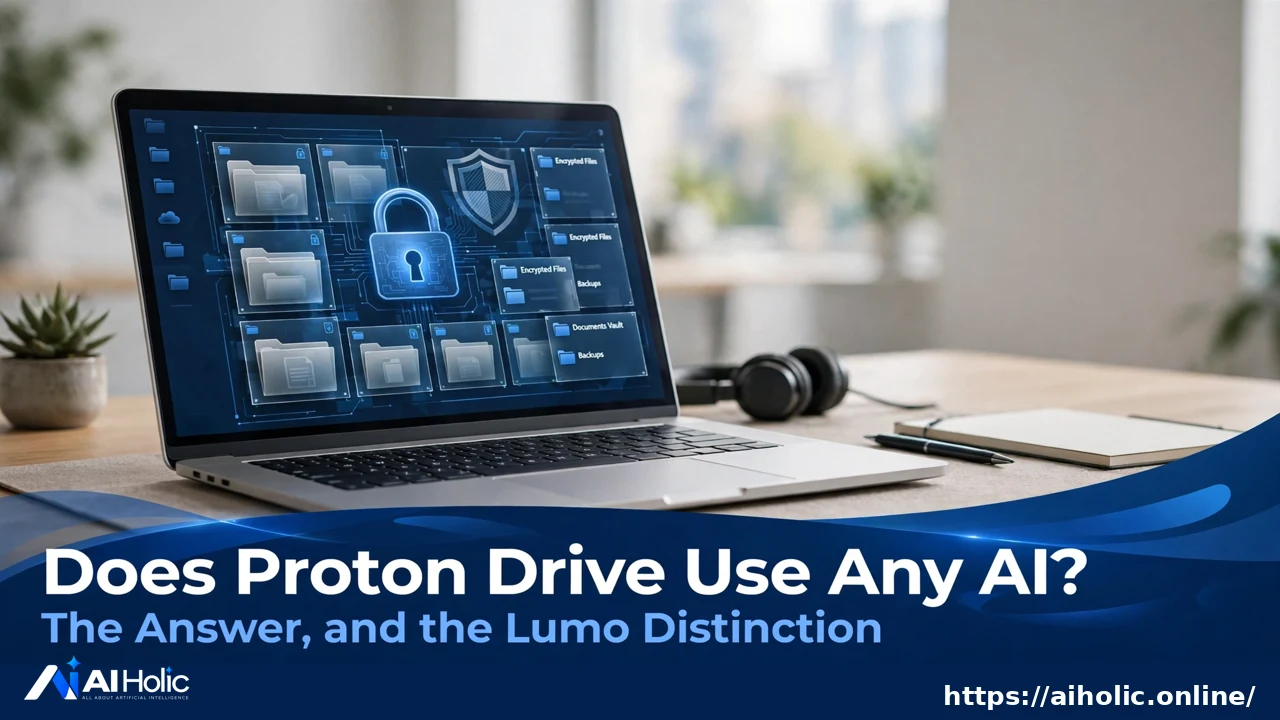
Does Proton Drive Use Any AI? The Short Answer and the Lumo Distinction
If you don’t want to read the whole guide or have difficulty reading, you can listen to this guide instead.
Proton now sells an AI assistant, and that launch made many storage customers ask a fair question: does proton drive use any ai on the files they keep there?
The short answer is no. Proton Drive does not scan, read, summarize or train on your files with AI, and its design makes that kind of processing impossible rather than merely switched off.
At AI Holic we checked what Proton and independent coverage actually say. This guide separates Drive itself from Proton’s AI product, because the confusion lives in that gap.
The Short Answer
No AI runs inside Proton Drive. There is no AI sidebar in Drive, no assistant reading your documents, and no training pipeline behind it.
PCMag, covering the launch of Proton’s encrypted Docs in July 2024, put it plainly. Proton is not trying to add AI to its products, the magazine reported.
The same report gives the practical example. Drive indexes your files locally, on your own device, so you can search them. The search happens on your machine, not in a cloud model.

Why Encryption Settles the Question
Most cloud AI features need the provider to read your files on its servers. Summaries, smart search and training all start with server side access to the content.
Proton Drive is built the opposite way. It uses end-to-end encryption on all files, and Proton states the consequence directly: no one, not even Proton, can access your files unless you share them.
A company that cannot read the files cannot feed them to a model. That is why the no-AI answer for Drive is architectural, not a policy promise that a settings page could reverse tomorrow.
The Docs editor inside Drive follows the same rule. PCMag notes that Drive documents are end-to-end encrypted, so they cannot be used to train generative AI models.
The only exception the magazine names is you. If a document’s creator downloads the content, copies it and feeds it to an AI tool themselves, that is the user’s own act, not the platform’s.
The Part That Confuses People: Lumo
Proton does have an AI product. Lumo launched on July 23, 2025, and it is a separate service inside the Proton account family, not a feature added to Drive.
The confusion in Proton’s own forums is understandable. Users asked whether Drive was still safe to store their work after the Lumo launch, and the community answer repeated one point: Lumo is completely separate from Proton Drive.
Lumo was also built to Proton’s privacy pattern. Its chats use zero-access encryption, it keeps no logs, and Proton states that conversations are not used to train the model.
It runs on open-source language models from Proton’s European datacenters. None of that changes Drive, which keeps its own design whether or not you ever open Lumo.

The One Bridge Between Drive and AI
There is exactly one connection between your stored files and Proton’s AI, and you control it. Lumo lets you add end-to-end encrypted files from your Proton Drive to a chat, so you can ask questions about a document you choose.
The direction matters. The file travels because you attached it, for that conversation. Drive does not send files to Lumo on its own, and nothing is attached in the background.
Community discussion of the Proton services makes the same point in plainer words. There is no forced AI usage in the Proton services, and anyone who wants no AI at all can simply not use Lumo.
How This Differs From Google Drive
The contrast PCMag drew in 2024 still describes the two designs. Google has been putting Gemini inside Drive, Docs, Sheets and Slides as a working sidebar.
That model needs server access to your content, which mainstream drives have by design. Proton’s encryption removes that access, and with it the possibility of equivalent built-in AI features.
Proton has stated its position publicly as well. On its official account it said its use of AI will never be at the expense of security, and that it would publish where AI is permitted in its products and where it is not.
So the trade is explicit. Drive gives up AI conveniences that competing drives advertise, in exchange for storage the provider itself cannot read.
This guide sits in our AI Basics and Guides coverage. For another place where AI behavior surprises users, see our explainer on the data challenges generative AI faces.
Frequently Asked Questions
Which AI model does Proton use?
Proton Drive uses none. Proton’s separate assistant, Lumo, is based on open-source language models and runs on Proton’s own European servers, with chats protected by zero-access encryption and no training on your conversations.
Can you trust Proton Drive?
On the AI question, the reassurance is structural rather than rhetorical. Your files are end-to-end encrypted and Proton states it cannot access them unless you share them. A provider that cannot read your files cannot scan or train on them either.
Does Proton train AI on my files?
No. Drive files, including documents written in Proton Docs, are end-to-end encrypted and are not used to train generative AI models. Lumo also states that its chats are not used for training. The only route from your files into any AI is you attaching one yourself.
Is Lumo connected to Proton Drive?
Only at one point you control. You can add an encrypted file from Drive into a Lumo chat. Otherwise the two services are separate, Drive works the same whether you use Lumo or never open it, and no AI usage is forced on any Proton service.
Conclusion
Does Proton Drive use any AI? No. Its encryption blocks server side reading by design, and Proton’s AI lives in Lumo, a separate assistant you choose to use or ignore.