
Medit i900 AI Features: Scan Assistance, Realtime Intelligence and AuraVue
If you don’t want to read the whole guide or have difficulty reading, you can listen to this guide instead.
Dental scanner pages use the word AI loosely, and the Medit i900 is no exception. Three quite different systems sit behind the medit i900 ai features label, and they do not all ship on the same models.
One helps while you scan. One checks your preparation work the moment you finish. The third reads X-rays, and only on one model, in one country.
At AI Holic we read Medit’s own pages and the independent review coverage to separate them. Here is what each system actually does, which models include it, and what it costs.
Three Different Things Get Called AI Here
The first system is scan assistance. It watches the scan as it forms and fixes gaps while the patient is still in the chair.
The second is Realtime Intelligence, a checking layer that grades the preparation and the scan data in real time. The third is AuraVue, an X-ray diagnostics app built with a partner company.
Keeping them separate matters. Marketing pages blend the medit i900 ai features into one AI story, but a buyer comparing scanners needs to know which parts are included, which are limited, and which belong to a different model entirely.
AI Scan Assistance While You Scan
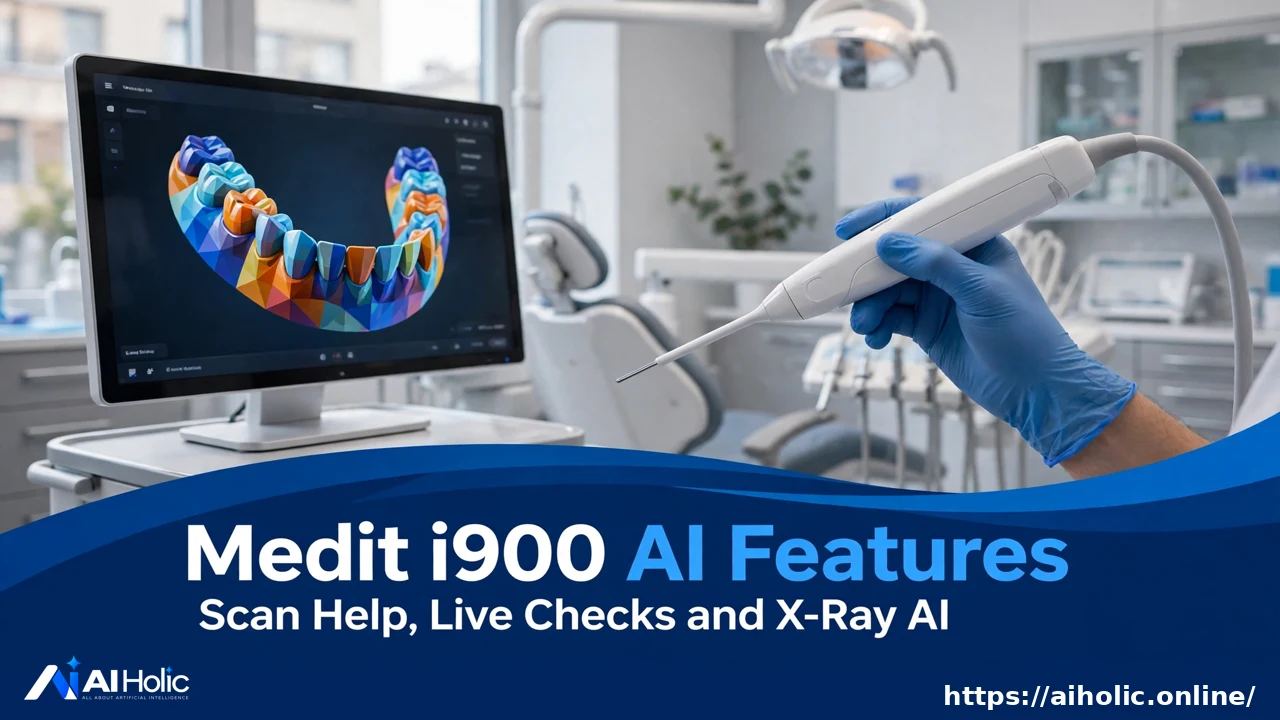
On the i900 Classic page, Medit describes AI-powered scan assistants that detect and correct missing data in real time. The stated aim is fewer rescans and less human error, so the first attempt at a digital impression holds up.
The hardware supports that claim in two practical ways. Lift and Scan starts scanning automatically when you lift the handpiece, and Medit says a full scan can finish in under a minute without touching a button.
The scanner also handles hard surfaces better than older models. Medit lists deeper scanning depth for areas with fluids and soft tissue, and optimized metal scans that capture reflective surfaces in detail instead of dropping them.

Realtime Intelligence: Checks at the Moment of Scanning
Realtime Intelligence is the most substantial of the medit i900 ai features. Medit says it analyzes and validates both scan quality and preparation quality at the exact moment of scanning, before the case leaves the chair.
On the preparation side, it checks five things: the margin line, shown as a color map of curvature changes, undercuts that could block insertion, reduction depth, occlusal space, and interproximal space. Each check flags a specific shortfall, such as insufficient clearance.
On the scan side, it flags areas with insufficient coverage, detects overlapping or multilayered data, checks occlusion balance, analyzes how the upper and lower arches meet, and captures high-resolution images of prepared teeth from up to five angles automatically.
The workflow is simple. You scan, the findings appear within seconds with guidance, you rescan or adjust or dismiss each one, and then the complete data goes to the lab. Medit stresses that the final clinical decision stays with the clinician.
Availability is clear. Realtime Intelligence is built into the i900, the i900 Classic and the i900 Mobility at no extra cost. Owners of the i700 wireless, i700 and i600 can buy it as a license, and the i500 is not supported. Medit’s page also shows free access through December 31, 2026 as a launch offer.
In Medit’s own beta-program survey, 70 percent of users reported fewer remakes, rescans or recalls, and 91 percent said they caught issues earlier than before. Treat those as the maker’s own survey numbers, not independent testing.
AuraVue: AI Diagnostics, With Two Catches
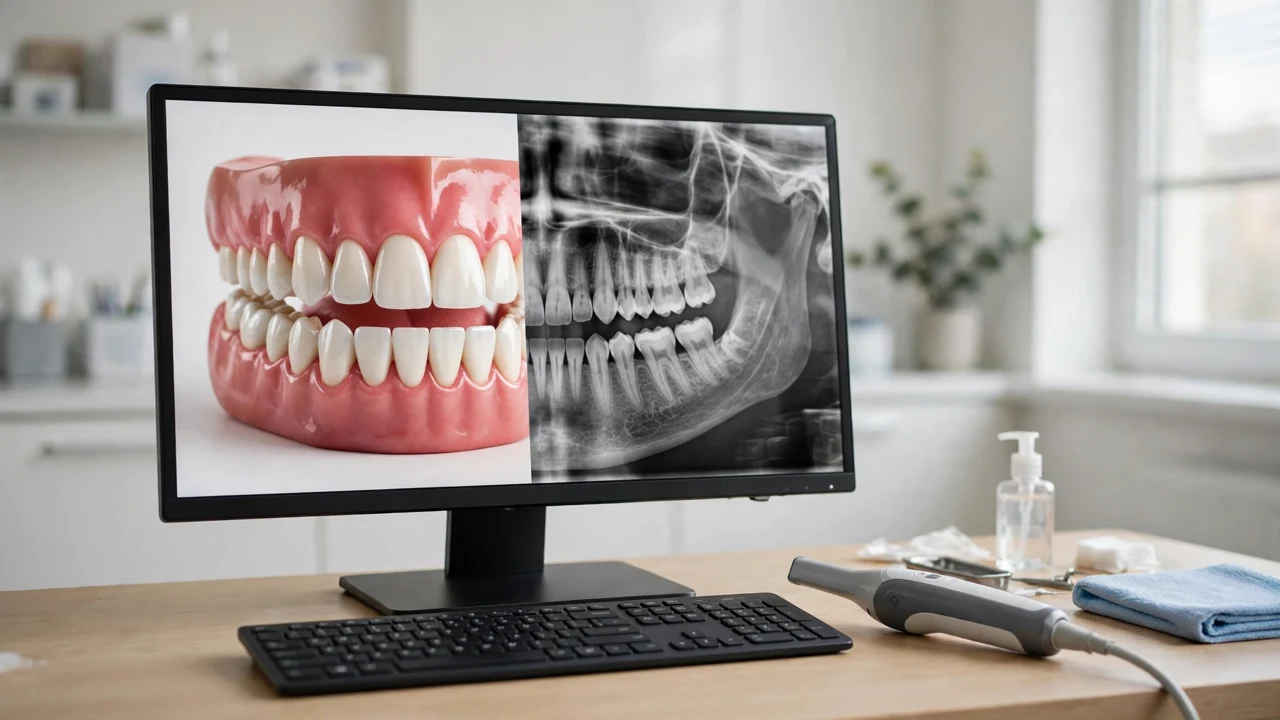
The headline feature in recent coverage is AuraVue, a web-based consultation app that shows intraoral scans and X-rays side by side with AI diagnostic notes.
The Institute of Digital Dentistry’s review of the i900 Mobility is precise about who does the diagnosing. AuraVue itself does not perform AI diagnosis. The findings come from Overjet, an FDA-cleared dental AI system, and are displayed inside Medit’s interface.
Two limits follow. AuraVue belongs to the wireless i900 Mobility, not the wired models, and the review says it is currently available only in the United States. If you buy a Classic for its AI features, this is not one of them.
The Hardware the AI Runs On
The wired i900 weighs 165 grams including the tip, which Medit puts at 33 percent lighter than its predecessor. It uses a third-generation optical engine with 10-bit color imaging.
The Classic page lists a 30 mm scan depth. Tips come in large, medium and small, although the small tip is not in the standard bundle. Calibration runs up to 90 days, and tips survive up to 150 autoclave cycles.
What It Costs
Medit’s own pages list no prices for the medit i900 ai features or the scanners, only demo requests. The Institute of Digital Dentistry review lists the i900 Touch and Classic at 18,999 US dollars with a three-year warranty, and the Mobility at 21,999 dollars for the scanner alone.
Running costs are modest by scanner standards. The same review lists tips at 70 dollars each, which works out to under fifty cents per patient across 150 cycles. Core Medit apps come included with no subscription, and premium cloud storage is an optional extra.
This guide sits in our AI Hardware and Devices coverage. For another assistant built into a piece of hardware, see our guide to the Philips SpeechMike Ambient wearable microphone.
Frequently Asked Questions
What are the key differences between the Medit i700 and i900 scanners?
Weight and interface lead the list. The i900 weighs 165 grams, nearly half the i700’s weight in Medit’s overview, and the original model uses a touch band and touch pad instead of buttons. The i900 line also includes Realtime Intelligence at no extra cost, while i700 owners buy it as a license.
Is Medit a good scanner?
The i900 line is reviewed seriously by specialist outlets such as the Institute of Digital Dentistry, and its checking features address the most common reason scans fail, which is missed data found too late. Judge it on the checks above and the price against rivals, not on the AI label alone.
What are the downsides of using an intraoral scanner?
The purchase price is the first one, at roughly 19,000 dollars for the wired i900 models in the review cited here. Tips are a consumable at 70 dollars each. And the most advertised AI extra, X-ray diagnostics through AuraVue, is limited to the Mobility model in the United States for now.
Is Medit software free?
Mostly, yes. The review coverage says core Medit apps are included with the scanner and need no subscription, and Realtime Intelligence is built into the i900 line. Paid extras exist, such as premium cloud storage and license purchases of Realtime Intelligence for older scanners.
Conclusion
The Medit i900 AI features are three systems, not one: scan assistance, Realtime Intelligence checks, and Mobility-only AuraVue diagnostics from Overjet. The checking layer is the real value, and it is included on every i900.