AI Governance Maturity Model Medium: What the Middle Stage Looks Like and How to Move Past It
If you don’t want to read the whole guide or have difficulty reading, you can listen to this guide instead.
The ai governance maturity model medium stage is where most growing companies land. Policies are written down, roles are named, and risk checks run on a schedule. Yet much of the work still needs a person to push it along, and that gap is what this guide explains. Once you know where your team stands, our guide to ai lifecycle management medium walks through the seven stages, the checks at each stage, and when to retire a system.
At AI Holic, we write plain guides on AI governance, and this one walks through the middle stage step by step. You will learn how to spot it, what good looks like at this level, the traps that keep teams stuck, and the moves that carry a program to the next stage, without slowing real work.
What Is the AI Governance Maturity Model Medium?
In short, the ai governance maturity model medium stage describes a company that has moved past ad hoc AI use and now runs governance by written rules. Policies exist on paper and people follow them most of the time. Risk checks happen on a schedule, and named owners answer for each AI system.
The idea comes from the Capability Maturity Model, a five-level scale first built to judge software work. Wikipedia notes the model was created in 1986 after a study of groups that worked under contract with the US Department of Defense. The same ladder now fits AI governance, since each level adds form and proof to the one before it.
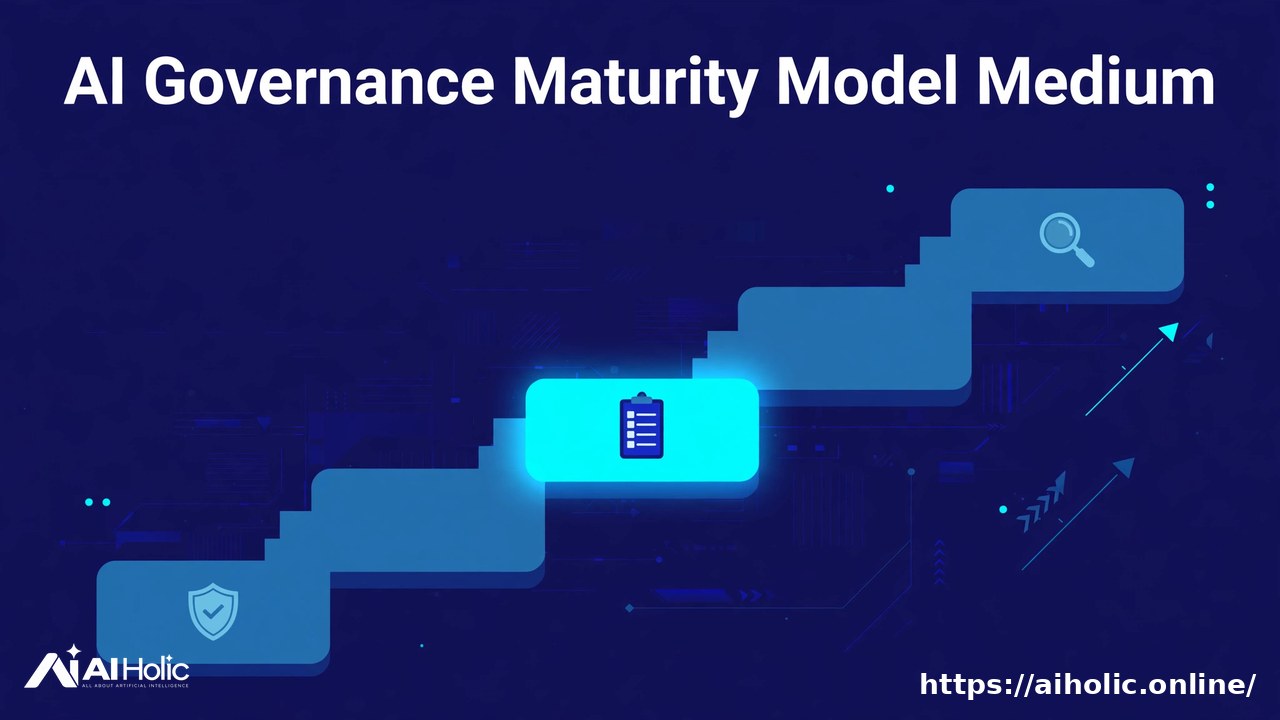
Medium sits in the middle of that ladder. It is the point where governance stops depending on memory and starts depending on process. It is also the point where the limits show, since much of the work still runs by hand. Closing that gap takes a specific set of ai governance skills and capabilities, from risk tiering to evidence that collects itself.
Our guide to unified AI governance architecture explains how one shared structure can hold policy, approval, monitoring, and evidence together. That shared structure is what medium maturity still lacks, since each team tends to run its own version of the rules.
The Five Stages, in Plain Terms
A maturity model is a staged scale that ranks how well a group handles one job, from ad hoc habits to steady, measured practice. Most AI governance models use five stages, though the names change from one writer to the next. The table below uses the names you will meet most often, and it keeps the focus on what you can check at each stage.
| Stage | What it looks like | What governance looks like |
|---|---|---|
| 1. Ad hoc | Staff use AI tools on their own, with no list and no rules | No policy, no owner, no record of what runs |
| 2. Aware | Leaders know AI is in use and a draft policy exists | Approved tools are named, but nothing enforces the rules |
| 3. Defined (medium) | Policies are written and roles are named | Risk tiers, intake checks, and regular reviews run by hand |
| 4. Managed | Controls run inside the systems, not beside them | Approvals wait in the workflow, logs are kept in one place |
| 5. Optimized | Evidence comes from logs on demand | Monitoring raises alerts and each failure tightens the controls |
The middle stage is stage three in most five-stage models. Some writers split the scale into four levels instead, and in those models medium lines up with the second or third level. The count of levels matters less than the test: can you show the controls working, or only describe them?
What Medium Maturity Looks Like Day to Day
A company at medium maturity has a written AI policy that staff can find and follow. It names approved tools, the data that must stay out of them, and the person who reviews AI output before it reaches a customer.
A registry lists the AI systems in use, with an owner and a risk tier for each one. New uses pass through one intake step, where they get a tier and an approval before anyone builds or buys.
Reviews happen on a calendar, not only after a problem. Model cards or short system notes record the intended use, the data sources, and the known limits. Logs exist, but each team may keep them in its own format.
What Still Runs by Hand
Approvals still wait on a person, and evidence for an audit is still gathered by hand. Monitoring runs before launch and rarely after, so drift can go unnoticed for weeks. That mix of written rules and manual work is the clearest sign of the middle stage.
That is the core of the ai governance maturity model medium stage: the rules are real, but the proof still depends on people.

How to Tell If You Are at Medium
You can test your own stage with six plain questions. Answer from what you can show today, not from what your policy promises.
- Can you name every AI tool in use today, with the person who owns it and the data it touches?
- Does every new AI use pass the same intake step and leave with a risk tier?
- Which actions wait for a named person, and can the system finish them without that person?
- For one answer the system gave last month, can you show who asked, what it read, and who approved the action that followed?
- If answer quality dropped this week, what would alert you?
- When an output is wrong, who gets the call, and how do they switch the system off?
Signs You Are at the AI Governance Maturity Model Medium Stage
You pass the first three questions but fail the last three. Your intake and tiers work, yet monitoring and incident response still depend on people remembering to check. That split is normal at medium maturity, and it is also the work list for the next stage.
Medium Compared With Low and High
The table below puts the three broad levels side by side. Use it to explain the gap to leaders who ask why more work is needed when policies already exist.
| Area | Low maturity | Medium maturity | High maturity |
|---|---|---|---|
| Policies | Informal, often unwritten | Written, approved, and shared | Written and enforced by the system |
| Ownership | No one owns AI risk | Named owners for each system | Owners plus on-call cover for every system |
| Risk checks | After incidents only | On a schedule, by risk tier | Continuous, with alerts on drift |
| Automation | None | Partial, with manual steps | End to end, inside the workflow |
| Evidence | Assembled after the fact | Gathered by hand for each review | Pulled from logs on demand |
Low maturity reacts to problems. Medium maturity plans for them. High maturity proves the plan ran, with logs and alerts that speak for themselves.
Leaders also need a clear view of where the program stands. Our guide to AI governance strategic visibility explains how to make governance work visible to the people who fund it.
What Keeps Teams Stuck at Medium
Many teams reach medium and stay there for years. The policy exists, audits pass, and leaders feel the job is done. The manual work underneath stays hidden until a failure or a new rule exposes it.
IBM and the Ponemon Institute studied 600 breached firms for the Cost of a Data Breach Report 2025. They found that 63% of those firms had no AI governance policy or were still writing one, and one in five reported a breach caused by shadow AI, the use of AI tools without approval. Of the firms whose AI models or apps were breached, 97% lacked proper AI access controls.
One common trap is a committee that reviews every use, even low-risk ones. The queue grows, teams route around it, and shadow AI comes back through the side door. Risk tiers exist to stop this, so use them: low-risk uses should pass fast, and only high-risk uses should wait for a full review.
A second trap is treating governance as a compliance task alone. When the only goal is to pass an audit, teams write documents and skip the controls that would catch a bad output in daily use. Our look at AI governance failures shows what happens when controls exist on paper but not in daily use.
How to Move From Medium to High
Moving up means turning manual controls into controls that run inside the system. The ai governance maturity model medium stage ends when the workflow itself enforces the rules, not when the policy gets longer.
- Put every request in one log: record who asked, what the system read, which checks ran, and who approved any action.
- Set approval gates inside the workflow: actions above a set limit wait for the named approver before they run.
- Score answers in production: test live output against a set of real cases and raise an alert when quality slips.
- Give each system an off switch and an owner on call: write the steps to follow after a wrong output and test them once a quarter.
- Make evidence a query: when an auditor asks a question, you should answer with a report, not a week of gathering files.
Take one control at a time, starting with the weakest. A perfect registry does not cover for missing approval gates, and monitoring without a risk tier produces alerts with no rule for which ones matter.
Two public frameworks can guide the work. NIST published its AI Risk Management Framework 1.0 in January 2023 as voluntary guidance, built around four functions: Govern, Map, Measure, and Manage. ISO/IEC 42001, published in December 2023, is described as the first AI management system standard, and it sets out how to run and keep improving such a system.

Medium Maturity for Medium-Sized Organizations
The phrase also shows up with a second meaning: maturity models for medium-sized firms. These firms face the same rules as large firms, but with smaller teams and tighter budgets. The middle stage fits them well, since it gives them written rules and named owners without the cost of full automation.
A medium-sized firm should start with the controls that answer outside questions first. A customer, an insurer, or an auditor will ask for the inventory, the risk tiers, and the review record. Build those three before you buy tools for monitoring or automation.
For a medium-sized company, the ai governance maturity model medium stage is often the right target for the first year. It shows outside parties that AI use is controlled, and it leaves room to automate later, once the manual steps are steady.
Mistakes to Avoid at Medium
These five mistakes show up again and again at the ai governance maturity model medium stage, and each one has a simple fix.
- Treating governance as a compliance-only task, so documents grow while controls stay weak.
- Letting the review committee handle low-risk uses, which slows teams and pushes them to work around the process.
- Skipping checks after launch, so model drift goes unnoticed until a customer reports it.
- Keeping logs in five formats across five teams, so audit evidence takes weeks to gather.
- Averaging scores across teams, which hides the one weak area that sets the real stage.
Frequently Asked Questions
What does the ai governance maturity model medium stage mean?
It means AI governance is formal, written down, and repeatable, with named owners and risk-based checks, but still partly manual. Policies exist and reviews run on a schedule, yet approvals, logs, and monitoring still need people to run them by hand.
Is medium maturity enough for regulated industries?
It can meet baseline needs, but firms in strict sectors often need to move higher. Regulators and large customers may ask for proof that controls run inside the system, not only on paper. Check the rules for your sector before you settle at this stage.
How long does it take to reach medium maturity?
One vendor guide reports 12 to 24 months with focused work and backing from leaders. That figure is reported, not verified, and the real time depends on how many AI systems you run and how scattered they are today.
What comes after medium maturity?
High maturity comes next, where controls run inside the workflow and evidence comes from logs on demand. Approvals wait inside the system, monitoring raises alerts, and each failure feeds back into tighter controls.
Can a small or medium-sized company reach medium maturity?
Yes. The stage needs written rules, named owners, and steady reviews, not a large team or costly tools. Start with the inventory, the risk tiers, and one intake step, then add controls as the firm grows.
Conclusion
Find your stage with the six-question check, then fix the weakest control first. The ai governance maturity model medium stage is a solid middle step: rules are written, owners are named, and risk checks run on a schedule. Automate one control at a time, and let the logs prove the work, until the next stage is in reach.