Integrated AI Governance Model Ethics Law Risk Operational Controls: How the Four Pillars Work as One System
If you don’t want to read the whole guide or have difficulty reading, you can listen to this guide instead.
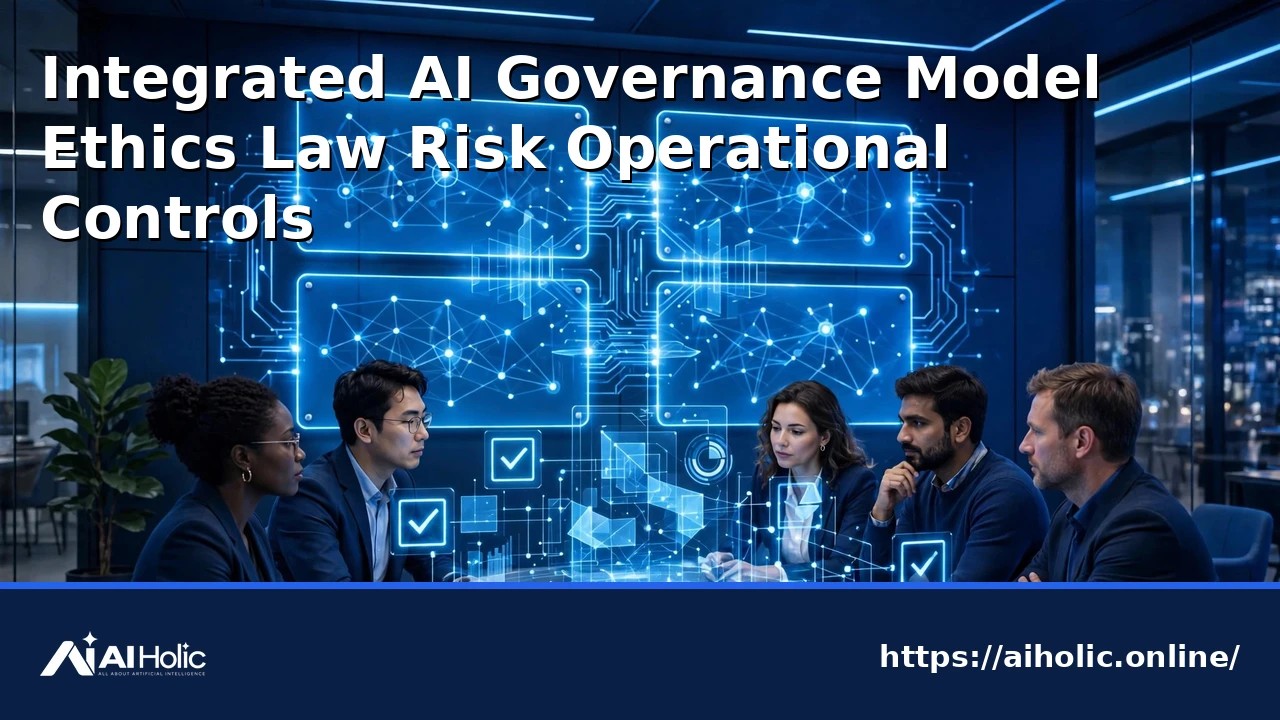
Most teams govern AI in pieces. Legal reviews a contract, security checks a tool, and no one owns the full picture. An integrated ai governance model ethics law risk operational controls system ends that split by joining ethics, law, risk, and day-to-day controls into one working model.
At AI Holic, this guide explains each pillar in plain language. You will see what ethics, law, risk, and controls each add, how they pass work to each other, and what a small team needs to start.
By the end, you will know how the four parts fit and what your first step should be.
What Is an integrated ai governance model ethics law risk operational controls System?
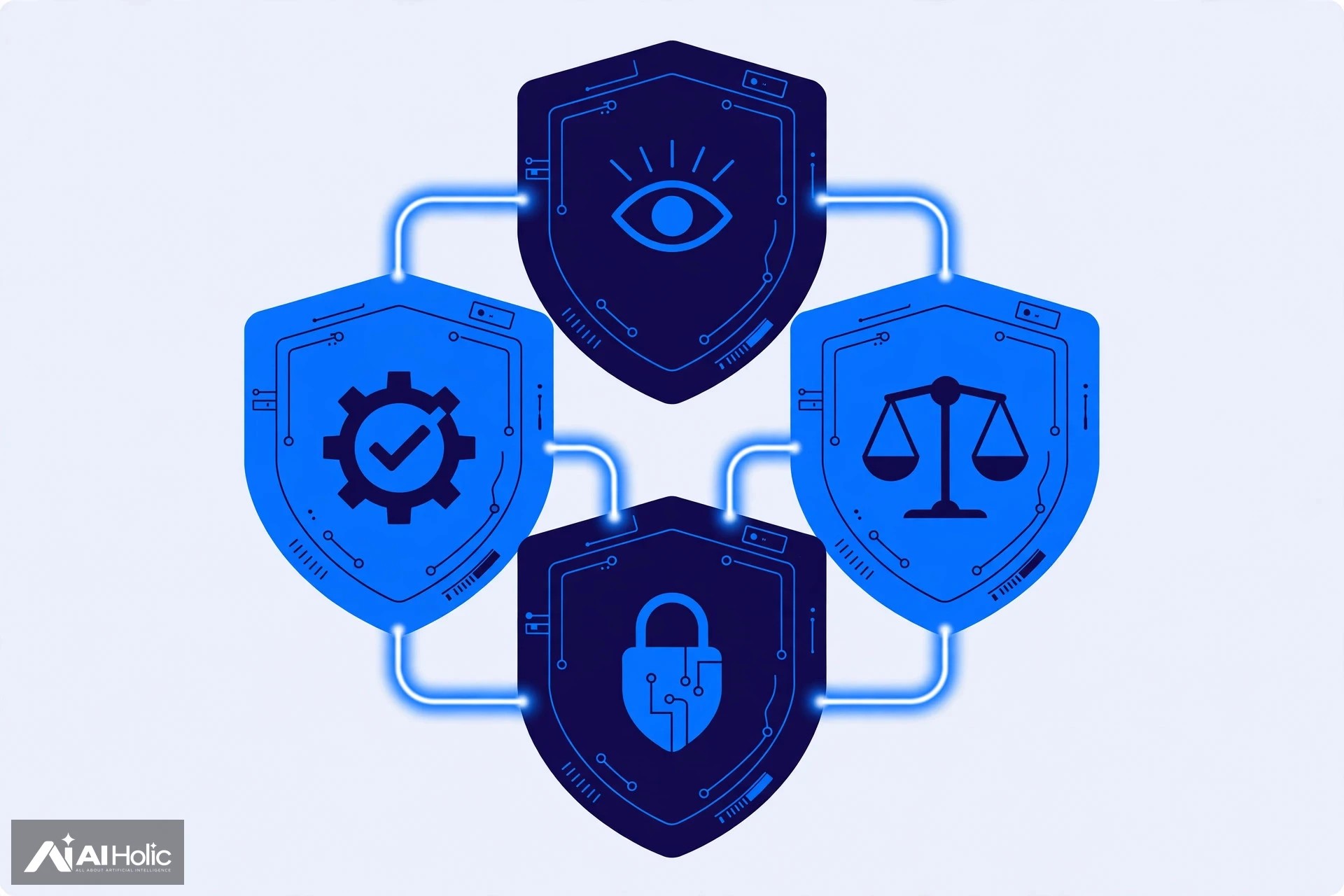
Think of it as one system with four jobs. Ethics sets the values, law sets the rules, risk sets the order of work, and controls make sure the work gets done. Each pillar covers a gap the other three cannot.
A policy alone is not a model. A model earns its name when a rule in one pillar changes what happens in the others. When a risk score rises, for example, the ethics review, the legal check, and the monitoring all tighten at the same time.
Most failures come from a missing link, not a missing policy. A team may have a fairness rule but no test to check it, or a law it must follow but no owner to track it. The integrated model closes those gaps by tying each rule to a person, a test, and a record.
The Four Pillars at a Glance
An integrated ai governance model ethics law risk operational controls program starts with a clear map. The table below shows what each pillar does and the control that proves it works.
| Pillar | What it answers | Key control |
|---|---|---|
| Ethics | Is this use fair and honest? | Bias testing before launch |
| Law | What rules must we follow? | Legal review and records |
| Risk | What could go wrong, and how bad? | Risk tiers and impact checks |
| Operational controls | Who does what, and how do we know? | Approvals, logs, and monitoring |
Pillar One: Ethics Sets the Bar
Ethics is the pillar that asks what your team stands for. It turns values such as fairness, honesty, and respect for privacy into tests a system must pass. Without those tests, values stay on a slide and never reach the product.
Fairness testing is the most concrete part. Before launch, a team checks whether the system treats groups of users differently in ways it should not. A hiring tool that ranks one group lower for no job-related reason fails the test, and the launch waits.
Transparency is the second test. Users and staff should know when AI shapes a decision about them and what data it used. A short plain-language note at the point of use does more than a long policy no one reads.
Ethics also sets limits on use. Some uses may be legal but still wrong for your team, such as scoring staff mood from webcam data. A clear list of uses you will not build saves hard debates later, and our guide to a unified AI governance architecture shows how those limits sit inside one shared structure.
Pillar Two: Law Sets the Floor
Law is the pillar that draws the line you cannot cross. It covers the EU AI Act, privacy law such as the GDPR, and any sector rules that apply to your work. The EU AI Act is Regulation (EU) 2024/1689, and it entered into force on 1 August 2024.
The Act sorts AI systems into risk tiers. Unacceptable-risk uses, such as government social scoring, are banned. High-risk systems, such as hiring and credit tools, face the strictest duties, including risk management, data checks, human oversight, and records.
Fines give the law weight. Breaches of the banned practices can draw fines up to 35 million euros or 7 percent of worldwide annual turnover, whichever is higher. Most other breaches carry fines up to 15 million euros or 3 percent of turnover.
In an integrated ai governance model ethics law risk operational controls program, the law pillar sets the floor that the other pillars build on. Ethics can demand more than the law, but it can never demand less. Risk scoring then uses the legal tier as its starting point, not as an afterthought.
Keep a simple law register. List each rule, the systems it touches, and the person who tracks changes. Review it each quarter, since AI rules are still changing fast.
Pillar Three: Risk Sets the Order
Risk is the pillar that decides where attention goes first. A team cannot test everything at once, so it ranks systems by how much harm they could cause and how likely that harm is. High-risk systems get full checks, while low-risk tools get light ones.
Start with an inventory. List every AI system in use, including tools hidden inside vendor software. You cannot rank what you have not counted, and most teams find tools they did not know were running.
The NIST AI Risk Management Framework gives a plain method for this work. NIST released version 1.0 on 26 January 2023, and it runs on four functions: Govern, Map, Measure, and Manage. Govern sets the culture and roles, Map finds the risks, Measure tests them, and Manage acts on the results.
Risk work never ends at launch. Models drift as data changes, so a system that tested fair in January may not test fair in July. A schedule of re-tests, with dates and owners, keeps the ranking honest, and the cost of skipping this step shows up in our roundup of AI governance failures, where small gaps grew into public incidents.
Pillar Four: Operational Controls Do the Work
Controls are the pillar that turns the other three into daily habits. A control is a named action with an owner, a schedule, and a record. If no one can show the record, the control does not exist.
The core controls are simple. An approval step stops high-risk systems from going live without sign-off, and an audit log records who did what and when. Access rules limit who can change a model or its data, while monitoring watches live systems for drift, bias, and errors.
Model cards and data sheets are the records that tie controls together. A model card lists what a model is for, what data trained it, how it tested, and where it should not be used. An auditor can read one card and see the whole story.
ISO/IEC 42001:2023 gives this pillar a certifiable shape. Published on 18 December 2023, it is the first international standard for an AI management system, and it runs on the Plan-Do-Check-Act cycle. It does not replace the law or the risk framework, but it gives an auditor a clear system to check.
How the Four Pillars Work Together
The four pillars pass work to each other in a loop. Ethics flags a fairness concern, risk scores it, law checks the duty, and controls set the test and the owner. When the test result comes back, the loop starts again with fresh facts.
One example makes the loop clear: a bank plans a loan tool. Ethics asks whether the model treats applicants fairly, law confirms the credit rules that apply, risk ranks the system as high, and controls demand bias testing, sign-off, and monthly monitoring. No pillar works alone, and each one checks the others.
An integrated ai governance model ethics law risk operational controls program does not pick one framework and ignore the rest. It uses each framework for the job it does best, as the table below shows.
| Framework | Type | What it gives your model |
|---|---|---|
| EU AI Act | Binding law | Risk tiers, duties, and fines |
| NIST AI RMF 1.0 | Voluntary guidance | The Govern, Map, Measure, Manage method |
| ISO/IEC 42001:2023 | Certifiable standard | A management system an auditor can check |
| OECD AI Principles | International values | Shared principles for trustworthy AI |
Notice that no single framework is the standard. The law tells you what you must do, the NIST framework tells you how to manage risk, and ISO 42001 tells you how to run the system so an auditor can verify it. Your model uses all three, each in its own role.
How to Build an integrated ai governance model ethics law risk operational controls Program
Building an integrated ai governance model ethics law risk operational controls program is a 90-day job for a small team, not a year-long project. The steps below keep the work in order.
- Weeks 1 to 2: list every AI system in use and name an owner for each one.
- Weeks 3 to 4: sort the list into risk tiers and write the ethics rules that apply to each tier.
- Weeks 5 to 6: map the laws that touch each high-risk system and start the law register.
- Weeks 7 to 8: set up the core controls: approvals, audit logs, access rules, and monitoring.
- Weeks 9 to 10: test the highest-risk system end to end and fix what the test finds.
- Weeks 11 to 12: write the model cards, run a first internal review, and set the quarterly cycle.
Start with the highest-risk system only. A pilot on one system teaches the team more than a policy written for fifty. Once the loop works on one system, copy it to the next.

Keep the paperwork light. A policy longer than ten pages will not be read, and a checklist no one follows is worse than no checklist at all. Short rules, named owners, and dated records beat thick binders every time.
Mistakes That Stall the Model
The most common mistake is writing principles with no controls. A charter that says “we value fairness” changes nothing until a test, a threshold, and an owner sit behind it. Regulators audit controls, not posters.
The second mistake is letting one team own governance alone. Legal writes the policy, engineers ship the model, and neither talks to the other. A cross-team board with real decision power fixes this, even if it meets only once a month.
The third mistake is treating launch as the finish line. In an integrated ai governance model ethics law risk operational controls program, launch is the middle of the job, since monitoring, re-testing, and incident response all come after it. A system with no owner after launch is a system no one governs.
The fourth mistake is building for one law only. Rules change, and a model built purely for the EU AI Act will need rework when the next rule arrives. Build the loop once, then map each new rule into it, and our guide to the AI governance maturity model shows how teams move from ad hoc checks to a steady, repeatable system.
Watch: NIST AI RMF Explained
Frequently Asked Questions
What is an integrated ai governance model ethics law risk operational controls system?
It is one system that joins four pillars: ethics, law, risk, and operational controls. Ethics sets the values, law sets the rules, risk sets the order of work, and controls make the work happen with owners, tests, and records. The point is that a change in one pillar changes what the others do, so nothing is governed in isolation.
Which framework should a small team start with?
Start with the NIST AI Risk Management Framework, since it is free, voluntary, and written in plain steps. Use its four functions, Govern, Map, Measure, and Manage, to run your first risk review. Add the EU AI Act duties once you know which of your systems touch EU users, and look at ISO/IEC 42001 later, when you want an audit-ready system.
How is AI governance different from AI ethics?
Ethics states the values, such as fairness and privacy, that a team wants to protect. Governance is the system that enforces those values through risk tiers, tests, approvals, logs, and monitoring. A team can hold strong values and still fail, if no control checks whether the values hold in practice.
What does the EU AI Act require first?
The Act entered into force on 1 August 2024, and its ban on unacceptable-risk practices applied from 2 February 2025. Most other duties, including the full set for high-risk systems, apply from 2 August 2026. Teams should start now with an inventory and risk tiers, since the duties build on work that takes months, not days.
How often should AI systems be re-tested?
High-risk systems deserve a full re-test at least once a year, plus a check after any major change to data, users, or purpose. Lower-risk tools can follow a lighter cycle, such as a short annual review. Monitoring should run all the time, so drift and bias surface between scheduled tests rather than at the next audit.
Conclusion
integrated ai governance model ethics law risk operational controls is a simple idea with hard follow-through: ethics sets the bar, law sets the floor, risk sets the order, and controls do the work. Pick your highest-risk system, run the loop once, and build from there.