AI Wrapper Product Defensibility Moat Risk: How Thin Tools Get Replaced
If you don’t want to read the whole guide or have difficulty reading, you can listen to this guide instead.
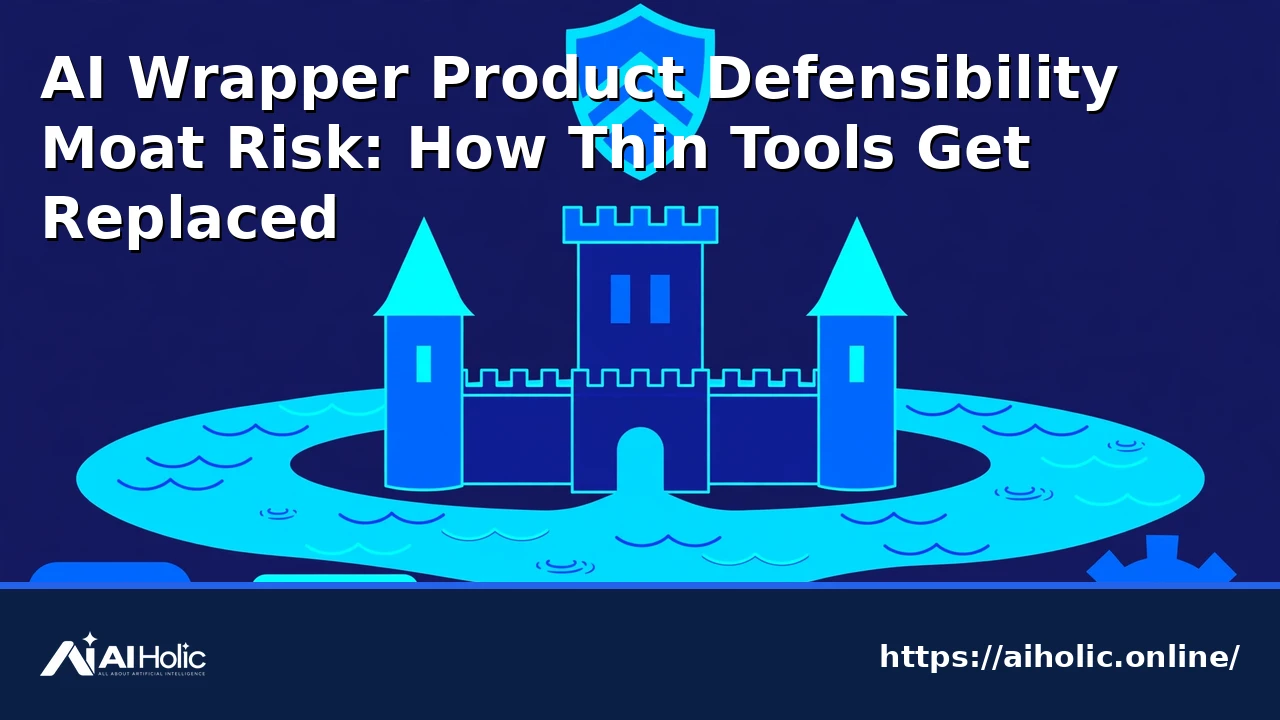
A thin AI wrapper is easy to build and easy to replace, and that is the heart of ai wrapper product defensibility moat risk. When your product is a simple layer on top of someone else’s model, the model owner can ship your feature, cut your price room, or change the rules, and your users can leave in a day. At AI Holic, we explain that risk in plain terms, then show the five moats that actually hold.
This guide covers what a wrapper is, why the risk is real, which defenses work, and a simple test you can run on your own product today. No hype, just the mechanics of what survives and what gets replaced.
The Short Answer
AI wrapper product defensibility moat risk is the chance that a thin AI tool loses its users and its margin because it owns nothing hard to copy. A wrapper adds a prompt and a nice screen on top of a rented model, so a rival can rebuild it in a weekend and the model owner can absorb it in one release.
The fix is to own something the model cannot ship: private data that grows with use, a place inside the customer workflow, distribution you control, trust buyers rely on, or a network that gets better as it grows. A product with one of those moats can survive a model update. A product with none of them is living on borrowed time.
What An AI Wrapper Is
An AI wrapper is a simple software layer that takes user input, sends it to a foundation model such as GPT-4 or Claude, and shows the result in a nicer form. It handles the interface, the prompt, and the output format, while the model does the real work.
Wrappers are not all bad. A good wrapper can save time, fit one job well, and serve users who will never open a raw model chat. The problem starts when the wrapper is all there is, with no data, no workflow, and no lock-in of its own.
Here is a quick test. If you swapped the model under your product for an open model tomorrow, would your users still pay you?
If the honest answer is no, your product is the model, dressed up, and you are renting your own product. That is the core of ai wrapper product defensibility moat risk.
Why AI Wrapper Product Defensibility Moat Risk Is Real
The risk is real because the numbers behind it are stark, even if they are projections rather than audited counts. One 2026 analysis, citing CB Insights and Gartner figures, projects that 80% of AI wrapper startups fail by the end of 2026. The same analysis says OpenAI alone shipped features that replaced more than 200 funded GPT wrapper companies in a single year, and it argues that ai wrapper product defensibility moat risk belongs in the term sheet conversation, not as an afterthought.
Other guides point the same way. One puts the collapse rate at 85% of wrapper startups within 18 months. Another cites a range of 80 to 95% of AI wrapper startups failing to earn revenue in their first year.
These are estimates from founder and investor writing, not audited counts, but they all describe the same pattern.
That pattern has a name. When a platform ships your feature inside its own product, it is called Sherlocking, and it can end a wrapper overnight. Copy.ai, Writesonic, and dozens of AI for X tools raised money on a thin layer, then shrank as the models added their features for free.
Price pressure adds a second squeeze. In January 2025, DeepSeek released R1, a model close to frontier reasoning at a much lower cost, and OpenAI’s chief executive publicly noted it ran 20 to 50 times cheaper than the matching OpenAI model. When buyers can see what an API call costs, they will not pay ten times that price for a thin layer on top.
There is also a quieter trap called the intelligence paradox. As foundation models grow more capable, the value of adding a simple screen on top of them keeps shrinking. Each model release does more of what your wrapper used to do, so your product has to run faster just to stay in place.
The Five Moats That Hold
A moat is a lasting edge that keeps rivals from taking your users and your margin. The classic types, listed on the economic moat page, are network effects, intangible assets, cost advantage, switching costs, and efficient scale. For AI products, five moats matter most, and each one lowers ai wrapper product defensibility moat risk in a different way.
1. A proprietary data flywheel
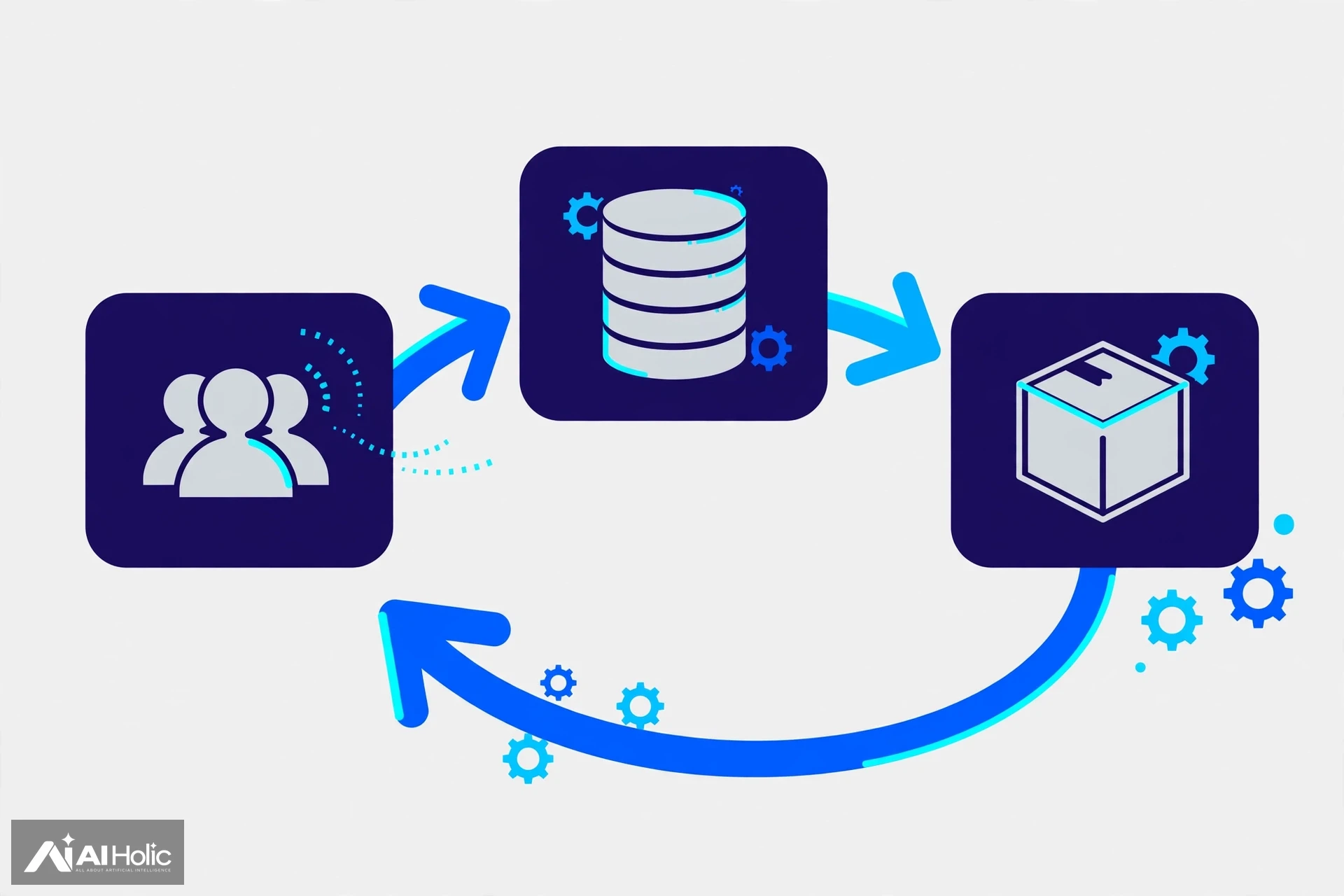
A data flywheel means every customer interaction makes the product better for the next customer. The data is private, it grows with use, and a rival cannot copy it from a standing start. This is the strongest moat for most AI products, because models are becoming cheap while private data stays scarce.
Volume alone is not a moat. The data must be hard to copy because it comes from exclusive contracts, from users doing work inside your product, or from years of aggregation. Large, stale, or public data does not protect you.
2. Workflow lock-in
Workflow lock-in means your product sits inside the daily work, not beside it. It connects to the CRM, the ERP, the support queue, or the system of record, and leaving means rebuilding a work habit. That switching cost is real, and it is the reason workflow embedded AI startups survive at far higher rates than thin wrappers in the estimates cited above.
3. Owned distribution
Owned distribution means you reach buyers without paying a platform for every user. A direct sales motion, a partner channel, a community, or an app store presence you control all count. A wrapper that depends on one marketplace or one model store can lose its users when that platform changes its terms.
4. Brand and trust
Brand and trust matter most where the stakes are high, such as health, finance, and legal work. Buyers in those fields pay for a name they can defend in front of a regulator or a board. Trust takes years to earn and cannot be shipped in a model update, which is why it counts as a moat.
5. Network effects
Network effects mean the product gets more useful as more people use it. A marketplace, a shared data pool, or a community of users all add value with each new member. Once that loop is running, a rival must beat the whole network, not just your feature list.
Our guide to a unified AI governance architecture shows the same logic from the buyer side: firms that run AI inside governed workflows with clear records are far harder to displace than a chat box on the side.
Four Layers That Make A Product Hard To Replace
Moats describe the edge. These four layers describe how to build it into the product itself. A defensible AI product usually has all four, while a thin wrapper has none, and that gap is the practical side of ai wrapper product defensibility moat risk.
Layer 1: Workflow and systems of record lock-in
Embed the AI into the systems where work already happens. When the product holds the record, the history, and the approvals, switching means moving the record too. That cost keeps buyers in place even when a cheaper wrapper appears.
Layer 2: Proprietary and private domain context
Build a store of private context that the model alone cannot see: customer history, internal rules, past outcomes, and feedback loops. With that context, your output is far more accurate than a raw model reply, and the gap grows with every use.
Layer 3: Deterministic code plus probabilistic AI
Never let the model do work that code should do. Use plain code for math, database queries, login, and compliance checks, and use the model only for language and judgment. That split makes the product reliable, testable, and far harder to copy with a prompt alone.
Layer 4: Multi-model resilience
Never tie the whole product to one vendor API. Design the back end to switch between models by task, cost, and speed, so a price rise or a feature loss at one vendor does not break your product. Model changes then make you faster, not weaker.
Governance teams already think this way. Our guide to AI governance quick wins on policy intake, risk tiering, and a registry shows how a register of models, risks, and owners turns a loose wrapper habit into a controlled system.
A Simple Test For Your Own Product
Run these three checks before you invest more in a wrapper. They take an hour, and they tell you plainly where the risk sits.
| Test | Thin wrapper result | Defensible product result |
|---|---|---|
| Paste test | A user pastes your prompt into ChatGPT and gets 80% of the value | The prompt alone gives a weak answer without your data and workflow |
| Swap test | Swapping the model kills the product | Swapping the model changes little, since the value sits in data and workflow |
| Price test | Buyers balk once they see the API cost behind your price | Buyers pay for the outcome, not for the model call |
If you fail the paste test, you have no switching barrier. If you fail the swap test, you are renting your product. If you fail the price test, your margin will compress toward zero as models get cheaper.
Any one failure is a warning, and all three together mean the product needs a moat before it needs more features.
What To Do If You Already Built A Wrapper
First, do not panic and do not rebuild everything at once. Pick the moat closest to your users and build that one layer well. For most teams, that means capturing the data your users already create inside your product and turning it into a feedback loop, which is the fastest way to cut ai wrapper product defensibility moat risk.
Second, move into the workflow. Add the integration your best users ask for, store the record they need, and make your product the place where the work is tracked. Each integration raises the cost of leaving.
Third, cut the single vendor tie. Add a second model behind a router, keep prompts and context in your own layer, and price on the outcome rather than the model call. That change alone removes the worst of the platform risk.
Fourth, check the governance side before you scale. Our guide to an AI governance wake-up call explains what boards must fix before the next incident, and the same checks protect a small product team from a costly surprise.
Frequently Asked Questions
Is every AI wrapper doomed to fail?
No. A wrapper fails when it has no moat, not when it uses a rented model. A wrapper that adds private data, workflow lock-in, or trusted distribution can last, and many useful products start as wrappers before they grow a moat. The question is never whether you rent a model, but whether ai wrapper product defensibility moat risk is covered by something you own.
What is the single strongest moat for an AI product?
A proprietary data flywheel is usually the strongest, because private data grows with use and cannot be copied by a model release. Workflow lock-in is a close second, since it raises the cost of leaving for every user.
What does Sherlocking mean?
Sherlocking means the platform owner ships your feature inside its own product, so your users no longer need you. It is named after Apple bundling Sherlock with its system, and it is the fastest way a wrapper can lose its market.
Can a small team build a moat?
Yes. A small team can own a narrow workflow, serve one vertical well, and collect private data that a large model cannot reach. A narrow moat in one niche beats a broad claim with no defense.
Does using more than one model really help?
Yes. Multi-model design cuts the risk that one vendor price rise or feature loss breaks your product. It also lets you route each task to the cheapest model that handles it well, which protects your margin.
How does this risk link to AI governance?
Governance and defensibility share the same base: records, risk tiers, and clear ownership. A product with a registry of its models and data is easier to defend, easier to audit, and easier to sell to buyers who ask hard questions.
Conclusion
A wrapper with no moat is a feature waiting to be absorbed, so own private data, sit inside the workflow, and cut the single vendor tie. Run the three tests, fix the weakest layer first, and that is how ai wrapper product defensibility moat risk turns from a threat into a plan.