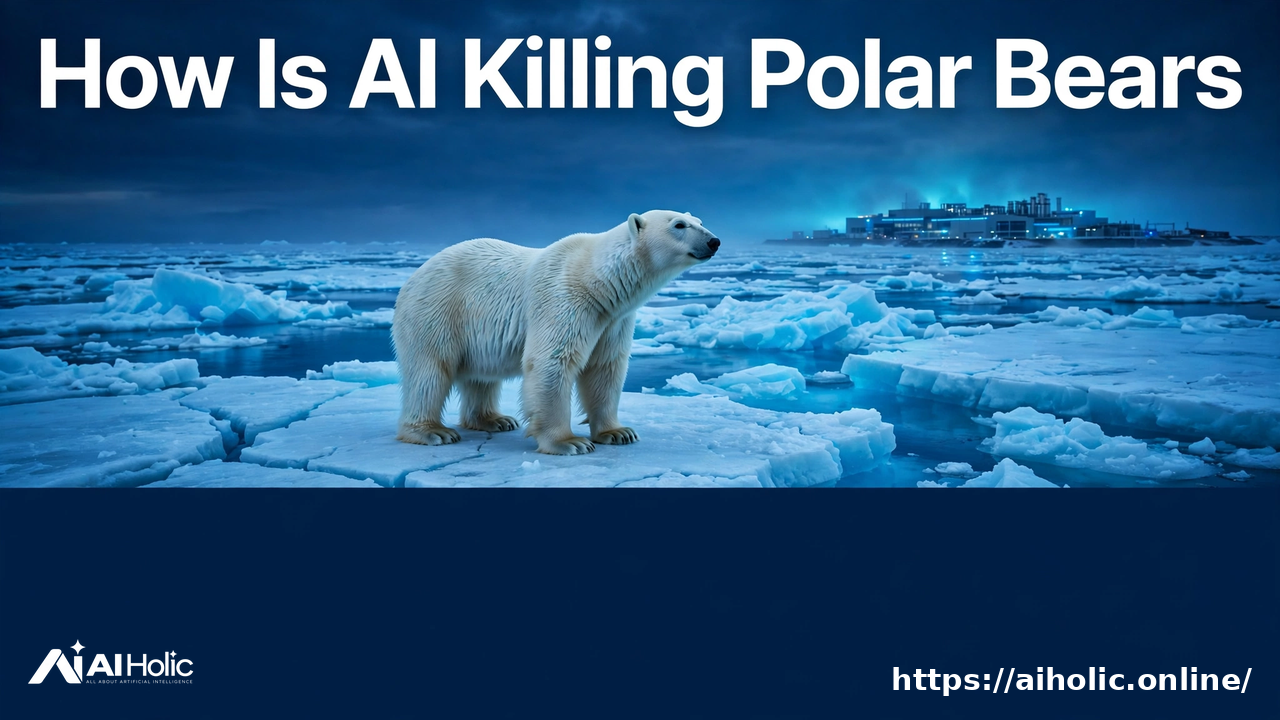
How Is AI Killing Polar Bears: The Energy, Ice, and Emissions Chain Explained
If you don’t want to read the whole guide or have difficulty reading, you can listen to this guide instead.
AI does not hunt polar bears, and no study has tied a single bear death to an AI system. Yet how is ai killing polar bears is a real question people ask, and it deserves a straight answer. The harm is indirect, and it runs through power use, emissions, and melting sea ice.
This guide traces that chain step by step. You will see how much electricity data centres use, what the International Energy Agency says about the growth, and why less sea ice means less food for bears. You will also see where the phrase came from and what AI does to help bears.
At AI Holic, we explain AI in plain language, with sources you can check. Read the short answer first, then the numbers behind it.
The Short Answer: How Is AI Killing Polar Bears
The short answer is that AI does not kill polar bears directly. No AI system meets a bear in the wild, and no research has counted bear deaths caused by AI. The question of how is ai killing polar bears only makes sense as a question about energy and climate.
AI runs on servers in data centres, and those buildings use large amounts of electricity for computing and cooling. When that power comes from coal or gas, it adds carbon dioxide to the air. That gas traps heat, the Arctic warms, sea ice shrinks, and bears lose the platform they hunt from.
That chain is real, but its size is small next to the whole climate problem. Data centres use about 1.5 percent of the electricity in the world, and AI is only one part of that total. The rest of this guide puts numbers on each link so you can judge the claim for yourself.
Where the Phrase Came From
The phrase took off as a meme in January 2026. Short videos on TikTok and Instagram put the question bluntly, how is ai killing polar bears, and the claim spread fast. Some clips were serious, and others were jokes that played on the same idea.
Know Your Meme dates the spread to mid-January 2026. An Instagram compilation from youth.4.earth appeared on January 8, 2026, and a TikTok video from @savingpolarbears followed on January 10. By January 17, a TikTok video that showed AI robots caring for polar bears had passed 1.8 million views in three days.
The meme worked because it mixed a true fact with a false picture. The true fact is that AI uses energy, and energy use can add to warming. The false picture is a machine harming a bear, and that part has no basis in fact.
The Chain From a Data Centre to the Sea Ice
Five links answer the question of how is ai killing polar bears, and the table below puts them in order. Each link is simple on its own, and the weak point is the last step. No one can say how much of the warming comes from AI alone.
| Step | What happens | What it means for bears |
|---|---|---|
| 1. Your prompt runs in a data centre | Servers draw power for computing and cooling | More AI use means more demand |
| 2. The grid supplies the power | Coal or gas plants add carbon dioxide | Clean grids cut this link |
| 3. Carbon dioxide traps heat | The Arctic warms faster than the world average | Ice forms later and melts earlier |
| 4. Sea ice shrinks | Less ice, and a shorter hunting season | Bears hunt less and fast longer |
| 5. Bears lose food | Less seal hunting means poorer body condition | Fewer cubs survive in bad ice years |
The first and last links are well established. Data centres use real power, and bears need sea ice to hunt seals. The middle links depend on the power grid, since clean power breaks the chain and coal power keeps it going.
How Much Electricity AI Data Centres Use
The International Energy Agency, known as the IEA, published the most cited numbers on this topic in its Energy and AI report of April 2025. Data centres around the world used about 415 terawatt hours of electricity in 2024, or about 1.5 percent of all electricity used on Earth. AI is a major driver of the growth, but the figures cover every data centre job, from video streaming to banking, not AI alone.
The same report looks ahead. In its base case, data centre electricity use reaches about 945 terawatt hours by 2030, which is slightly more than Japan uses today. The IEA also expects emissions from data centre electricity to rise from about 180 million tonnes of carbon dioxide today to about 300 million tonnes by 2035.
A typical AI-focused data centre uses as much electricity as 100,000 homes, and the largest sites under construction will use 20 times as much. The IEA updated its figures in April 2026, putting 2025 data centre use at 485 terawatt hours, up 17 percent. Those numbers are estimates, not meter readings, and the IEA warns that the path of AI growth is still uncertain.
| Measure | Figure | Source |
|---|---|---|
| Data centre electricity, 2024 | About 415 TWh | IEA, Energy and AI (April 2025) |
| Share of world electricity, 2024 | About 1.5 percent | IEA |
| Data centre electricity, 2030 base case | About 945 TWh | IEA |
| Emissions from data centre electricity, today | About 180 million tonnes of CO2 | IEA |
| Emissions, 2035 base case | About 300 million tonnes of CO2 | IEA |
| Typical AI-focused data centre | As much power as 100,000 homes | IEA |
The totals matter because how is ai killing polar bears is a question about a share of the whole energy system, not the whole system. Data centre emissions stay below 1.5 percent of energy sector emissions in the IEA base case. The question is not whether the numbers are big, but what share of the warming they cause, and that share has not been measured.
A quick question to a search assistant still runs on servers in a data centre, so even small tasks add to the total. The cost of one short text question is small, but billions of questions add up.

Why Less Sea Ice Hurts Polar Bears
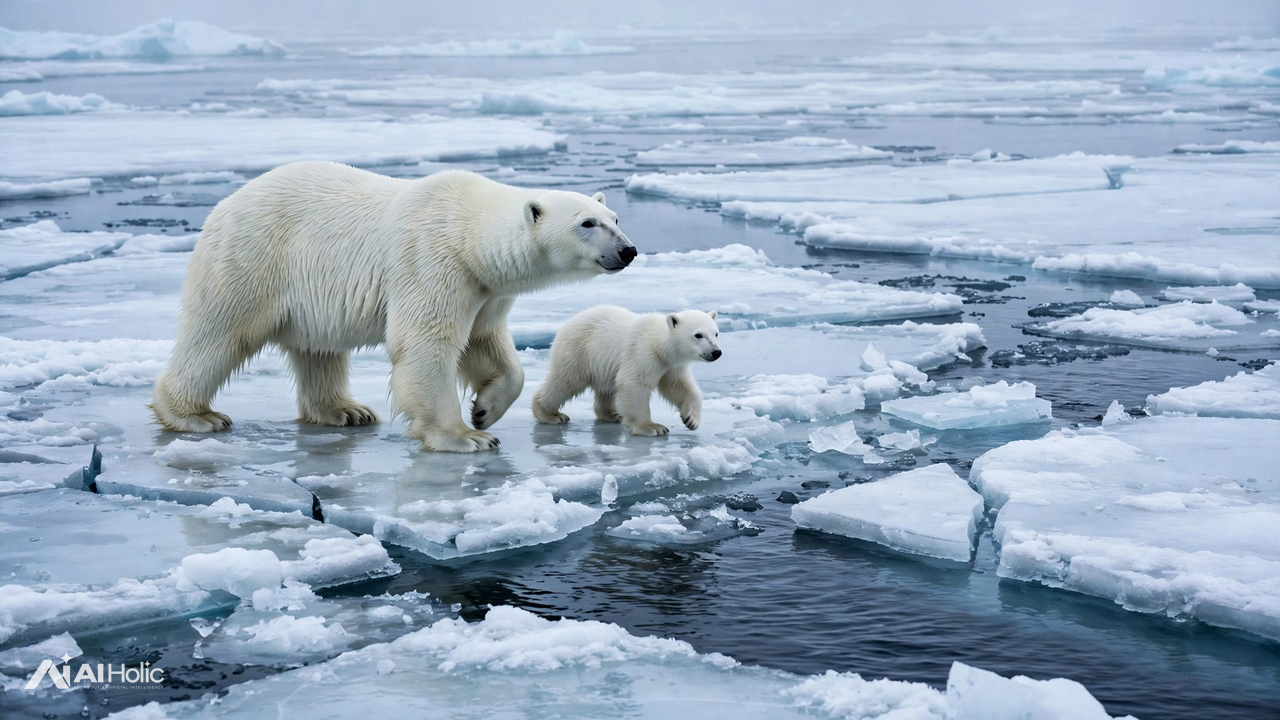
Polar bears hunt seals from sea ice, and they need that platform for most of the year. When the ice forms later in autumn and breaks up earlier in spring, the hunting season gets shorter. Bears then spend more time on land, where food is scarce, and they burn fat they cannot replace.
The numbers show the trend. The September sea ice minimum has fallen by about 12 to 13 percent per decade since satellite records began in 1979, according to the National Snow and Ice Data Center.
NOAA recorded September 2024 sea ice extent at 4.38 million square kilometres, against a 1991 to 2020 average of 5.58 million. The last 18 September extents, from 2007 to 2024, are the 18 lowest on record.
The long record of Arctic sea ice decline shows ice loss in every month, with the fastest loss at the end of summer. That pattern is why the September minimum matters most for bears. A shorter summer hunting season hits mothers and cubs first, since they need the most food.
The effect on bears is clearest in Western Hudson Bay. A 2025 study in Science used 42 years of monitoring data and found that sea ice loss and shorter hunting seasons explained a fall of about 50 percent in that group from 1979 to 2021.
Shorter hunts meant less body fat, fewer cubs, and lower survival. That study is the strongest proof of the ice-to-bear link behind how is ai killing polar bears, and it still does not blame AI.
The world population is about 26,000 bears, with a wide range of 22,000 to 31,000, according to the US Fish and Wildlife Service. That figure rests on research from 2015, so it is an estimate, not a fresh count.
The IUCN Polar Bear Specialist Group counted 20 groups in 2024 and found 10 with too little data to judge, 3 likely falling, 5 likely steady, and 2 likely rising. The species stays listed as Vulnerable, and the US lists it as threatened, with sea ice loss named as the main threat.
Water, Chips, and the Rest of the Footprint
Energy is the main link, but it is not the only cost. Data centres need water to cool their servers, and they need chips, buildings, and power lines. Each of those adds its own footprint, and each one is easy to overstate for polar bears.
Water is the clearest case. Polar Bears International notes that bears live far from any major data centre, so cooling water does not reach them.
Water use still matters for the towns and rivers near a data centre, but it is not a direct threat to bears. The IEA estimates data centre water use at about 560 billion litres in 2023, rising toward 1,200 billion litres by 2030.
Chips add a smaller share. Making a chip takes energy and clean water, and old hardware becomes electronic waste.
Those costs are real, but they are small next to the power the chips draw over their working life. The power bill, not the factory, is where AI leaves most of its mark.
The Other Side: How AI Helps Polar Bears
AI is not only a cost in this story. Researchers use it to read satellite images, sort camera trap photos, and spot bears near towns before a conflict starts.
Polar Bears International points to Bear-dar, a radar system that warns people when a bear comes close. Those tools save bears and people alike.
One study shows what the tools can do. In 2021, researchers trained a neural network on web images and aerial survey photos to find polar bears on sea ice.
In its test data, the system found 20 of 21 bear images and 1,172 of 1,179 background images. That speed helps researchers review large sets of images, but it cannot replace field surveys or local knowledge.
AI can also cut emissions in other parts of the economy. The IEA lists uses such as forecasting renewable power, improving factory efficiency, and managing transport and buildings.
In its scenarios, wide use of those tools could save more emissions than data centres produce. Those savings are modelled, not measured, and they depend on how the tools are used.
What You Can Do
You cannot change the grid on your own, but you can change how you use AI. Small choices add up when millions of people make them, and they cost you nothing. The part of how is ai killing polar bears that you control is your own use, so start with the tasks you run most often.
Use short text questions instead of long image or video jobs when a short answer will do. Image and video generation uses far more energy than a plain text question, so save the heavy jobs for work that needs them. Think twice before you send pictures to an AI assistant for fun, and keep the files you send to the ones the job needs.
Pick tools that report clean power use, and ask your provider how it powers its data centres. Our guide to AI assistant capabilities and limitations explains which jobs are worth handing to an assistant and which ones to keep for yourself. A lighter habit also saves you time, since short prompts get short answers.
Frequently Asked Questions
Does AI directly kill polar bears?
No, no AI system meets a bear in the wild, and no study has counted a bear death caused by AI. The harm is indirect: AI data centres use electricity, and where that power comes from fossil fuels, the emissions add to warming and sea ice loss. That is the whole chain behind how is ai killing polar bears, and it is the only one the evidence supports.
How much electricity do AI data centres use?
Data centres used about 415 terawatt hours in 2024, or about 1.5 percent of world electricity, according to the IEA. AI is a major driver of growth, but the total covers all data centre work, not AI alone. The IEA base case puts 2030 use at about 945 terawatt hours.
How many polar bears are left?
The best estimate is about 26,000 bears, with a range of 22,000 to 31,000, according to the US Fish and Wildlife Service. That figure rests on research from 2015, so treat it as an estimate, not a fresh count. Some groups are falling, some are steady, and 10 of 20 groups lack enough data to judge.
Can AI help polar bears?
Yes, AI reads satellite images, sorts camera photos, and powers radar warnings that keep bears and people apart. A 2021 study found a neural network spotted 20 of 21 bear images in test data. Those tools speed up research, but they cannot replace field work or fix the ice problem on their own.
What can I do to cut the impact of my AI use?
Use short text questions where they will do, and save image and video generation for jobs that need it. Pick providers that report clean power use, and ask how their data centres are powered. Small habits matter most when millions of people share them.
Conclusion
How is ai killing polar bears? It is not hunting them. AI adds to the climate pressure that melts sea ice, and that ice is the hunting ground bears need, so use AI with care, pick clean power where you can, and keep the facts straight.