Manufacturing AI News: The Factory Stories That Matter in November 2026
If you don’t want to read the whole guide or have difficulty reading, you can listen to this guide instead.
Factories changed fast in November 2026, and the latest manufacturing ai news shows robots, design tools, and chip rules all moving at once. This guide pulls the month’s biggest factory AI stories into one place, with dates and sources for each one.
You will find robots working on real car lines, a new design tool for factory staff, fresh rules for AI chips, and survey data on what manufacturers plan to spend. Each item is dated, so you can tell what is new and what is background.
At AI Holic, we track AI stories across industries so you can follow them without reading ten press releases a day. Start with the short answer below, then read the items that matter to your work.
The Short Answer
The manufacturing ai news this month points in one direction: AI is moving from demos to daily factory work. Humanoid robots ran real jobs on car lines, design software started taking plain-language orders, and factories added AI to quoting, quality checks, and maintenance planning.
The money follows the same trend. A November survey of 588 manufacturing professionals found 77 percent plan to raise AI budgets in the next 12 to 18 months. At the same time, new US rules tightened who can buy advanced AI chips, so supply chains now matter as much as software.
If you run a plant, the message is simple. Pick one real workflow, test AI on it with human checks, and measure the result before you expand. The rest of this guide gives you the dated facts to make that call.
November 2026 at a Glance
| Date | Development | Why it matters |
|---|---|---|
| Nov 5, 2026 | Rootstock survey: 77% of manufacturers plan to raise AI budgets | Spending keeps rising even as trust in AI output becomes the top worry |
| Nov 10, 2026 | Google DeepMind Gemini Robotics 2.5 runs Apollo 2 humanoids on Mercedes-Benz lines at 96% success | First strong public result for a general-purpose humanoid on a real line |
| Nov 12, 2026 | Anthropic launches Claude for Manufacturing with 17 skills | AI help for quoting, quality checks, and supplier work in factories |
| Nov 16, 2026 | Siemens links Industrial AI with additive manufacturing | Design orders in plain words, printed as custom parts |
| Nov 2026 | NVIDIA announces AI-defined fabs, and TSMC tightens China chip curbs under new US rules | Chips get smarter to make, and harder for some buyers to get |
| Nov 2026 | NVIDIA GTC Washington: factory digital twins and robot fleets | Big manufacturers commit to simulated factories before real builds |
The table above collects the manufacturing ai news we verified from ranking pages fetched on November 20, 2026. These stories sit inside the wider shift known as Industry 4.0, where connected machines, data, and AI reshape how factories run. Each section below adds the detail, the source, and what it means for a factory team.
Robots Reach Real Production Lines
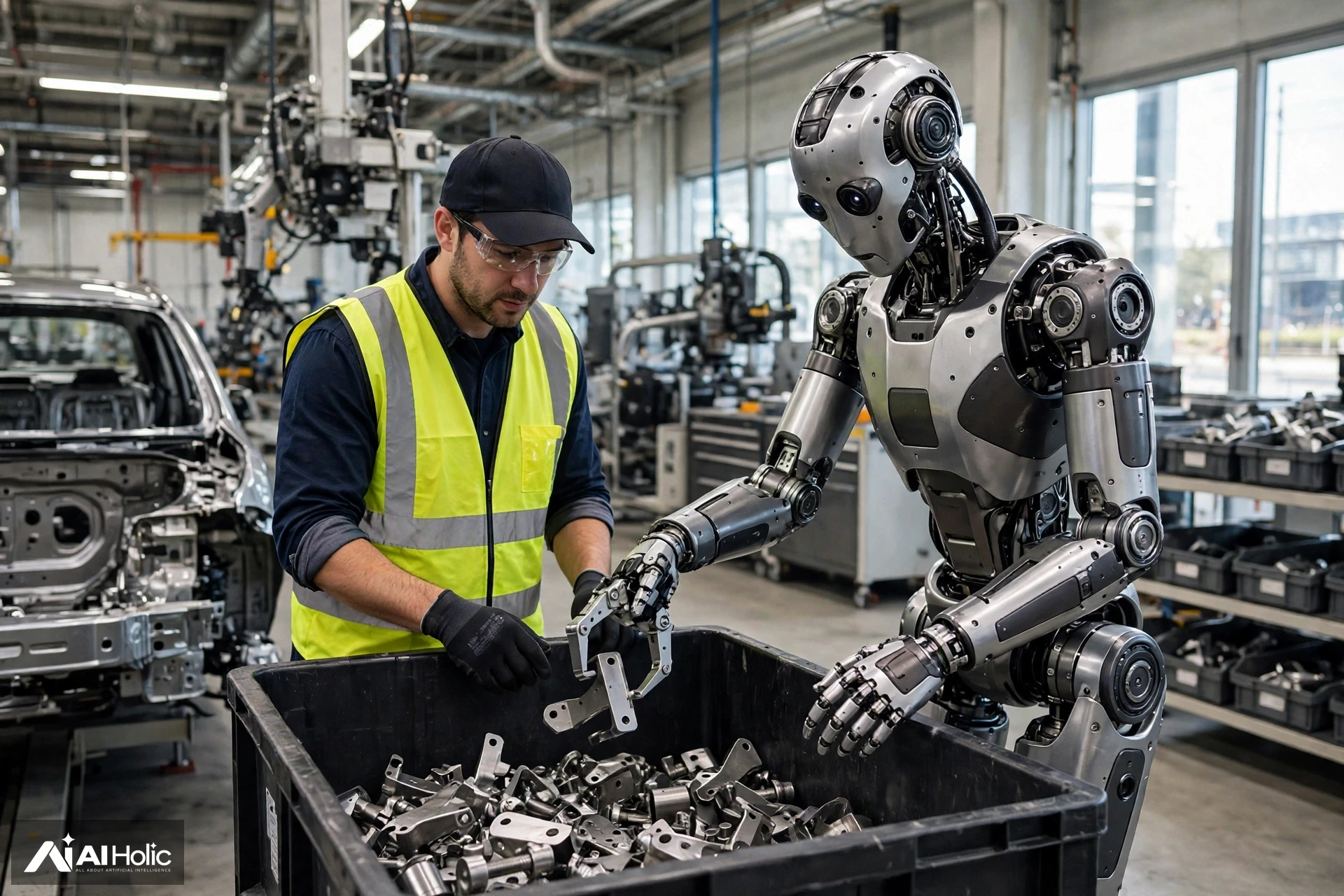
The biggest robot story of the month came from a car factory, not a lab. On November 10, 2026, Google DeepMind introduced Gemini Robotics 2.5, and Apptronik Apollo 2 humanoid robots ran kitting jobs on real Mercedes-Benz production lines in Kecskemét, Hungary, and Sindelfingen, Germany. The robots picked metal brackets from mixed bins and placed them in trays in the order each car needed, with a 96 percent success rate reported by Google DeepMind.
That number needs context. DeepMind calls the work a proof of concept, not a fleet running at scale, and it has not published how many attempts were made or how often a person stepped in. A 96 percent rate means about one pick in 25 fails, and a missing bracket can hold up a car, so the result is a strong signal rather than a finished product.
NVIDIA made the same point from a different angle at GTC Washington, D.C., in November 2026. Its expanded Mega Omniverse Blueprint adds tools for building factory-scale digital twins, and Siemens is the first company whose digital twin software supports it. A digital twin is a live virtual copy of a real factory, fed by real data, so engineers can test changes before they touch the floor.
Belden, Caterpillar, Foxconn, Lucid Motors, Toyota, TSMC, and Wistron are all building factory digital twins on the platform, NVIDIA said. Foxconn is using the tools to design a 242,287-square-foot facility in Houston, Texas, that will build NVIDIA AI infrastructure systems. Robot makers joined in too: Agility Robotics, Amazon Robotics, Figure, and Skild AI are building robot fleets on NVIDIA’s three-computer design, and Amazon said its BlueJay picking arm moved from concept to production in just over a year.
Cameras play a quiet part in this shift. Edge AI cameras already watch lines for defects and safety risks, and the same vision skills now guide robot arms that pick mixed parts. When a robot can see a part clearly, it can handle the mess of a real bin instead of needing every piece placed just so.
AI Moves to the Design Desk and the Print Bed
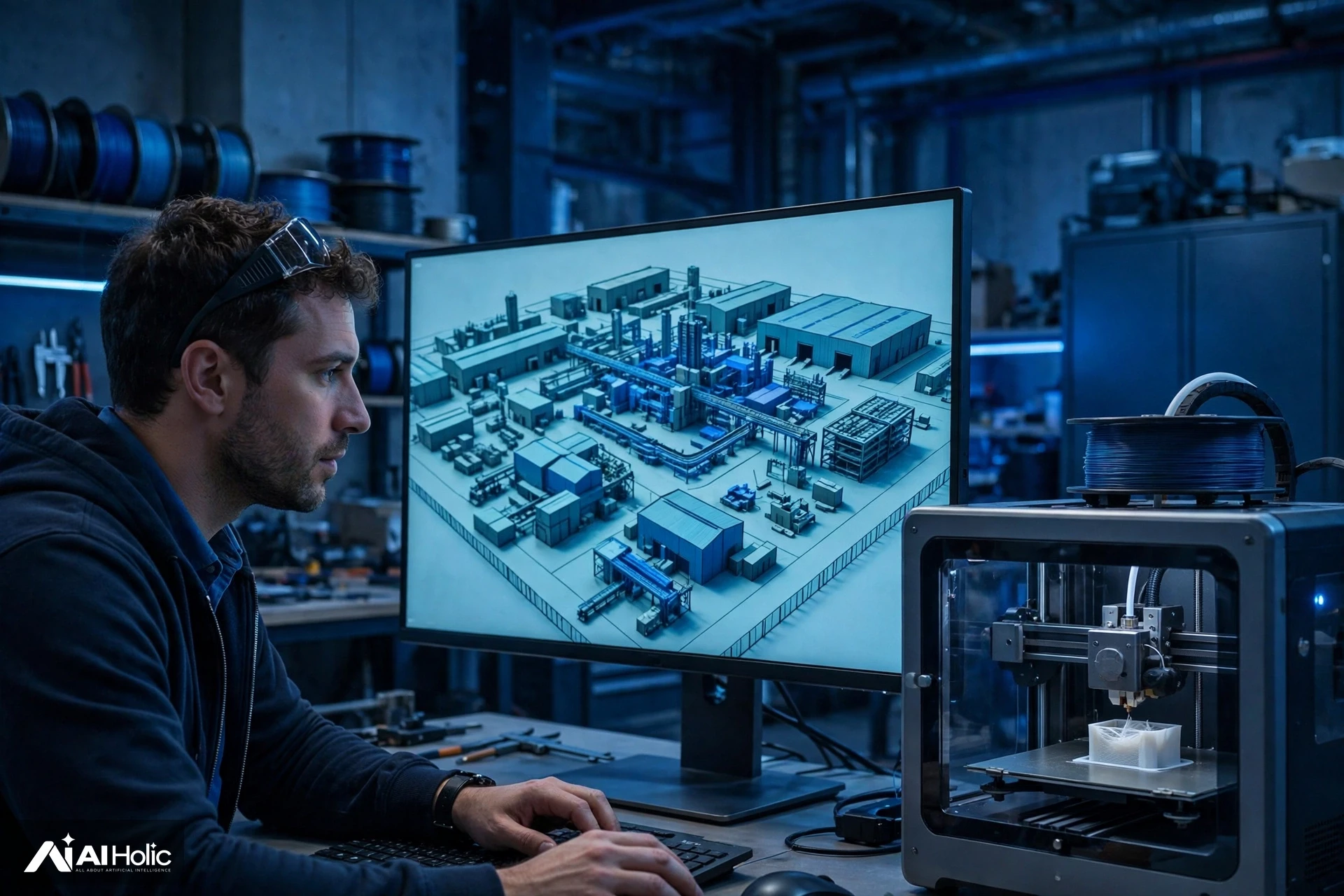
Siemens showed how AI can change the front end of making things. In a press release dated November 16, 2026, the company described an agentic AI workflow that turns plain-language orders into engineered parts, then prepares them for 3D printing. A worker describes the object to handle and the task, and the system picks a gripper type, adapts its shape, simulates it, and checks the robot interface.
The demo used a gripper for a humanoid robot, built with AGIBOT, EOS, and AM Solutions. Siemens plans an adaptive production cell at its Electronics Factory in Erlangen, Germany, where printing, automation, and post-processing work as one chain. The company will present the workflow at Formnext 2026 in Frankfurt.
Anthropic took a different route into the same factory. On November 12, 2026, it launched Claude for Manufacturing, a plugin with 17 skills for estimating, quality checks, supplier comparison, and production reporting. It connects to Autodesk Fusion, Infor, Microsoft 365, and Oracle NetSuite, so it works from a company’s own records instead of general web knowledge.
The limits matter here, since Anthropic says the tool does not operate factory equipment and people stay responsible for reviewing and approving its output. That boundary is the right one: a draft quote or a ranked list of defect causes is useful, but a machine command is not a job for a chatbot. Start with read-only access to approved records, and let a named person approve anything that affects a machine, a worker, or a schedule.
Chips, Fabs, and New Rules
The manufacturing ai news around chips split into two stories in November: smarter ways to make chips, and tighter rules on who can buy them. NVIDIA announced new CUDA-X libraries that speed up chip design and factory simulation, including a tool called cuPotential for atomic-level modeling. The company said Lam Research reached 30 times faster simulation with its NanoVDB library, and KLA sped up inspection work.
Applied Materials, Cadence, KLA, Lam Research, Siemens, and Synopsys are using the libraries across chip design, manufacturing, and testing, according to NVIDIA. These are AI-defined fabs: factories where AI helps engineers predict process behavior, fix production issues, and improve yield before a change reaches the floor. The same idea applies beyond chips, since any factory can test a change in a simulation before it risks real output.
The rules story ran the other way, with Reuters reporting on November 19, 2026, that TSMC is tightening limits on Chinese chip designers after new US Commerce Department rules took effect. Orders using 16-nanometre processes and below are now halted unless customers hold US export licences, and affected designers are generally limited to older 28-nanometre and 40-nanometre processes. The Financial Times first reported the suspensions, and the move closes one of the last routes for Chinese firms to make powerful AI processors.
Chips sit at the base of every AI story, so a supply squeeze reaches factories far from Taiwan. Our guide to AI infrastructure news explains the layers behind the headlines, from chips and data centers to power and cooling. If you buy hardware or plan capacity, read both guides together to see the full picture.
What Manufacturers Are Spending
Spending data gives the month a useful check. Rootstock announced its 2026 State of AI in Manufacturing Survey on November 5, 2026, based on 588 manufacturing professionals at companies with 100 or more staff in the United States, the United Kingdom, and Canada. Nearly two-thirds of respondents, 64 percent, have moved past exploration, with AI in pilots or already running.
| Finding | Share | What it means |
|---|---|---|
| Plan to raise AI budgets in the next 12 to 18 months | 77% | Investment keeps growing, down slightly from 82% in 2024 |
| Already using agentic AI (among AI users) | 31% | AI that plans and acts on its own is past the trial stage |
| Most common AI type in use | 52% automation | Plain automation still leads, ahead of generative AI at 49% |
| Prefer human-directed AI or AI within set limits | 73% | Only 13% want fully autonomous AI |
| Worried AI could limit career chances | 61% | Training and clear roles must sit beside every rollout |
Trust is now the top worry, according to Rootstock’s product chief Ohad Idan. He warned that an AI system that is wrong once in a thousand answers can be more risky than one that is wrong often, because staff stop checking its work. The fix he points to is not less AI, but clear permissions, audit trails, and business rules for every action the system takes.
That matches what workers say they want. Only 13 percent of respondents prefer fully autonomous AI, while 73 percent want a person in charge or clear limits with escalation when needed. Our roundup of AI governance news tracks how companies set those limits, from approval steps to audit logs, and it is worth reading before your first rollout.
Watch: How Industrial Robots Work
If the robot sections above left questions, this video fills the gaps. It explains how a robot arm turns programmed coordinates into motion, why fixed programs break when the world changes, and where cameras, force sensing, and machine learning help a robot handle variation. It also explains why safety stays with engineered controls, not with a probability score.
How to Follow Manufacturing AI News Without the Noise
Factory AI news moves fast, and much of the manufacturing ai news you see each week is vendor marketing. A simple routine keeps you current without taking hours of your day. Check one trade source and one vendor newsroom each week, note the date on every claim, and ignore any number that has no source attached.
Watch for three signals in each story. Check whether the result came from a real production line or a lab demo, and who measured the number. Then check whether the story names a date, a place, and a customer, or only a promise, since stories that pass all three tests are the ones worth acting on.
This guide will be updated as new factory AI stories land, so bookmark it and check back each month. For a wider view, follow the other news roundups on this site, and compare what vendors promise with what your own pilot measures. Your own numbers are the only ones that count for your plant.
Frequently Asked Questions
What is the biggest manufacturing AI story of November 2026?
The robot results lead the month. Google DeepMind’s Gemini Robotics 2.5 ran humanoid robots on real Mercedes-Benz lines at a 96 percent success rate, while NVIDIA’s GTC announcements put factory digital twins and robot fleets at the center of US manufacturing plans. Both are dated in November 2026 and covered in detail above.
Where can I follow manufacturing ai news each week?
Start with trade press such as Manufacturing Dive and the newsrooms of NVIDIA, Siemens, and Anthropic, then check this site’s news roundups for a plain-language summary. Always note the date on each story, since factory AI moves fast and old claims go stale within weeks.
Does Claude for Manufacturing control factory machines?
No. Anthropic says the plugin does not operate equipment. It prepares quotes, quality reports, supplier comparisons, and production summaries from company records, and a person reviews and approves the output before anything changes.
What is a factory digital twin?
It is a live virtual copy of a real factory, fed by real sensor and production data. Engineers test layout changes, robot paths, and schedules in the copy before they touch the real floor, which cuts risk and downtime.
Are manufacturers actually spending more on AI?
Yes, according to Rootstock’s November 2026 survey of 588 professionals. Seventy-seven percent plan to raise AI budgets in the next 12 to 18 months, and 64 percent have moved past the exploration stage into pilots or live use.
Conclusion
The manufacturing ai news of November 2026 shows AI settling into real factory work: robots on car lines, design tools that take plain orders, and spending that keeps rising with human checks in place. Pick one workflow, test it with clear limits, and let your own results decide what comes next. The same planning logic now runs in submarine shipyards — see how us navy submarine ai machine learning helps schedule Columbia-class and Virginia-class builds.