US Navy Submarine AI Machine Learning: How Silent Boats Learn to Listen
If you don’t want to read the whole guide or have difficulty reading, you can listen to this guide instead.
A submarine stays hidden by staying quiet. Its crew listens for sounds no one else can hear, and a single missed contact can matter. That is why the Navy now trains machine learning models to listen with them.
This guide explains us navy submarine ai machine learning in plain English. You will learn what the Navy has tested at sea, what is still a lab project, and what the limits are.
At AI Holic, we checked every program in this guide against the source that reported it. You will see plain facts first, vendor claims labeled as vendor claims, and no hype about secret weapons.
What US Navy Submarine AI Machine Learning Actually Means
The phrase us navy submarine ai machine learning covers five separate Navy efforts, not one system. The efforts share one idea: teach software to read sound, sensor data, and machine data faster than a tired crew can. The five strands are sonar detection, combat decision aids, predictive maintenance, unmanned vehicles, and shipbuilding.
A submarine is a listening machine first and a weapons platform second. Its crew tracks contacts by sound, because radio and radar do not work well underwater. Machine learning helps by sorting the sounds, flagging the ones that matter, and cutting the noise.
None of the five strands hands decisions to software alone. Every program in this guide keeps a sailor in charge of the final call. That limit is a design choice, not a gap in the tech.
| Program | What it does | Status |
|---|---|---|
| SensorMAX | AI sonar expert that reads sonobuoy sound | Tested at RIMPAC 2026 |
| AN/BYG-1 decision aid | ML aid for submarine combat choices | Request stage, award near 2027 |
| Project AMMO | AI mine detection for uncrewed vehicles | Models in use, fast updates |
| NSWCPD compressor ML | Vibration models that predict faults | Lab test, exploratory |
| ShipOS | AI planning for submarine building | Launched December 2025 |
How AI Learns to Hear a Submarine
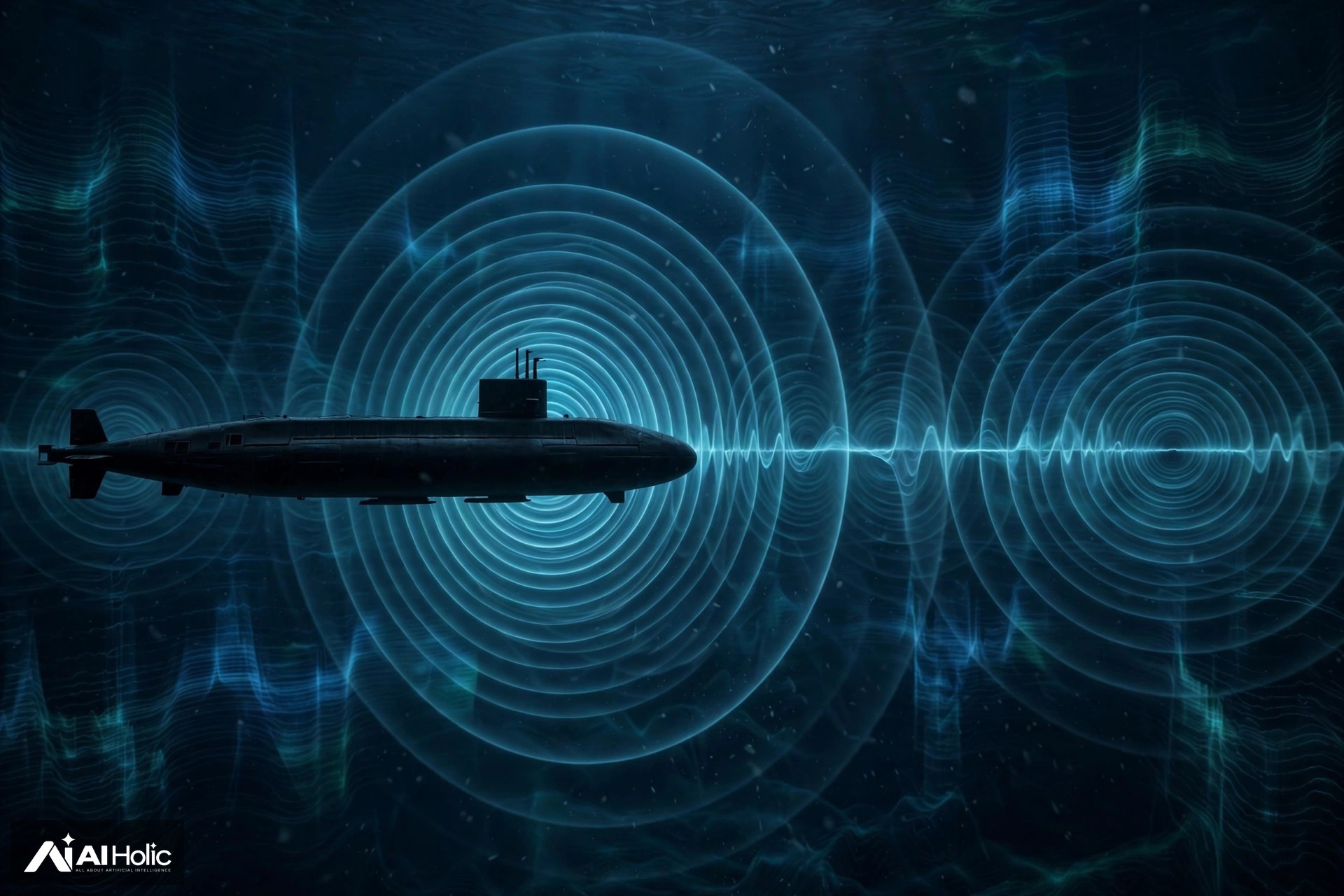
Sound travels far underwater, and every ship, whale, and wave makes its own noise. Passive sonar listens without sending out a ping, so the listening boat stays hidden. The hard part is telling a submarine apart from everything else in the water.
Machine learning models learn from labeled examples of sound. Engineers feed them recordings of ships, marine life, and known submarine sounds, and the model learns the patterns that mark each one. New sounds get labeled by operators, and the model updates so it can spot them next time.
The catch is training data. Real sonar recordings are rare and costly to collect at sea, and much of the data is classified. One Office of Naval Research project builds tools that synthesize realistic sonar data, so models can train on fake but realistic sounds before they meet real ones.
SensorMAX: The Live Test at RIMPAC 2026
The clearest live example of us navy submarine ai machine learning is SensorMAX, an AI sonar expert built by Lockheed Martin. The Navy tested it during RIMPAC 2026, a large multinational exercise held near Hawaii in July 2026. Two MH-60R helicopters flew anti-submarine missions with the system on board.
The helicopters dropped sonobuoys, small floating microphones that listen underwater and radio what they hear back to the aircraft. SensorMAX read the sound from up to eight sonobuoy feeds at once, which Lockheed says doubles what older systems could handle. It flagged contacts and helped the crew sort real threats from background noise.
The test also showed fast learning. When crews found a new sound, ground operators labeled it and retrained the model in under five minutes. The update then traveled back to the helicopter over an encrypted link, so the whole team used the same improved model within minutes.
Lockheed calls SensorMAX portable, and says the same software brain could work in the air, at sea, or on land. That claim comes from the vendor, not from an independent test, so treat it as a goal rather than a proven fact.
The models run close to the action, not in a distant data center. Our edge AI camera news page follows the same idea in cameras, where AI runs on the device itself.
The Combat Aid Inside the Boat: AN/BYG-1
Inside the boat, us navy submarine ai machine learning looks different from a sonar test at sea. The Navy’s AN/BYG-1 combat system runs on every in-service American submarine, and the Navy wants to add an AI and machine learning tactical decision aid to it. The aid would help the crew weigh options during an engagement, not fire weapons on its own.
The plan comes from a Request For Information posted by the Navy’s submarine combat program office, PMS 425, in 2025. The notice asks industry for three updates: a new tactical control setup, a new payload setup, and the AI decision aid. Software would arrive in small builds every thirteen weeks, so the crew gets steady upgrades instead of one big change.
The same plan ties the combat system to new weapons and vehicles. It names the Compact Rapid Attack Weapon, unmanned underwater vehicles, heavyweight torpedoes, and unmanned aerial systems. A contract award is penciled in for July 2027, which means this is a plan in motion, not a system at sea today.
The Royal Australian Navy uses AN/BYG-1 too, and the AUKUS submarine may use the new features as well.
Predictive Maintenance: Catching Breakdowns Early
A second strand of us navy submarine ai machine learning keeps the boats running instead of hunting other boats. At the Naval Surface Warfare Center in Philadelphia, engineers test machine learning models that read vibration data from high-pressure air compressors. Those compressors support key submarine functions, so a failure at sea is a serious problem.
The team built a test loop and broke things on purpose. They caused air leaks, inlet restrictions, and cooling-water problems, then recorded the vibration with arrays of accelerometers. The models learned to tell healthy vibration from the early signs of each fault, and early tests show they can pick out the fault signals from thousands of vibration inputs.
This work sits inside the Navy’s Condition-Based Maintenance Plus program, known as CBM+. The goal is not just to spot a fault but to track how far it has grown and estimate how long the part has left. The compressor project is still exploratory, and the Navy has not said it is ready for operational use.
The same center also builds digital twins of shipboard systems and machine learning models for power-system health. Congress backed the direction in the fiscal year 2026 defense law, which tells the Navy to adopt predictive maintenance algorithms and digital twin technology for ship maintenance.
Unmanned Underwater Vehicles and Project AMMO
The third strand of us navy submarine ai machine learning works away from the submarine, on robots that swim on their own. Project AMMO, short for Accelerated Machine Learning for Maritime Operations, helps uncrewed underwater vehicles read sonar and camera data to spot mines and other threats. The vehicles survey an area, and the AI flags objects that look like mines.
The win here is speed of updates, not just detection. Domino Data Lab supplies the software that trains, checks, deploys, and retrains the detection models. Its case study says putting a new model on a vehicle fell from six months to six days, and retraining for a new threat fell from twelve months to six days.
The money trail is public but needs care. The Defense Department announced a 16.5 million dollar award for the project in April 2025. A later Reuters report described a Navy contract ceiling of up to 99.7 million dollars in April 2026, but a ceiling is a maximum value, not proof the full sum was spent.
The vehicles do not clear mines by themselves. Human-led teams still run mine countermeasure work, and the AI only speeds up the part where models get better. That gap between the headline and the reality is worth keeping in mind.
ShipOS: AI in the Shipyard
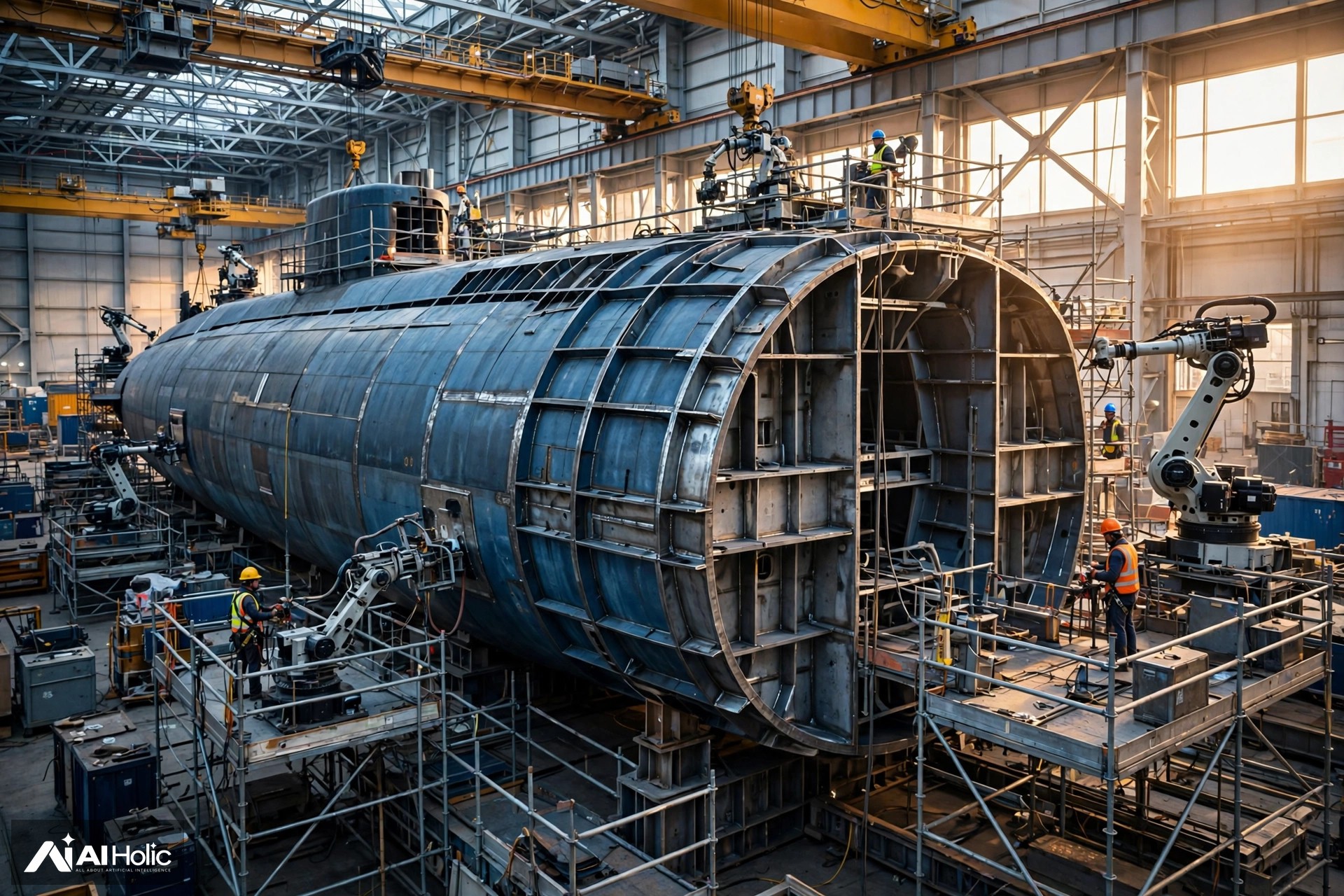
ShipOS is us navy submarine ai machine learning applied to the shipyard rather than the sea. The Shipbuilding Operating System is an AI production management system for Columbia-class and Virginia-class submarines. The Navy revealed it in its May 2026 Shipbuilding Plan and launched it in December 2025.
The problem it attacks is delay. Submarine building has run late for years, and the Navy wants one Columbia-class boat and two Virginia-class boats per year by fiscal year 2031. ShipOS pulls data from shipbuilders, suppliers, logistics, and old databases into one live picture of the whole build.
The Navy’s own numbers show a sharp cut in planning time. Schedule planning that took 160 hours of manual work now takes under ten minutes, and material review that took weeks now takes under an hour. Those are Navy figures from the plan, and they describe planning speed, not boats finished faster.
The shipyard story is part of a wider shift. Our manufacturing AI news roundup tracks how factories use AI to plan work and catch delays, and the same logic now runs inside submarine yards.
What AI Cannot Do Underwater Yet
The limits of us navy submarine ai machine learning matter as much as the wins, because the ocean is a hard place for software. Sound bends with temperature and salt, so a model trained in one patch of sea can misread another. Crews must retrain models on local sounds, which is why the five-minute retraining loop at RIMPAC mattered.
Data is the second limit. Models need many labeled examples, but real submarine sounds are scarce and secret. Synthetic data helps, yet a model trained on fake sounds still needs proof against real ones before anyone trusts it at sea.
The third limit is trust. No Navy program in this guide lets software fire a weapon or run a boat alone. Humans check the output, label new sounds, and make the final call, while AI narrows the search and speeds the work.
That human-in-the-loop rule is a governance choice as much as a technical one. Our AI governance news page follows how organizations set rules for who stays in charge of AI decisions.
| Program | Status | What proves it |
|---|---|---|
| SensorMAX | Tested at sea | RIMPAC 2026 demo, two helicopters |
| AN/BYG-1 decision aid | Request stage | Navy RFI, award penciled for July 2027 |
| Project AMMO | Models in use | Deployment fell from six months to six days |
| NSWCPD compressor ML | Lab test | Exploratory vibration tests, no operational use yet |
| ShipOS | Launched | December 2025 launch, planning times cut |
Frequently Asked Questions
Is US Navy Submarine AI Machine Learning Already in Use?
Yes, in limited form. SensorMAX was tested at RIMPAC 2026, and us navy submarine ai machine learning already helps with mine detection models and shipyard planning, while the AN/BYG-1 aid is still a request and the compressor models are lab tests. So parts are live, parts are testing, and parts are still plans.
Can AI Find a Submarine on Its Own?
No, not by itself. AI can flag sounds that look like a submarine and rank them for the crew, but sailors check each contact and make the call. SensorMAX works the same way, assisting target identification while the crew keeps the final decision, and every Navy program in this guide keeps a human in the loop.
What Is SensorMAX?
SensorMAX is an AI sonar expert built by Lockheed Martin for anti-submarine warfare. It reads sound from sonobuoys and other sensors, flags possible contacts, and helps aircrew manage up to eight feeds at once. Ground operators can retrain it on a new sound in under five minutes and send the update to the aircraft over the air.
What Is Project AMMO?
Project AMMO stands for Accelerated Machine Learning for Maritime Operations. It helps uncrewed underwater vehicles read sonar and imagery to spot mines and other undersea threats. Domino Data Lab supplies the software that trains and updates the models, and its case study says deployment fell from six months to six days.
Does AI Help Build Submarines Too?
Yes. ShipOS is an AI system that manages submarine construction for Columbia-class and Virginia-class boats, and the Navy says it cut schedule planning from 160 manual hours to under ten minutes and material review from weeks to under an hour. It plans the build, but it does not weld steel or launch boats.
Conclusion: What US Navy Submarine AI Machine Learning Means Today
The Navy’s work on us navy submarine ai machine learning is real, tested, and still early. Sonar aids work at sea, maintenance models work in the lab, and the combat aid is still a plan. Follow the test results, not the headlines, and check the source before you trust any claim.