Edge AI Trends: Smaller Models, Faster Chips, and Smarter Devices in 2026
If you don’t want to read the whole guide or have difficulty reading, you can listen to this guide instead.
Edge AI is moving fast, and edge ai trends in 2026 point in one clear direction: smaller models running on faster chips, closer to where data is made. A factory camera can now spot a fault on its own. A phone can run an assistant with no signal.
A car can read the road and react in milliseconds. This guide explains what changed, which trends matter, and what to watch next.
At AI Holic, we read the trade press, analyst reports, and vendor guides behind this topic so you do not have to. You will get a plain definition, the six trends that matter most, a simple table for where each workload should run, and a short starter plan. No engineering background is needed.
Edge AI Trends: The Short Answer
Edge AI means running AI models on the device itself, or on a small computer nearby, instead of sending every question to a faraway data center. Your phone, a factory camera, a hospital monitor, or a car computer does the thinking where the data is made. The answer comes back in milliseconds, and the raw data often never leaves the building.
In short, edge ai trends describe how this shift is playing out in 2026: models are shrinking, chips are getting faster and cheaper, and more work is split between the device, the local edge, and the cloud. The cloud still trains the big models. The edge now runs them, day to day, where speed and privacy matter most.
What Edge AI Is
The word edge means the place where data is made: a sensor, a camera, a phone, a machine, or a car. Edge computing moves storage and processing closer to that place, instead of keeping everything in a central data center. Edge AI adds a model to that setup, so the device can decide, predict, or flag a problem on its own.
A simple test tells you if a job is edge AI. If the model runs on the device or on a nearby gateway, and the decision happens without a round trip to the cloud, it counts. If every request still travels to a data center, it is cloud AI, even when the user holds a phone.
Many real systems mix both, and the mix is where most of the 2026 trends sit.
Three layers now show up in most designs. The device handles fast, simple decisions. A local edge node, such as a store server or a factory gateway, handles context across many devices.
The cloud handles training, heavy analysis, and updates. Our look at edge AI cameras in the news shows the same pattern, since cameras now flag events on the spot and send only short clips upward.
Why Inference Moved to the Edge
The big shift is from training to inference. Training builds a model, and inference uses it to answer real questions. InfoWorld notes that the industry is entering a phase defined by widespread use of models in everyday products, and that phase runs on inference.
Inference has to be fast, cheap, and close to the user, which is why so much of it now happens at the edge.
Latency comes first. A car that must brake, a machine that must stop, or a monitor that must warn a nurse cannot wait for a server hundreds of miles away. Local inference answers in milliseconds.
That speed is the main reason factories and car makers moved first.
Privacy comes second. Health data, faces, voices, and factory secrets are safer when they stay on the device. Network World quotes analysts who point to data control and data residency rules, mainly in Europe, as a strong driver.
When the model runs locally, there is less personal data to send, store, or lose.
Cost comes third. Sending video and sensor data to the cloud all day costs money in bandwidth and cloud fees. InfoWorld reports that Amazon raised prices by 15 percent for graphics cards used in some machine learning training jobs, a sign that cloud AI costs can move without warning.
Local inference cuts the flow of data, and that cuts the bill. A January 2025 arXiv paper, cited by InfoWorld, found that hybrid edge cloud setups for agentic AI workloads could save up to 75 percent of energy and cut costs by over 80 percent under modeled conditions. Treat that as a modeled result, not a promise for every setup.
Scale comes last. Gartner puts the 2025 count at about 11.7 billion connected devices, growing 9 percent a year, and says as much as 90 percent of edge data goes unprocessed, according to Network World. No cloud can swallow all of that.
Filtering and deciding at the edge is the only way the numbers add up.
Six Edge AI Trends to Watch in 2026
The six trends below cover the full stack, from chips to networks to the way teams run models. Some are ready for production now. Others are still maturing.
All of them shape buying choices over the next 18 months, according to N-iX.
1. Smaller Models Do More
Small language models sit at the center of edge ai trends in 2026. Models such as Meta Llama 3.2, Google Gemma 3, and Microsoft Phi run on phones, laptops, and factory tablets. They handle chat, search, summaries, and simple agents without a cloud call.
Research firm Mordor Intelligence puts the small language model market at 1.37 billion dollars in 2026, up from 1.05 billion in 2025, and forecasts 4.84 billion by 2031. Other firms give different numbers, so read the direction, not the exact figure: small models are growing fast.
Shrinking a model is a craft, not a trick. Quantization uses lower precision numbers, which can cut a model to a quarter or an eighth of its size. Pruning cuts links the model does not need.
Distillation trains a small model to copy a large one. N-iX reports that quantization can shrink models 4 to 8 times, and that small models now deliver 80 to 90 percent of large model capability for many jobs. The gap that remains is complex reasoning, where big models still lead.
2. Chips Built for the Edge
Neural processing units, or NPUs, are now standard in phones, laptops, and cameras. They run AI work at low power, while the main processor rests. N-iX cites specialized chips that reach up to 26 tera operations per second at only 2.5 watts.
Google Tensor Processing Units and Qualcomm Snapdragon chips play the same role in phones and devices. Neuromorphic chips, which copy how brains fire only when something happens, are still early, but Intel Loihi and IBM TrueNorth show the direction: far less power for always on sensing.
The result is practical. A phone can run face sign-in, night photos, and voice typing with no signal. A camera can count people or read plates on its own chip.
A wearable can watch a heartbeat all day on a small battery. Cheap, cool, quiet AI is what makes the rest of the trends possible.

3. Hybrid Edge Cloud Becomes the Default
Few teams pick edge only or cloud only, and that split is one of the edge ai trends shaping 2026. The winning pattern splits the work. Quick decisions run on the device.
Context across many devices runs on a local edge node. Heavy training and long term analysis stay in the cloud. Federated learning trains one shared model across many devices without moving the raw data, which helps hospitals and banks that cannot share records.
Split inference runs the first layers on the device and the last layers in the cloud. Our AI infrastructure news coverage tracks the same split, since new data centers and edge nodes are being built side by side.
4. 5G, MEC, and the Road to 6G
Fast networks make edge AI stronger, not weaker. Multi access edge computing puts small cloud servers at cell towers, so a phone or a sensor gets cloud like power with edge like delay. Smart cities can coordinate thousands of sensors in real time.
Factories can run robots over a private 5G network. N-iX expects 6G to build AI into the network itself, with far higher speeds and steadier links. That is still years away, but 5G edge nodes are being built now.
5. Privacy and Security Move to the Front
Keeping data local helps privacy, but edge devices bring new risks. They sit in public places, they are easy to steal or tamper with, and many run old software. N-iX warns that edge models can leak data through model inversion, where an attacker probes a model to learn what it was trained on.
The fixes are becoming standard: encrypted model storage, secure boot, signed updates, and federated learning with added noise to hide single records. Rules such as GDPR in Europe and HIPAA in US health care push teams the same way, since less data sent means less data to protect.
6. Agents Arrive at the Edge
AI agents are software that can plan steps, call tools, and act without a human in the loop. At the edge, small agents watch machines, route support tickets, or guide a technician through a repair, all offline. Network World notes that agentic AI is speeding up edge adoption, since agents create many small inference calls that are cheaper to run locally.
The catch is trust: an agent that can act can also act wrong, so teams start with narrow jobs, clear limits, and a human check on big moves.
Where Each Workload Should Run
Use this table as a first pass. The right answer depends on your latency budget, your privacy rules, and your network. Most real systems use all three places at once.
| Workload | Best Place | Why |
|---|---|---|
| Instant alerts, such as braking or alarms | On the device | Milliseconds matter, with no network wait |
| Face checks and shelf scans | On the device | Private data stays local |
| Store or factory wide view | Local edge node | Sees many devices at once |
| Fleet learning across sites | Cloud, with federated learning | Trains on all sites, keeps raw data local |
| Long term reports and audits | Cloud | Needs big storage and heavy compute |
| Voice help with no signal | On the device | Works offline and answers fast |
Edge AI Trends in Factories, Hospitals, and Cars
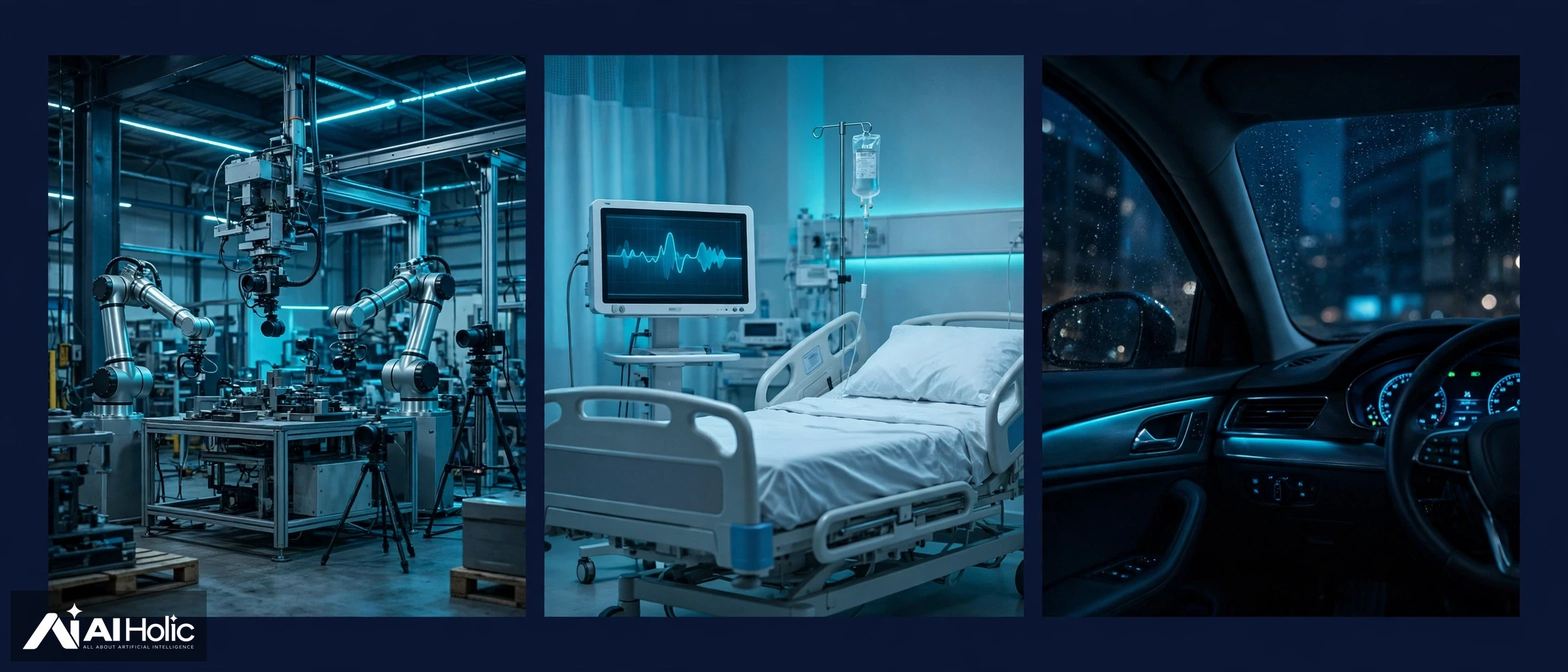
Manufacturing leads adoption, and the numbers explain why. N-iX cites manufacturing chiefs who report up to 40 percent less unplanned downtime from edge based predictive maintenance, and other deployments that report 25 percent cuts. Cameras check parts as they move down the line, and a fault stops the line in seconds.
Our manufacturing AI news page follows these rollouts, from quality checks to worker safety alerts.
Health care uses the same idea with higher stakes. Portable ultrasound and bedside monitors run models on the spot, so a warning reaches a nurse in seconds and patient data stays in the building. Wearables watch glucose and heart rhythms around the clock.
The gain is speed plus privacy, and the limit is trust: a model that misses a warning is worse than no model at all.
Cars are the most visible case. Cameras, radar, and lidar feed models that brake, steer, and warn the driver. EE Times describes a three tier setup: local inference in the car, shared inference at the network edge, and training in the cloud.
One recent driving model from NVIDIA explains its choices in plain words, but the talking costs time and compute, so it stays quiet most of the time.
| Sector | Edge AI Job | Payoff Reported |
|---|---|---|
| Manufacturing | Predictive maintenance, visual inspection | Up to 40 percent less unplanned downtime (N-iX) |
| Health care | Bedside monitoring, portable imaging | Faster warnings, data stays on site |
| Automotive | Braking, lane help, sensor fusion | Split second reactions, less network load |
| Retail | Shelf scans, theft alerts, checkout | Live stock view, faster checkout |
| Agriculture | Drones, crop checks, soil sensors | Field decisions with no signal |
What Still Gets in the Way
The edge is messy. Every vendor ships its own chips, tools, and formats, and nothing works out of the box. InfoWorld calls this a fragmented ecosystem, and staff from SUSE and Red Hat quoted there agree that the lack of one common stack forces custom work.
A team that buys ten device types may need ten setup paths.
Updates are the next headache. A cloud model updates in one place. An edge fleet means thousands of devices in stores, trucks, and fields, each needing a safe update that cannot break the job.
Version checks, staged rollouts, and a way to roll back are now part of the job, not an afterthought.
Security cuts both ways. Local data is safer from network snooping, but a device in a public place can be opened, copied, or swapped. The US guide NIST SP 800-161 covers supply chain risk for systems and suppliers, and the same thinking applies here: know who made each part, check each supplier, and plan for a breach.
Money is the last limit. Chips, install work, and upkeep add up, and a pilot that works in one store can cost far more across a thousand stores.
How to Start in Five Steps
- Pick one job where a slow answer costs money, such as a machine fault or a safety alert.
- Check if a small model can do it, and test it on the real device, not only on a laptop.
- Run a four week pilot on ten devices, and measure the answer time, the miss rate, and the cost.
- Set update and security rules before you scale, including signed updates and a rollback plan.
- Scale only the jobs that beat the cloud on speed, cost, or privacy, and keep the rest in the cloud.
That order matters. A small win on one real job teaches more than a big plan on paper. Start narrow, measure honestly, and let the results decide the next step.
Frequently Asked Questions
What are edge ai trends?
Edge ai trends are the shifts that shape how AI runs on devices instead of in the cloud. In 2026 the main shifts are smaller models, faster low power chips, hybrid edge cloud setups, 5G edge nodes, stronger on device privacy, and agents that act locally. The common thread is simple: more thinking happens where the data is made.
Is edge AI better than cloud AI?
Neither is better on its own. Edge AI wins when you need instant answers, offline use, or strict privacy. Cloud AI wins for heavy training, huge models, and long term analysis.
Most real systems use both, with the device deciding fast and the cloud learning slow. Pick the place that fits each job, not one side for everything.
What is a small language model?
A small language model is a compact AI model built for one job, such as chat, search, or summaries, on a phone or a laptop. Examples include Meta Llama 3.2, Google Gemma 3, and Microsoft Phi. They use less memory and power than large models, and they run without a network.
They trail large models on hard reasoning, so teams use them where speed and cost matter most.
How big is the edge AI market?
Estimates differ, so treat any single number with care. InfoWorld cites a forecast that puts the edge AI market at 143 billion dollars by 2034. The EdgeAI Foundation, quoted by Network World, puts edge AI growth at 37 percent a year through 2030, faster than the 28 percent growth of the AI market as a whole.
The direction is clear, even when the exact size is not.
What skills do edge AI teams need?
Teams need a mix of hardware and software skills. Model compression, such as quantization and pruning, matters most for fitting models on small chips. Teams also need device security, over the air updates, and monitoring across a fleet.
Start with one pilot and one engineer who can test on real hardware. The tools are still maturing, so hands on testing beats theory.
Conclusion
In short, edge ai trends in 2026 favor small models on fast chips, close to the data. Pick one job where speed or privacy pays, test a small model on real hardware, and measure the result. The edge rewards teams that start narrow and scale what works. The same spike pattern shows up in consumer apps too, and our guide to halloween ai trendwalks through one photo format that took over feeds for a few weeks in October 2026.