What Is The Industry Of Ronins.ai: An AI Software Product Company
If you don’t want to read the whole guide or have difficulty reading, you can listen to this guide instead.
Ronins.ai describes itself as a product company that creates AI based solutions for business efficiency, cost control, and service quality, and that plain self description gives a clear answer to what is the industry of ronins.ai. At AI Holic, we read that claim against what the site says it sells, not against its customers or its similar sounding names, so the answer stays tied to the vendor itself. The short version is simple, since it sits in the AI software industry, with its main offer framed as AI as a Service.
This guide explains what the company sells, why software fits better than consulting or a customer industry, and how you can check the label yourself.
The Short Answer
The primary industry for Ronins.ai is AI software, sold as ready to use products and framed on its own homepage as AI as a Service. That label fits because the site leads with products, not with advice alone, and it stresses integration with systems a customer already runs. If you need one label, use AI software products, and keep AI services as a secondary note rather than the headline.
That answer does not come from a customer case, since a vendor can serve a food company, a clinic, or a school without joining that industry. It comes from the offer itself, which is software that customers use, connect, and pay for. The same test works for other names, since the question is always what the vendor sells, not who buys it.
What Ronins.ai Says It Does
Ronins.ai presents itself as a vendor of AI based tools that help a business work faster and spend less. Its public pitch stresses ready to use software, clear product pages, and support for common business tasks, rather than long custom projects built from scratch.
The site frames that offer as AI as a Service, which is a delivery model, not a separate industry. A customer uses the tool through the vendor’s system, and the vendor keeps the model, the hosting, and the updates. That model is common in modern software, and it points to a product business, even when the vendor also answers support questions.
The same pitch shows up in how the company talks about value. It does not sell hours, headcount, or a one off study as its main product, and it does not claim to be a bank, a clinic, or a food brand. It sells a tool that a customer can adopt, connect, and reuse, which is the core test for a software label.
That claim gives three useful checks for any reader who wants to repeat the test.
- A ready to use AI software product, not only a report or a workshop.
- A cloud or browser delivered product, which fits the AI as a Service label.
- A product offer that uses terms like integrate, connect, and automate, which point to software, not to advice alone.
Taken together, those checks support the same answer, since the vendor leads with a product, delivers it online, and describes it in software terms.

The Industry Classification, With Reasons
The industry label fits for four reasons, and each reason uses a different test.
| Test | What Ronins.ai shows | What it rules out |
| Offer type | Ready to use AI software products | Advice only |
| Delivery | Online product, framed as AI as a Service | One off custom build |
| Value claim | Efficiency, cost control, and service quality through tools | A customer industry |
| Reuse | Same product for many customers | Staffing or headcount |
The offer type test is the strongest, since a product that can be adopted by many customers belongs in software, even when the vendor also gives onboarding help. The delivery test supports it, because AI as a Service is how the product is sold, not what the product is. The value claim test also supports it, since efficiency and cost control are benefits of the tool, not a separate industry.
What It Is Not, And Why That Matters
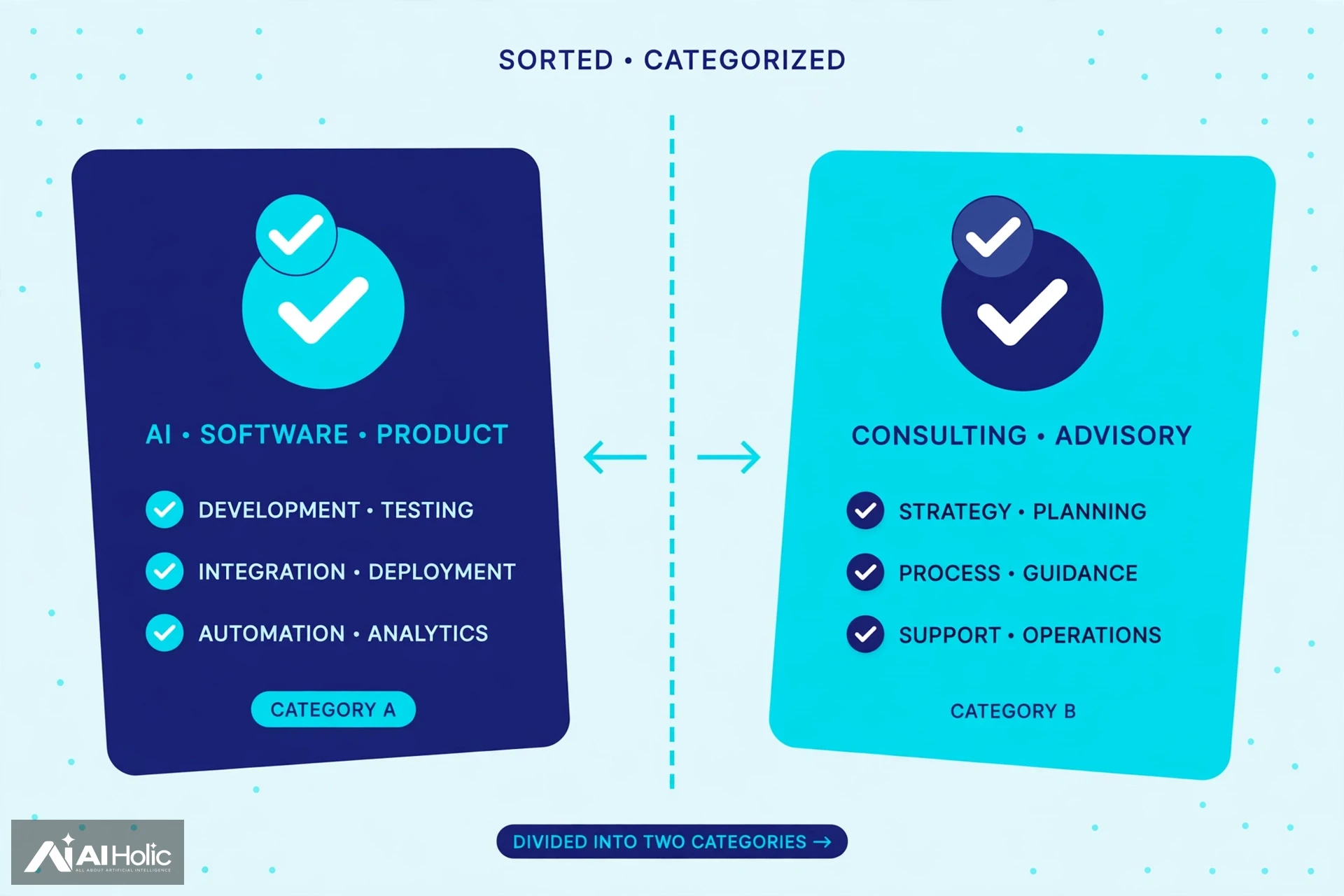
Ronins.ai is not a consulting firm in the usual sense, since consulting sells expertise and time, while this vendor sells a tool that keeps working after the sale. A consultant can leave, and the advice stays, while a product vendor must keep the tool running, updated, and supported.
It is also not a customer industry company, since a tool used by a retailer does not make the vendor a retailer, and a tool used by a clinic does not make the vendor a health company. The vendor industry follows the seller, not the buyer, and that rule stops a useful label from turning into a long list of customer sectors.
Finally, it is not a hardware company, since the value sits in software and models, not in a device that the customer owns. That distinction matters for rivals, since the nearest rivals are other AI software vendors, not device makers, staffing firms, or consulting firms.
How To Verify An Industry Label Yourself
A reader can check the label in five steps, and each step takes only a few minutes.
- Open the vendor homepage and note what it leads with, a product, a service, or a customer story.
- Open the product or pricing pages and note whether a customer can buy, try, or connect a tool.
- Look for a support, docs, or changelog page, since a product vendor usually keeps those pages live.
- Search the company name with the words product, pricing, and services, and compare which pages rank first.
- Ask who the nearest rivals are, since rivals in the same industry usually sell a similar offer.
Those sources do not carry equal weight, since the vendor homepage and product pages matter most, and a single customer story matters least. A directory listing can help, but it often copies the vendor pitch, so it should not replace the vendor pages.
If you check those sources in order, the answer usually becomes clear. If the vendor’s own pages, its product list, and its support pages all point to software products, the software label holds. If the main pages point to advice or custom work, services becomes the safer label.
Common Confusions Around This Name
The first confusion is the name itself, since Ronins.ai sounds like a person, a team, or a brand, and readers may search for a founder, a company history, or a famous product. Those details can help, but they do not change the industry test, which still asks what the vendor sells.
A second confusion is to call the vendor a customer industry company, since a tool used by a shop, a clinic, or a school can look like part of that sector. The vendor industry stays with the seller, so a software tool remains software, even when its buyers work in many sectors.
A third confusion is to label every AI vendor as a services company, since many vendors do give demos, onboarding, and support. Those extras do not turn a product into a service, since the customer still pays for a tool that can be reused, updated, and connected to other systems.
A fourth confusion is the broad technology label itself, since technology covers hardware, telecoms, software, and services, so it answers the question only in a loose sense. A reader who needs rivals, buyers, or benchmarks needs a narrower label, and AI software products gives that detail.
Frequently Asked Questions
Is Ronins.ai a technology company?
Yes, in the broad sense, since AI software sits inside technology, but the useful label is narrower, and it is AI software products. A broad label helps a reader place the vendor in a large sector, while a narrow label helps a reader find rivals and buyers.
Is Ronins.ai a SaaS company?
Yes, in the delivery sense, because AI as a Service is a delivery model, not a separate industry. The product still sits in AI software, and SaaS or AI as a Service only describes how it is sold, hosted, and updated.
Is Ronins.ai a consulting company?
Not as its main offer, since consulting sells advice and time, while Ronins.ai leads with a tool that a customer can use again and again. Support and onboarding can sit beside a product, but they do not turn the product into a consulting offer.
Why do some sources use a different industry?
Some sources use a customer industry, a broad technology label, or a services label, because they copy a customer story, a directory tag, or a short pitch. A reader should trust the vendor product pages first, and treat a directory tag as a hint, not as proof.
Can the industry label change over time?
Yes, since a vendor can add services, move into hardware, or change its main offer, and the label should follow the current offer, not an old pitch. A reader who checks the product pages again after a year may find a new headline offer, and that new offer should set the label.
Conclusion
So, what is the industry of ronins.ai? It is the AI software industry, with AI software products as the precise label and AI as a Service as the delivery model. That answer fits the vendor pitch, the product model, and the rival set, and it avoids the common trap of naming a customer industry instead. If you need a one line answer, use this: Ronins.ai is an AI software product company.
For a related question, see our live check on does ronins.ai have a blog.
For a related industrial AI profile, see what is the industry of groundup.ai, which applies the same vendor-versus-customer test to Groundup.ai’s Cognitive Maintenance platform.