AI Scholarship for Aspiring College Students: Where the Money Is and How to Win It
If you don’t want to read the whole guide or have difficulty reading, you can listen to this guide instead.
College tuition keeps rising, and a strong student can still fall short on funds. An ai scholarship for aspiring college students can close that gap, since it pays part or all of tuition without adding debt. At AI Holic, we checked the main programs against their own sponsor pages, so every award below is real and named, and this guide shows what these awards cover, who can apply, and how to put together an application that stands out.
You will learn the main types of awards, the programs worth your time, and the exact steps to apply. You will also see the common mistakes that cost students awards, and how to spot a scam before it costs you money. Read the whole guide before you apply, since a small detail in the rules can decide the result.
The Short Answer
The short answer is that several real programs fund students who plan to study artificial intelligence, computer science, or a related field. They come from four main sources: professional societies, tech companies, universities, and governments. Most of them pay tuition directly to the college, and some add a stipend, mentoring, or an internship.
An ai scholarship for aspiring college students is not one single award with one form. It is a group of separate awards, each with its own rules, deadline, and application. Your job is to match your profile to the right ones, then apply to several, since no single award is a sure thing.
Many awards renew each year if you keep your grades up and stay in the same major, so an award that looks small in year one can grow into real support over four years. Read the renewal rules when you apply, since some awards end after one year no matter how well you do. A renewable award is often worth more than a larger one year award, so ask the sponsor before you choose.
What an AI Scholarship Actually Covers
A scholarship is money for study that you do not repay, and the award is based on merit, need, background, or a mix of these. Some awards cover full tuition, while others pay a fixed sum toward tuition, fees, or living costs. The sponsor sets the terms, so read them before you count on the money.
An ai scholarship for aspiring college students usually falls into one of four types. A merit award rewards grades, test scores, or a strong project record. A need based award looks at family income, a diversity award supports students from groups that are underrepresented in tech, and a university award is tied to one college and often comes with the admission offer itself.
A few awards go past money and add real career help. Winners may get a mentor in the field, an internship interview, or a place at a conference. Those extras matter, since a mentor and a first internship can shape a career more than a single check, so weigh the full package, not just the dollar figure, when you compare awards.
| Type | What it rewards | Typical support | Example sources |
|---|---|---|---|
| Merit | Grades, scores, project work | Fixed sum to full tuition | IEEE, professional societies |
| Need based | Family income | Partial to full costs | Universities, governments |
| Diversity and access | Underrepresented groups in tech | Tuition plus mentoring | Intel, Society of Women Engineers |
| University | Admission to one college | Fee waiver or tuition cut | La Trobe, Singapore Management University |
| Government and fellowship | Research promise and talent | Grant, stipend, travel help | IndiaAI Fellowship, Spärck AI |
Scholarships Worth Knowing
The programs below are all real, and each one is named so you can check it on the sponsor site. Amounts and deadlines change, so treat the figures here as a starting point and confirm them on the official page before you apply. An ai scholarship for aspiring college students may come from a society, a company, a university, or a government, and the mix below covers all four.
The Merwin Scholarship comes from the IEEE Computer Society and awards 40,000 dollars each year across its winners, with individual awards up to 1,000 dollars. It goes to active student volunteers, and winners serve as Student Ambassadors for a year. The Society of Women Engineers runs a different model, with one application covering all of its awards, and it disbursed more than 330 scholarships worth over 1,500,000 dollars in 2023.
The Lockheed Martin STEM Scholarship pays 10,000 dollars a year and can be renewed, and it asks for a grade point average of 2.5 or higher plus United States citizenship. The Betty Stevens Frecknall Scholarship supports information technology majors with a grade point average of 3.0 or higher. Intel AI for Youth offers nearly 2 million dollars a year in scholarships, with a focus on African American, Latinx, Native American, women, and veteran students.

The DeepMind Scholarship covers full tuition plus a stipend for students from underrepresented groups in artificial intelligence, and it runs through partner universities. The United Kingdom government funds the Spärck AI scholarships with 17.2 million pounds, giving full funding for masters degrees at nine leading universities to 100 students, and the first cohort began in October 2026, so check the official pages for the next round. Mohamed bin Zayed University of Artificial Intelligence in Abu Dhabi gives graduate students a full support package that covers tuition, a monthly stipend, health insurance, and housing.
The IndiaAI Fellowship supports students in India who run artificial intelligence projects, with up to 100,000 rupees for undergraduates and up to 200,000 rupees for postgraduates, and applications for the 2026 round close on 30 November 2026. La Trobe University in Australia offers a 50 percent or 100 percent tuition reduction for international students who start an artificial intelligence degree in 2027. Singapore Management University runs the Frontier AI Scholars Programme, worth 101,800 Singapore dollars in total, with full tuition, a living allowance, a computer allowance, and an overseas study grant.
Who Can Apply
An ai scholarship for aspiring college students has rules that vary widely, so no single checklist fits every award. Most programs ask for a major in computer science, engineering, data science, or a related field, and some accept students from any major if the project uses artificial intelligence. Check the major rule first, since it is the fastest way to rule an award in or out.
Grades matter, but the bar differs by program. Many awards set a minimum grade point average of 3.0, while competitive applicants often hold 3.5 or higher, and the Lockheed Martin award accepts 2.5 when the applicant shows strong work. A few programs ask for citizenship or residency in one country, so read that line before you spend time on the form, and a strong project record can lift an application with a lower grade point average, so show real work when you have it.
Level matters as well. Some awards are only for high school seniors about to start college, while others serve current undergraduates or graduate students. Doctoral students have their own track, with fellowships from Microsoft Research, NVIDIA, Meta, and Google, so match your level to the award and do not apply to a program that serves a different stage.
- Major. Computer science, engineering, data science, or a related field, with some awards open to any major with an AI project.
- Grades. A grade point average of 3.0 is the common floor, and 3.5 or higher is competitive.
- Level. High school senior, undergraduate, or graduate, matched to the award.
- Citizenship. Some awards are open to all, while others ask for citizenship or residency in one country.
- Proof of work. A project, a portfolio, or a clear record of study in artificial intelligence.
How to Apply in Six Steps
An ai scholarship for aspiring college students rewards a careful application, so treat the process as a project with a deadline. Start at least two months before the closing date, since letters of recommendation and transcripts take time to arrange. The six steps below cover the full process, from search to submit.
- List every award that fits your major, level, and citizenship, and note each deadline in one calendar.
- Read the rules of each award in full, and drop any award you clearly fail before you write a word.
- Ask two teachers or mentors for letters early, and give them your resume and the deadline in writing.
- Draft one strong personal essay about a real project, then adapt it for each award instead of starting over.
- Check every fact, date, and figure in the form twice, since one error can end the application.
- Submit at least a week early, and keep a copy of everything you sent.
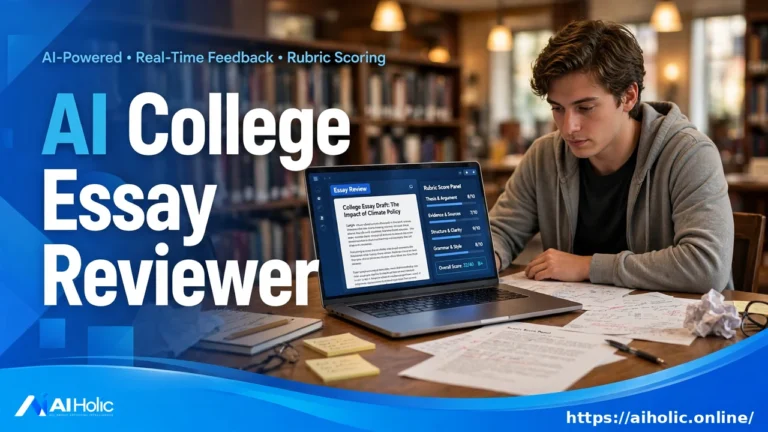
Our guide to the ai college essay reviewer explains how review tools score a draft and where their limits sit. Use one to polish structure and clarity, then rewrite the fixes in your own words. A reviewer can sharpen an essay, but the story and the voice must stay yours.
Using AI Tools in Your Application
Artificial intelligence can help you prepare, and our guide to AI in education shows how students already use these tools for study and revision. You can use a chatbot to brainstorm essay angles, to quiz yourself on interview questions, or to check a draft for grammar. Keep the tool in a support role, and let your own judgment make every final choice.
Never let a tool write the essay for you. Committees read hundreds of essays, and text written by a chatbot sounds flat and generic, so it hurts more than it helps. If a school or sponsor bans artificial intelligence in applications, follow that rule in full, since breaking it can cost you the award and your place.

Mistakes That Cost Students Awards
An ai scholarship for aspiring college students can be lost on a small error, so watch the traps below. The most common error is a missed deadline, and the second is an incomplete form, so use a checklist for each award. A third error is a generic essay that could belong to any student, so name a real project and a real result.
Scams are the worst trap of all. A real scholarship never asks you to pay to apply, and no one can promise you an award for a fee. If a message asks for payment, bank details, or a fee for a guaranteed award, walk away and report it, and use the official sponsor page for every deadline and rule instead of trusting a forwarded link that you cannot verify.
Where to Find More Awards
Start with the financial aid office of each college on your list, since many awards are tied to admission and never appear on public lists. Ask the office which awards fit your major and whether one application covers several awards. Your school counselor or a teacher in computing may also know local awards that larger lists miss.
Use free public databases next, and check every result against the official sponsor page. The United States Department of Education runs the free federal aid form, and its site explains how grants and scholarships differ, so start there before you trust any paid list. A database is only a pointer, and the sponsor page is the source that counts.
Ask the sponsor directly when a rule is unclear. A short email to the award office can clear up a grade rule, a citizenship question, or a deadline that two sites state differently, and the answer you get is the one that counts. Keep a simple tracker with one row per award, and note the deadline, the documents, and the date you submitted, so nothing slips past you in a busy term.
Application Timeline
| When | What to do |
|---|---|
| 8 weeks before | List awards, note deadlines, ask for letters |
| 6 weeks before | Draft the main essay and gather transcripts |
| 4 weeks before | Adapt the essay per award and review drafts |
| 2 weeks before | Check every form field and confirm letters arrived |
| 1 week before | Submit each application and save copies |
| After submit | Track replies and tell the college finance office |
Once your results are published, our guide on how to check college results shows how to verify them against the official college record. Keep your award letters and your admission letters in one folder, since the college finance office may ask for them. A tidy record also helps if a sponsor asks for proof of enrollment.
Frequently Asked Questions
Can I apply for more than one AI scholarship at a time?
Yes, and you should, since each award is judged on its own and most students who win applied to several. An ai scholarship for aspiring college students is one of many awards, so build a list of five to ten that fit your profile and apply to all of them. Just check whether any award limits other funding, since a few full awards do.
Do I need a computer science major to qualify?
Not always. Many awards ask for computer science, engineering, or data science, but some accept any major when the student project uses artificial intelligence. University awards tied to an artificial intelligence degree are stricter, so read the major rule for each award before you apply.
What grade point average do I need?
Most awards set the bar at 3.0, while the strongest applicants often hold 3.5 or higher in maths and computing subjects. The Lockheed Martin award accepts 2.5, which shows that a strong project record can offset a lower average. A clear upward trend in grades also helps, so show it when you have it.
Are these scholarships open to international students?
Some are, and some are not. The DeepMind Scholarship, the La Trobe award, and the SMU programme welcome international students, while the Lockheed Martin award is limited to United States citizens. Always check the citizenship line on the official page, since it is the rule that most often ends an application.
How much money can an AI scholarship pay?
It varies from a few thousand dollars to full tuition plus living costs. Scholarships in the United States range from partial tuition help to full ride awards that cover tuition, housing, and more. Check what each award covers, since a smaller award that also brings mentoring and an internship can be worth more than a larger check alone.
Conclusion
Start with the awards that fit your major, level, and citizenship, then apply to several with a careful, honest application. Check every amount and deadline on the official sponsor page, keep your own voice in the essay, and never pay to apply. An ai scholarship for aspiring college students rewards real work and real care, so put both into every form you send.