AI Writing Tools Updates April 2026: What Changed And What To Use Now
If you don’t want to read the whole guide or have difficulty reading, you can listen to this guide instead.
April 2026 was a busy month for writing software, and the ai writing tools updates april 2026 roundup below sorts the real changes from the noise. The biggest moves came from the models underneath the tools, with new defaults at ChatGPT, Claude, and Gemini, while Grammarly, Jasper, and WRITER pushed their products further toward full content workflows. At AI Holic, we looked back at what each vendor actually shipped that month so you can see what changed and what it means for your writing.
April 2026 has passed, and some prices and plans have changed since then. Check the current plan page of any tool before you pay for it.
The Short Answer
The ai writing tools updates april 2026 story has one clear theme: the tools stopped competing on who writes the best paragraph and started competing on who runs the whole job. ChatGPT made GPT-5.5 its default model, Claude launched Opus 4 with extended thinking turned on, and Gemini 3.1 Pro became the default across Google Workspace. Grammarly kept building its document editor, Jasper leaned into agents and brand voice, and WRITER added governance controls and app connectors.
For most writers, the practical result was simple. A general assistant such as ChatGPT, Claude, or Gemini now handles drafting, editing, and research in one place, and a specialist tool earns its price only when it solves a clear bottleneck, such as brand checks, team review, or bulk publishing. The rest of this guide walks through each April change in turn, then helps you pick the right setup for your own work.
AI Writing Tools Updates April 2026 At A Glance
The table below lists the main April 2026 changes in one place, with the source for each item. Read it as a quick reference, then read the sections below for the detail behind each row.
| Tool | April 2026 change | Source |
|---|---|---|
| ChatGPT | GPT-5.5 became the default model across all paid tiers | ClickUp tested guide |
| Claude | Opus 4 launched with extended thinking as default | ClickUp tested guide |
| Gemini | Gemini 3.1 Pro became default across Workspace integrations | ClickUp tested guide |
| WRITER | Organization settings moved into AI Studio, plus app Connectors | WRITER changelog |
| SEO Content Machine | AI Writer gained a Polish tab, preview find and replace, and bulk pipeline tools | SCM April changelog |
| Grammarly | Document editor and AI Grader work continued after the Superhuman rebrand | WorkflowFiesta 2026 review |
Two notes on this table are worth keeping in mind. First, the model changes mattered more than any single feature, because every writing tool sits on top of a foundation model, so a new default model changes the output of the whole category at once. Second, the ai writing tools updates april 2026 list above covers what shipped in April, while the Grammarly rebrand itself happened in October 2025 and only shaped the April work that followed it.
The Model Shift Behind The Updates
April 2026 landed at the end of a crowded release window. OpenAI had shipped GPT-5 in August 2025 and GPT-5.1 in November, Google had shipped Gemini 3 Pro in November, and Anthropic had answered with Claude Opus 4.5 in the same month. By April, the race had settled into a new pattern, with each lab making its newest model the default rather than an optional extra.
ClickUp tested more than 30 tools for its 2026 guide and lists pricing verified as of April 2026, and its timeline is the clearest record of ai writing tools updates april 2026. It says GPT-5.5 became the default model across all paid ChatGPT tiers in April 2026, Claude Opus 4 launched with extended thinking as default in the same month, and Gemini 3.1 Pro became the default across all Workspace integrations. That guide also calls Claude the strongest tool for writing quality, with prose that reads like a competent human wrote it.
The writing quality question had a twist that month. In January 2026, OpenAI chief Sam Altman had said in public that GPT-5.2 writing quality suffered because training had favored coding and maths, and users reported stiff, overly formal prose.
WorkflowFiesta reported in its 2026 review that the problem had still not been fixed by February. The lesson for writers is plain: a model can top reasoning tests and still write copy you would never publish, so test output against your own standards before you trust a version number. You can read how these systems turn data into text in the Wikipedia entry on natural language generation, which explains the process in plain terms.
March 2026 set the stage for April, with releases such as Grok 4.20 Beta 2 arriving in early March. If you want the March context, read our guide to does Grok AI generate videos in March 2026 for a dated roundup of the same kind.

Grammarly And The Superhuman Rebrand
The ai writing tools updates april 2026 picture for Grammarly starts months before April, with the most visible rebrand in the category. In October 2025, Grammarly announced that its parent company would change its name to Superhuman, after buying the Coda workspace platform and the Superhuman email client. The product kept the Grammarly name, and the company now runs four products: Grammarly, Superhuman Mail, Coda, and Superhuman Go.
Superhuman Go is the piece that matters most for writers. It sits in the browser extension and reads context from email, calendar, and project tools before it drafts anything, instead of starting from a blank prompt.
WorkflowFiesta reported that the company offered Go at no extra charge to paid users through February 1, 2026, to drive adoption. For everyday editing, almost nothing changed: the core writing assistant works the same way it did before the rebrand.
The product itself kept moving toward full documents. Grammarly rebuilt its platform into a document-based editor on Coda technology, with a block-first layout, a sidebar AI assistant, an AI Grader, a Citation Finder, and tools that detect AI-written text and plagiarism.
WorkflowFiesta reported that Grammarly Pro cost $12 per month as of April 2026, with a Business plan at $33 per month that bundles in Superhuman Mail. One caution from March 2026 is worth noting: Grammarly shut down a feature called Expert Review after writers found AI-generated advice presented under their names, and the company now faces a class action over it, according to a 2026 review of the product.
Jasper, Copy.ai And WRITER: The Enterprise Shift
The ai writing tools updates april 2026 story for enterprise tools was about agents, not templates. Jasper, which began in 2021 as a template-based copywriting tool, reorganized around three parts: purpose-built AI agents that run multi-step marketing workflows, a workspace called Jasper Canvas, and a brand context engine called Jasper IQ. The pitch is a team briefing an agent on a campaign and getting multi-channel assets back without touching a single prompt template.
Jasper also moved firmly upmarket. WorkflowFiesta reported that the company arrived at 2026 with about 100,000 active users and 850 enterprise clients, and that its own research found 91 percent of marketing teams now use some form of AI. Two later changes show who Jasper wants as a customer: the Creator plan was discontinued in May 2026, which pushed the entry price to $59 per month, and the agentic features sit behind the Business plan.
WRITER picked a different lane and owned the governance side. Its April 23, 2026 changelog entry says organization settings moved into AI Studio, which put AI governance, model selection, and organizational controls in one central place.
The same entry introduced Connectors, which let WRITER Agent reach data and act inside Google Workspace, Salesforce, Slack, and other enterprise apps through an MCP gateway. For teams whose legal or IT staff review their tools, that kind of control often decides the purchase. Copy.ai moved in a third direction and now presents itself as a go-to-market platform, chaining prospecting research into outreach copy and follow-up sequences, with writing as one step in a larger pipeline rather than the destination.
Smaller Tools: SEO Content Machine In April
The ai writing tools updates april 2026 roundup is not only about the big names. SEO Content Machine published an April changelog listing 89 changes, most of them in the two screens its users live in: the AI Writer and the Page Pipeline.
The AI Writer gained a Polish tab with a real rewrite workflow, find and replace that shows the result before you commit, and a click on any term to highlight it in the draft. Rewrite translate also became HTML-aware, so tags survive translation.
The Page Pipeline changes were about bulk work. A reworked CSV importer takes a spreadsheet without a fight, bulk edit handles twenty tasks in one go, and a table of contents is generated from your headings.
The changelog also notes a save that names the field you missed instead of just refusing, and a fix so OpenAI retries an empty response instead of failing the article. None of these changes made headlines, but for a small team publishing at volume, they cut the friction between a draft and a published page.
The Agentic Shift: Tools That Do Work, Not Just Text
Step back from the single products, and one pattern defines every major update of 2026. The ai writing tools updates april 2026 list shows tools that stopped waiting for prompts and started running work on their own.
The older loop was simple: you wrote a prompt, the tool returned text, and you edited it. The 2026 generation watches a pipeline, runs multi-step workflows, routes decisions between small specialist agents, and in mature setups triggers actions in other systems without a human starting each step.
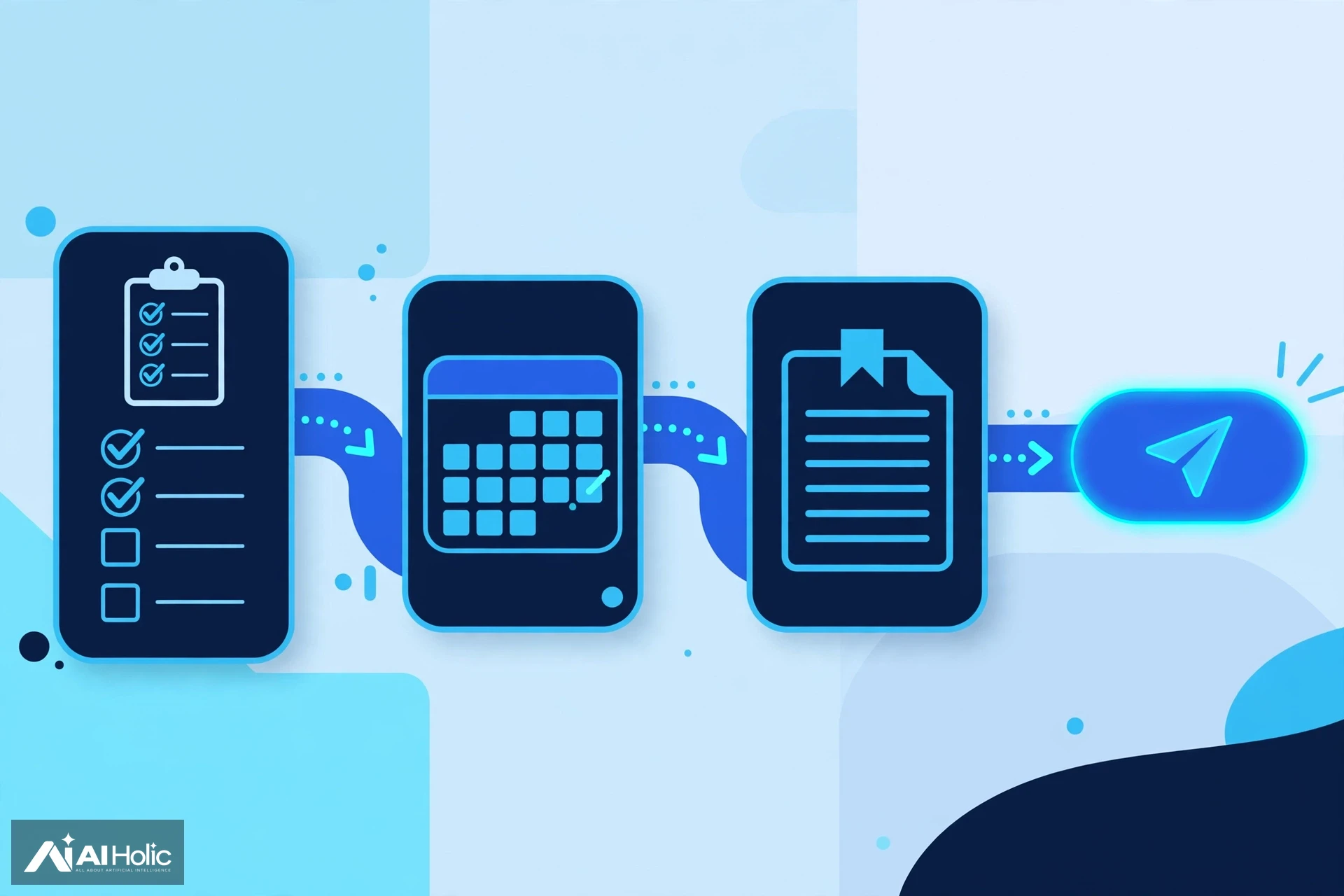
In practice, that shift looks like three things. First, brief-to-publication pipelines, where Jasper and Copy.ai let teams define a reusable flow and one brief produces drafted, reviewed, and formatted assets across channels.
Second, context-aware help, where Superhuman Go reads email and calendar context before it drafts. Third, two-way sync and direct publishing, where tools write straight into Google Docs or schedule posts into a CMS, so the copy-paste step between drafting and publishing disappears.
That shift changes the skill that matters. Prompt writing is becoming less valuable, while workflow design is becoming the skill that sets teams apart: knowing which steps to automate, where human review belongs, and how context flows between stages.
The trust problem has not gone away, though. AI still overstates facts, flattens voice, and at times invents details with full confidence, so the strongest teams use these tools as drafting partners with a human making the final call.
How To Choose A Writing Tool After April 2026
The ai writing tools updates april 2026 changes left the market split by user type, not by feature count. The right answer depends on your situation more than any ranking list, so match the tool to the job you actually do each week. The table below gives a starting point for the three most common cases.
| Who you are | Best fit after April 2026 | Why it fits |
|---|---|---|
| Solo writer or freelancer | One general assistant, plus Grammarly Pro if you want an editing layer | About $20 a month covers drafting, editing, and research |
| Small content team | General assistants plus a clear internal workflow | Sync and CMS publishing now work without the copy-paste tax |
| Enterprise or multi-brand team | Jasper, Copy.ai, or WRITER, matched to who owns the purchase | Brand voice points to Jasper, sales workflows to Copy.ai, compliance to WRITER |
Build your workflow so you can swap models when the next release lands. The past year saw four frontier releases leapfrog each other, plus a writing regression in one flagship model, and teams locked into a single provider felt every swing. Our guide to AI in publishing workflows in 2026 shows how teams fit these tools into a full publishing process, from brief to live page, and it is a useful next read once you have picked your tools.
Price is the other check to run before you commit. Enterprise platforms now price solo users out on purpose, and the features that make them worth the money sit behind higher plans. Start on the cheapest plan and upgrade only when a clear bottleneck shows up.
What To Watch Out For
The April 2026 updates made writing faster, but they did not make it safer to publish without checks. AI drafts still need a human to verify facts, names, dates, and quotes, because a fluent paragraph can carry a wrong claim without any sign of doubt.
The Wikipedia case from March 2026 shows how seriously publishers now take this: Wikipedia banned AI-generated article text, with only two exceptions, basic copyedits to an editor’s own writing and translation first drafts. Its policy notes that AI text can change the meaning of a passage in ways the cited sources do not support.
Detection is now part of the workflow too. Grammarly added AI detection to its editor, and standalone checkers flag text that looks machine-written, which matters for school work, client work, and any page where trust is on the line.
If you need to check a draft before you publish it, our guide to the AI detection tool explains what these checkers can and cannot prove. No detector is perfect, so treat its verdict as a signal, not a final judgment.
Evaluation work is catching up with the tools. NIST runs a GenAI testing and evaluation program that assesses generative systems across text, code, image, audio, and video, and its GenAI overview page describes how it tests generators, detectors, and prompt methods against each other.
That kind of independent testing matters, because vendor claims about quality are not a substitute for a check you can repeat yourself. Keep your own test set of real tasks, run each new model or tool against it, and let your own results decide what stays in your workflow.
Frequently Asked Questions
What was the biggest AI writing tool change in April 2026?
The model defaults changed. GPT-5.5 became the default across paid ChatGPT tiers, Claude Opus 4 launched with extended thinking turned on, and Gemini 3.1 Pro became the default across Google Workspace. Those three moves changed the output of the whole category at once, more than any single feature did.
Did Grammarly change its name in April 2026?
No. The parent company renamed itself Superhuman in October 2025, after buying Coda and the Superhuman email client. The Grammarly product kept its name, and the April 2026 work continued the document editor and AI Grader features that followed the rebrand.
What did WRITER ship in April 2026?
On April 23, 2026, WRITER moved organization settings into AI Studio, which put governance, model selection, and organizational controls in one place. It also added Connectors, which let WRITER Agent reach Google Workspace, Salesforce, Slack, and other enterprise apps.
Which AI writing tool is best for solo writers after April 2026?
A general assistant such as ChatGPT, Claude, or Gemini covers most of the job at about $20 a month. Add Grammarly Pro at $12 a month if you want a dedicated editing layer. Enterprise platforms price solo users out on purpose, so skip them unless a team workflow forces the choice.
Can I trust AI writing tools to publish without checking?
No. AI drafts can state wrong facts in fluent, confident language, and Wikipedia banned AI-generated article text in March 2026 for exactly that reason. Check every fact, name, date, and quote by hand before you publish, and keep a human in charge of the final call.
Conclusion
April 2026 moved writing tools from text machines to workflow partners, with new model defaults and agentic features leading the change. The ai writing tools updates april 2026 lesson is simple: pick one strong assistant, test it on real work, and keep a human in charge of facts. April 2026 also brought the biggest image generation news of the year — see our roundup of ai image generation news april 2026.