Data Quality Data Architecture Asset Management AI Transformation: Building the Foundation That Makes AI Work
If you don’t want to read the whole guide or have difficulty reading, you can listen to this guide instead.
Most AI projects do not fail because the model is weak. They fail because the data under the model is wrong, and data quality data architecture asset management ai transformation is the work that fixes that foundation before you spend more on AI.
Think of it as three jobs that belong together. Quality checks the data, architecture gives it a clear structure, and asset management keeps a list of what you own and who owns it.
At AI Holic, we read the top guides on this topic and compared what they agree on. This guide explains the six quality checks, the shape of a sound data foundation, and a five-step order you can follow with a small team.
- Data Quality Data Architecture Asset Management AI Transformation: The Short Answer
- Why AI Projects Stall on Bad Data
- The Six Dimensions of Data Quality
- Data Architecture: The Structure AI Runs On
- Asset Management: Know What Data You Own
- How the Three Parts Fit Together
- A Five-Step Build Order That Works
- How to Measure Progress
- Mistakes That Waste Time and Money
- Frequently Asked Questions
- Conclusion
Data Quality Data Architecture Asset Management AI Transformation: The Short Answer
Data quality data architecture asset management ai transformation means getting your data ready before you scale AI. You check that the data is right, you give it a clear structure, and you keep a full list of every data asset with a named owner.
That order matters. A model trained on wrong numbers gives wrong answers with total confidence, and a business that acts on those answers pays for the mistake.
The rest of this guide breaks the work into parts you can start this month. None of it needs a new platform on day one.
Why AI Projects Stall on Bad Data
The pattern repeats in firm after firm. The board asks for an AI plan, a tool is bought, and the team tries to connect it to live data. Then the numbers do not match.
The customer list in the CRM says one thing. The billing system says another. The same client appears under three spellings, and the sales report counts them as three people.
Someone then builds a manual fix in a spreadsheet. It works for the demo and breaks the next week, and the project stalls while the team argues about which number is true.
Gartner predicts that through 2026, organisations will abandon 60% of AI projects that lack AI-ready data, according to a prediction cited by Datafabric. McKinsey, also cited by Datafabric, puts the prize for asset managers at 25 to 40% of their total cost base in efficiencies from AI-enabled workflow change.
Both numbers point the same way. The gap between AI promise and AI delivery is a data problem first and a model problem second.
AI also makes bad data worse. A person can spot a wrong figure in a report and ask about it. A model takes the same wrong figure, treats it as fact, and repeats it at scale in every answer it gives.
The Six Dimensions of Data Quality
Data quality data architecture asset management ai transformation starts with six checks. Each one asks a plain question about your data, and each one has a clear test you can run.
| Dimension | The question it asks | A plain example |
|---|---|---|
| Accuracy | Does the data match reality? | A client address that is two years out of date |
| Completeness | Are the needed fields filled in? | Records missing email addresses or account status |
| Consistency | Is the same thing written the same way everywhere? | One client spelled three ways across systems |
| Timeliness | Does the data arrive when you need it? | Last week stock figures used for today orders |
| Validity | Does the data follow the right format and rules? | A date field holding text instead of a date |
| Uniqueness | Is each record listed only once? | The same adviser counted twice in the CRM |
Accuracy
Accuracy asks whether a value is true. If your CRM says a client holds $50 million and your custodian says $47 million, one of them is wrong, and an AI report built on the wrong one misleads everyone who reads it.
Check accuracy by comparing your records against a trusted source. Bank statements, signed contracts, and official registers all work as that source.
Completeness
Completeness asks whether the fields you need are filled in. A client record without an adviser link is incomplete, and a product record without a price cannot be sold by any system.
Measure it as a simple share. Count how many records in a set have the required fields filled, then divide by the total number of records.
Consistency
Consistency asks whether the same thing is written the same way in every system. “ANZ”, “Australia and New Zealand Banking Group”, and “ANZ Banking Grp” may all mean one bank, but a machine reads them as three separate firms.
Fix it with one shared list of names and codes. Every system uses the same spelling, and new entries pick from the list instead of typing free text.
Timeliness
Timeliness asks whether data arrives in time to act on it. Flow data that arrives two weeks late cannot guide next week travel plans, and stale stock counts cause orders to fail.
Set a fresh limit for each use. A trading desk needs minutes, a monthly board pack can wait days, and each limit should be written down and checked.
Validity
Validity asks whether data follows the format and rules you set. A phone field should hold a phone number, a date field should hold a date, and a code field should hold a code from your approved list.
Validity checks run well as automatic rules. They catch bad entries at the point of entry, before the bad value spreads to other systems.
Uniqueness
Uniqueness asks whether each real thing appears once. Duplicate client records inflate prospect counts, double-count revenue, and send the same person two different messages.
Match records on more than one field. Name plus email, or name plus account number, catches far more duplicates than name alone.
Data Architecture: The Structure AI Runs On
Data quality data architecture asset management ai transformation needs a structure to hold it together, and that structure is the data architecture. It is the set of models, policies, rules, and standards that decide which data you collect and how it is stored, arranged, integrated, and used.
Data management covers all the disciplines that treat data as a valuable resource, and architecture is the part that designs the overall shape of your data systems. It makes sure data flows work well and systems can grow with the business.
A sound architecture answers four plain questions. Where does each piece of data live, how does it move between systems, who may use it, and how do you trace it back to its source?
When those answers are missing, each team builds its own copy of the truth. Marketing keeps one customer list, finance keeps another, and the AI team gets a third list that matches neither.
The fix is a single trusted layer that sits over your current systems. It does not force you to replace your CRM or your custodian. It translates each source into one shared form, so every team reads the same numbers.
That layer also sets the rules for new data. New fields get a definition, a format, and an owner before they are added, which stops the next mess from forming while you clean the old one.
Our guide to AI advertising infrastructure shows the same idea in one business area: the systems work when the data layer under them is planned first, not added after the tools are bought.
Asset Management: Know What Data You Own
Data quality data architecture asset management ai transformation also needs a full list of your data assets. Asset management here means far more than tracking computers and licences. It means knowing every dataset your AI depends on, where it lives, how it is reached, and who owns it.
Without that list, AI teams find out mid-project that the data they need is missing, locked away, or in a form they cannot use. The project then stops while someone hunts for access or rebuilds a dataset from scratch.
A data catalog is the practical tool for this job. It lists each dataset, its source, its owner, its update rhythm, and its quality score, so any team can find what exists before it asks for something new.
Ownership is the part most teams skip. Every dataset needs one named person who answers for its quality, not a whole department where no one is sure who decides.
Lineage is the other half. It records where data came from and every change it passed through, so you can trace a wrong AI answer back to the exact source record that caused it.
Good asset records also save money. When you can see the whole estate, you can retire duplicate systems, drop datasets no one uses, and cut storage and licence costs.
The compliance case is just as plain. Financial services, health care, and insurance all face strict rules on data handling, and a clear asset list with lineage is how you show an auditor what data was used and why.
Our guide to banks using AI for customer experience shows why this matters in practice: personal service only works when the customer data behind it is complete, current, and tied to one real person.
How the Three Parts Fit Together
Data quality data architecture asset management ai transformation works because the three parts cover each other weak spots. Quality without architecture fixes one dataset while the next one breaks, and architecture without an asset list builds clean pipes to data no one can find. An asset list without quality checks is a neat list of bad data.
| Part | What it gives you | What breaks without it |
|---|---|---|
| Data quality | Data you can trust | Confident wrong answers from AI |
| Data architecture | One shared structure | Five versions of the same number |
| Asset management | A full list with owners | Missing data found mid-project |
| All three together | AI-ready data | Stalled pilots and lost trust |
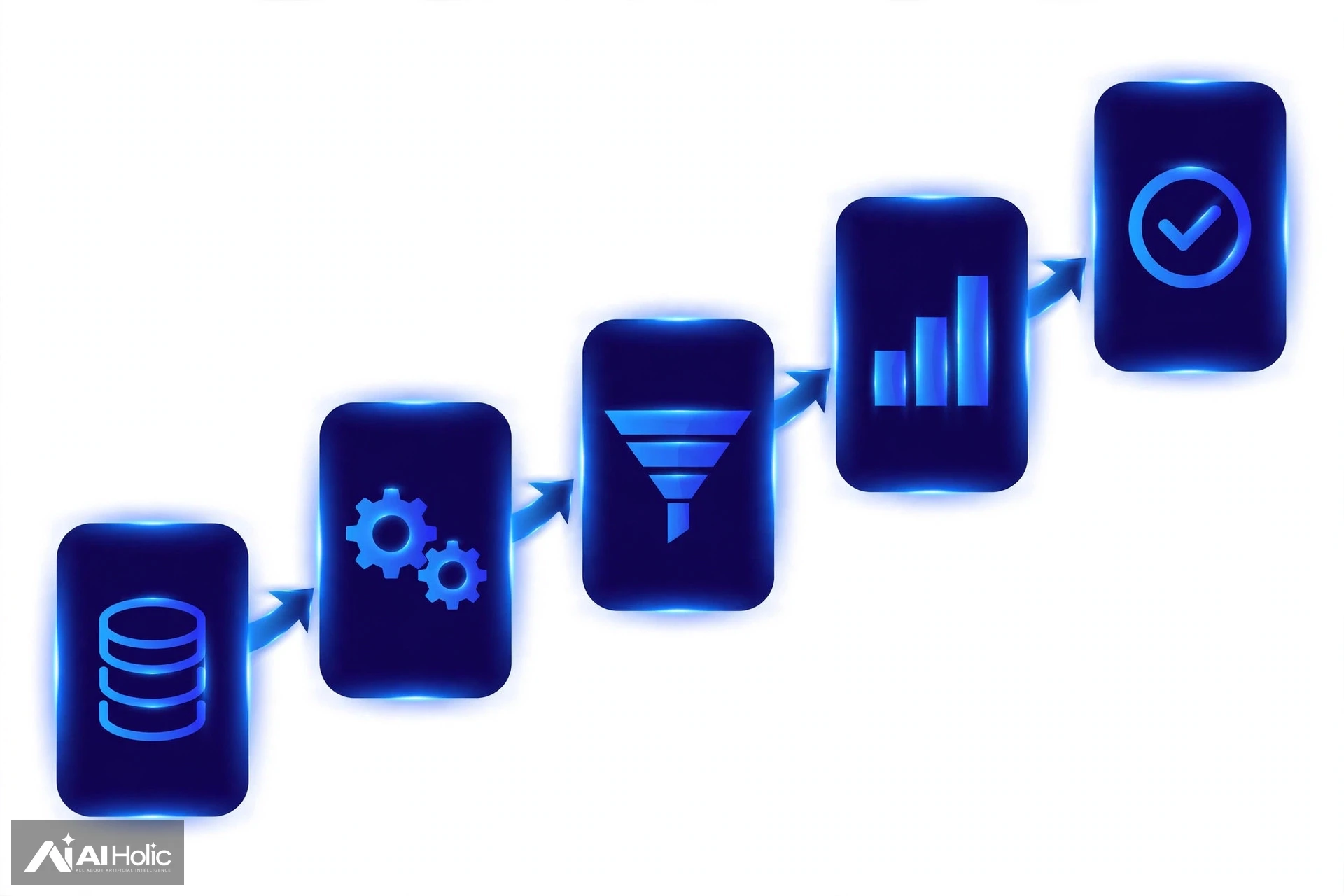
Think of the three parts as one loop. The catalog tells you what exists, the architecture moves it in a clean form, and the quality checks score it every day. A low score sends the record back for repair, and the loop keeps running.
Enterprise data management treats data as a strategic asset in the same way. Its framework joins governance, architecture, and quality into one program instead of three separate projects.
A Five-Step Build Order That Works
Data quality data architecture asset management ai transformation sounds large, so break it into five steps. Each step is small enough to finish, and each one makes the next step easier.
- Pick one AI use case. Choose a single job with a clear result, such as answering “what were our net flows last quarter” or drafting client summaries. One use case keeps the data work narrow and the win visible.
- List the data that use case needs. Write down every dataset, its source system, and its owner. If a dataset has no owner, assign one before you go further.
- Score the data on the six dimensions. Run the accuracy, completeness, consistency, timeliness, validity, and uniqueness checks on those datasets only. Fix the worst gaps first, not every gap at once.
- Build the shared layer for those datasets. Standardise names and formats, set the update rhythm, and record lineage from source to use. Keep the old systems in place and translate their data into the shared form.
- Set the daily checks and the review. Quality scores update every day, a low score raises an alert, and one person reviews the scores each week. Add the next use case only when the first one runs clean for a month.
That last rule is the one that saves budgets. A team that adds five use cases on shaky data gets five broken results. A team that proves one use case on clean data has a pattern it can repeat.
Start small on purpose. A mid-sized firm often connects 15 to 20 sources for a full build, but your first use case may need only three or four, and that is enough to learn the method.
How to Measure Progress
You cannot show the value of data work without a baseline. Score your key datasets on the six dimensions before you change anything, and write the scores down. That first scorecard is the proof of progress later.
Track four numbers each month. The quality score per dataset, the share of datasets with a named owner, the time it takes to answer a new data request, and the number of AI outputs that needed a human fix.
One vendor case, reported by Datafabric, shows what movement looks like: a specialist asset manager raised adviser count accuracy from 74% to 95% and funds under management accuracy from 69% to 94% after connecting 27 integrations. Treat that as one vendor example, not a promise for your firm.
Also track what you avoid. Fewer duplicate records, fewer failed feeds, and fewer hours spent reconciling numbers in spreadsheets are real savings, even when no one puts them on a slide.
Our guide to AI transformation as a governance problem covers the other half of this work: who decides, who checks, and how the rules stay in force once the first build is done.
Mistakes That Waste Time and Money
The first mistake is buying the model before fixing the data. A new tool on bad data gives faster wrong answers, and the team then blames the tool instead of the data under it.
The second mistake is trying to clean everything at once. A firm with hundreds of datasets cannot fix them all in one project, so pick the datasets your first use case needs and leave the rest for later.
The third mistake is skipping ownership. When no one owns a dataset, no one fixes it, and the same errors return after every cleanup.
The fourth mistake is hiding the work from the business. Data work that only the tech team sees gets cut first, so share the scorecard with the people whose decisions depend on the data.
The fifth mistake is treating the build as a one-off project. Data quality drifts as systems change, so daily checks and a weekly review are part of the job, not an extra.
Frequently Asked Questions
What Does AI-Ready Data Mean?
AI-ready data is data that passes the six quality checks, sits in a clear architecture, and is listed in a catalog with a named owner. It is accurate, complete, consistent, timely, valid, and free of duplicates, and you can trace it back to its source.
How Long Does It Take to Fix Data Quality?
It depends on how many datasets your first use case needs. A single use case with three or four sources can reach a usable baseline in weeks, while a whole firm takes months. Start with one use case and add more only when the first one runs clean.
Do We Need to Replace Our Old Systems First?
No. Build a shared layer over your current systems and translate their data into one form. Old systems often hold the most useful history, such as years of transactions, so keep them and make their data reachable instead of replacing them.
Who Should Own Data Quality in a Business?
Each dataset needs one named owner, usually a business person who uses the data, not the tech team alone. The tech team runs the checks and the pipes, but the owner decides what “good enough” means for each use and signs off on fixes.
What Is the First Step for a Small Team?
Pick one AI use case and list the data it needs. Score those datasets on the six dimensions, fix the worst gaps, and set a daily quality check. That small loop teaches your team the method and gives the business one visible win.
Conclusion
Data quality data architecture asset management ai transformation is the foundation, not the decoration. Pick one use case, score its data, name its owners, and build the shared layer. AI built on that ground earns trust instead of losing it.