AI Games: The Four Kinds of AI in Gaming, Explained
If you don’t want to read the whole guide or have difficulty reading, you can listen to this guide instead.
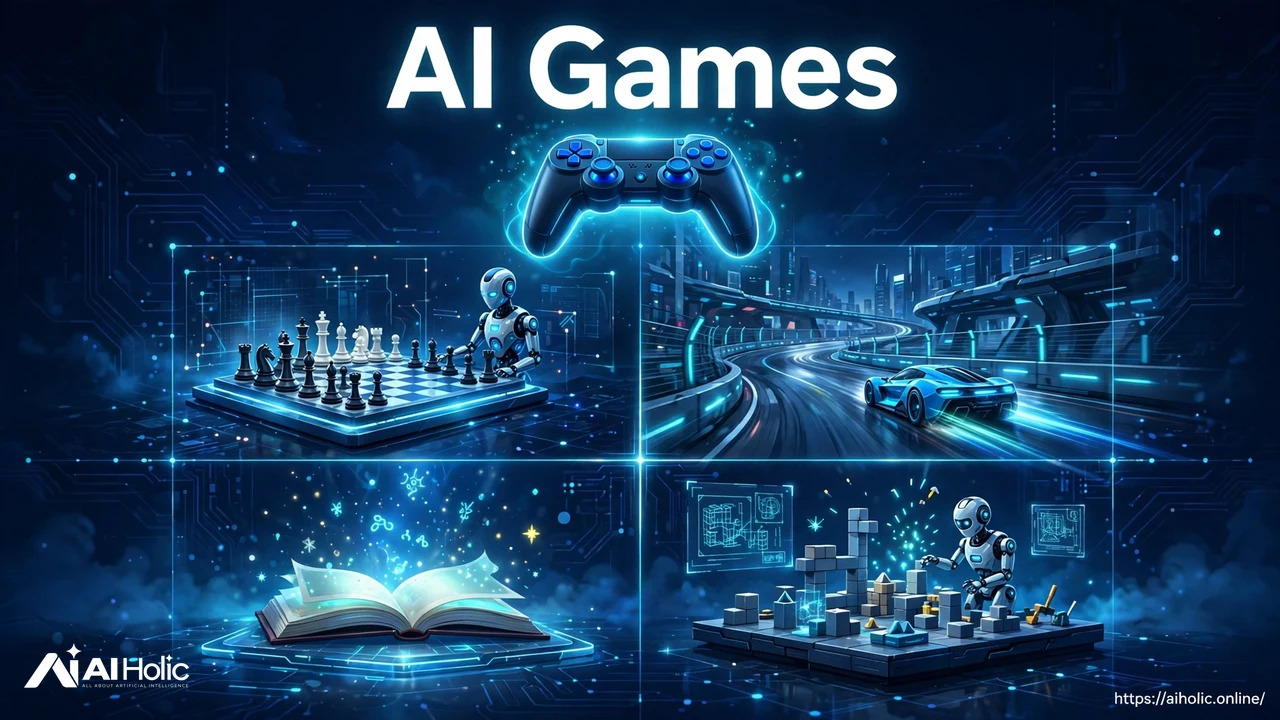
The phrase ai games covers four very different things, and most lists mix them up. It can mean a game with smart enemies, a game that adapts to how you play, a game where AI writes the story as you go, or a game that AI helped build. Each kind works in a different way, and each one gives you a different kind of fun.
At AI Holic, we test AI tools and explain them in plain words. This guide walks through all four kinds with real examples, so you can tell them apart and pick the ones worth your time.
What Are AI Games?
The term has no single meaning, so it helps to sort it before you play or buy anything. A game can use AI inside the match, while you play, or outside the match, while it is being made.
The four kinds below cover both sides. Once you know which kind a game belongs to, its ads and store page make much more sense.
This table sums up the four kinds in one place.
| Kind | What the AI does | Example |
|---|---|---|
| 1. Opponent and NPC AI | Controls enemies and characters | Pac-Man ghosts |
| 2. Learning systems | Adapts to how you play | Forza Drivatar |
| 3. Live creation | Writes story, dialogue, or levels as you play | AI Dungeon |
| 4. AI-built games | AI helped write code, art, or music | Slotbound |
Most modern games mix two or more kinds at once. A game can have smart enemies and AI-made art in the same match. The table still helps, because it shows which kind does what.
AI Opponents and NPCs: The Oldest Kind
This is the oldest kind of ai games, and it is the one most players mean when they say a game feels smart. The AI controls enemies, allies, and background characters, and it decides how they move, fight, and react to you. Its job is to feel fair and fun, not to be truly intelligent.
The classic example is Pac-Man from 1980. Each ghost follows its own pattern, so one chases you, one tries to cut you off, and one wanders. That small set of rules creates play that still feels fresh today.
Wikipedia explains that AI in video games covers the systems that control non-player characters, shape game behavior, and guide strategic choices. Space Invaders from 1978 used rising speed and shifting patterns to raise tension as you played. By the 1990s, finite-state machines became the standard way to script enemy reactions, and most games still use them in some form.
Chess shows how far this kind can go. In 1997, an IBM computer beat world champion Garry Kasparov in a six-game match.
Go followed in 2016, when AlphaGo beat champion Lee Sedol. These wins came from search and training, not from a machine that thinks like a person.
Modern NPCs add memory and voice to the same idea. In Middle-earth: Shadow of Mordor from 2014, the Nemesis system lets enemy orcs remember past fights with you and react to them.
Tools such as NVIDIA ACE now let characters hold spoken talks with players. Our guide to AI character cards shows how the same idea works for fan-made characters outside big games.
AI Games That Learn While You Play
The second kind watches how you play and changes the game in reply. It tracks your wins, your losses, and the moves you repeat, then it tunes the challenge to fit. The goal is a match that stays close, so you stay interested without feeling stuck.
Left 4 Dead is a clear example. Its AI Director watches your health, your pace, and your stress level, then it places enemies and supplies to match. A strong team faces more pressure, and a hurt team gets room to breathe.
Forza uses the same idea for racing. Its Drivatar system learns from real players and builds AI rivals that drive like them. Your rivals brake, overtake, and make mistakes in ways that feel human, because the patterns came from human drivers.
Machine learning sits behind most of these systems. Wikipedia notes that machine learning in video games is used for NPC control, procedural content generation, and learning-based content.
The models learn from past play, then they predict what should happen next. That is also why two players can get two different games from the same title.
This kind has a real limit. A system that learns from you can also learn your bad habits, and it can repeat them back to you.
A game that adapts too fast can feel unfair, since it seems to punish you for playing well. Good design keeps the tuning gentle, so the change feels like a fair match and not a rigged one.
When AI Creates the Game as You Play
In generative ai games, a model takes over part of the game while you play. The model writes the next scene, the next line of dialogue, or the next level, so no two sessions play the same way. This is the kind most people picture when they hear about generative AI in games.
AI Dungeon is the best-known example. You type what your character does, and a language model acts as game master and writes what happens next. The story can go anywhere, which is the fun and the risk at once.
The Google drawing game works the other way round. You draw, and a neural network guesses what you drew in 20 seconds. It is a small game, but it shows the idea in its purest form, since the model reacts to your input in real time.
Infinite Craft uses the same trick with words. You mix two items, and a language model names the result, so players keep finding new mixes that no one planned.
No Man’s Sky took an earlier path in 2016, and it built whole planets from rules instead of hand-made maps. That is procedural generation, a rule-based cousin of live creation, and it still shapes how big worlds get built.
The weak point here is quality control. A model can write a dull scene, repeat itself, or break the rules of its own world. Players who want a tight story often prefer hand-written games, while players who want surprise accept the rough edges.
Games Built With AI Tools
The fourth kind has no AI running while you play at all. The AI worked during production, and it wrote code, drew art, voiced lines, or drafted music before the game shipped. You play a normal game, and the AI is already gone by the time you start.
This kind grew fast in 2026. Tools that write code from plain prompts let small teams build full games in days, and the AI Game Atlas directory listed 51 browser games of this type by 19 November 2026, with 46 free to play. One of them, Slotbound, is a slot-machine game built with AI writing all of its code, and the games directory aigamer.gg reports it sold 200,000 copies on Steam in its first week. If you build in Godot, our guide to godot ai coding compares the free and paid tools that write GDScript, build scenes, and fix errors in the editor.
Steam now asks developers to say how they used AI. Valve set the rule in January 2024, and it splits AI use into two groups.
Pre-generated content is made with AI during production, and live-generated content is made by AI while the game runs. The store page shows much of that disclosure, so buyers can see it before they pay.
Outside counts show how common this has become. Data from GYLD, as reported by 9to5AI in October 2026, puts AI disclosures on about one in three new Steam releases in 2026. That is a reported count from an outside source, not a figure from Valve, but it shows the direction of travel.
If you want to see how this kind of building works in practice, our report on AI for game development in Unreal Engine 5 covers the tools and news in this space. The key point is simple: a game built with AI is judged like any other game, by how it plays, not by how it was made.
How to Tell the Four Kinds Apart
Store pages rarely use these four labels, so you need a quick test. Ask one question: where does the AI work?
If it works in the match, you are looking at kinds one, two, or three. If it worked before release, you are looking at kind four.
| Ask this | If the answer is yes | You are looking at |
|---|---|---|
| Does the game react to your choices in new ways each time? | Yes | Live creation |
| Do enemies or rivals change as you get better? | Yes | Learning systems |
| Do characters act on set rules and patterns? | Yes | Opponent and NPC AI |
| Does the store page mention AI art, code, or voice? | Yes | AI-built game |
A single game can pass more than one test. A game with learning rivals and AI-made art sits in two kinds at once, and that is normal. The test still helps you know what you are buying and what to expect from it.
Free Games to Try First
You do not need to pay to try games from the first three kinds. The list below starts with free browser games, and each one shows a different kind in action. Play one from each row, and the four kinds will feel concrete instead of abstract.
- Quick, Draw!: draw an object and let a neural network guess it in 20 seconds.
- AI Dungeon: type your own story and let a language model act as game master.
- Human or Not: chat for two minutes and guess if the other side is a person or a model.
- What Beats Rock: name anything that beats the last item and see how the model judges it.
- Infinite Craft: mix two items and watch a model name the result.
If you have five minutes, start with the Google drawing game. Try AI Dungeon if you want a longer session with a story that bends to your choices. Both are free, and both run in your browser with no install.
Risks and Limits to Know
AI in games brings real risks, and the first is content you did not ask for. A model that writes freely can produce text that is rude, wrong, or off-topic, and a young player can meet it with no warning. Check the age rating and the chat settings before you hand a game to a child.
The second risk is data. Games that learn from you collect data about how you play, and some send it to servers you cannot see.
Read the privacy note on the store page, and turn off voice chat and data sharing when you do not need them. Our guide to the behavior AI moderation tool for gaming explains how one moderation tool watches chat for abuse.
The third risk is quality. AI-made art and writing can look fine at first and fall apart on a closer look, with wrong hands, mixed styles, or plot holes.
Steam asks developers to guard live-generated content and to keep it legal, and players can report bad content from the in-game overlay. If a game feels cheap or broken, trust that feeling and move on.
Frequently Asked Questions
What is an AI game in simple words?
An AI game is a video game that uses artificial intelligence somewhere in the loop. It can use AI to control enemies, to adapt to your skill, to create story or levels while you play, or to help build the game itself. Most games use only one or two of these, so ask where the AI works before you judge the game.
Are ai games free to play?
Many are, since the AI Game Atlas listed 51 browser games in November 2026 and 46 of them were free to play. Quick, Draw!, AI Dungeon, and Infinite Craft all run free in a browser. Big console and PC titles with AI features still cost money, but the free browser games are the best place to start.
Do AI games need an internet connection?
It depends on the kind. Games with live creation usually need a connection, since the model runs on a server. Games with smart enemies or AI-made art often run offline, since the AI work is already done, so check the store page for online needs before you buy or download.
Can AI build a full game on its own?
Not yet on its own. AI tools can write code, art, and music from prompts, and small teams shipped full games with them in 2026. A person still plans the game, fixes the bugs, tests the result, and checks that the finished game is fun to play, while the AI speeds up the work.
Are AI games safe for kids?
Some are, and some are not. Games with free-text AI chat can show content you did not expect, so check the age rating and turn off chat features first. Games with fixed rules and no chat, such as Quick, Draw!, are a safer first pick, so always test a game yourself before a child plays it.
Conclusion
ai games now cover four kinds, from smart enemies to games that AI built. Try one free game from each kind, and you will know which style fits you best.