AI Servers Price: What a GPU Server Costs in 2026 and How to Choose One
If you don’t want to read the whole guide or have difficulty reading, you can listen to this guide instead.
An 8-GPU AI server can cost as much as a house. The ai servers price for a mainstream system runs from about $250,000 to $750,000 in 2026, and the same machine can cost another $50,000 a year just to keep running. That spread confuses buyers, because two quotes for the same server can differ by $200,000.
At AI Holic, we compared the price guides published in September and October 2026 and pulled the numbers into one place. This guide gives you the price bands by system, the running costs, and the rent or buy math, so you can set a budget before you ask for a quote.
The Short Answer: AI Servers Price in 2026
If you want one number, plan on $250,000 to $470,000 for a mainstream 8-GPU server in 2026. That band covers the older H100 systems at the low end and the current B200 and B300 systems at the high end. A full rack of 72 GPUs costs about $3 million to $5 million, and a home build that runs small models starts near $300.
The ai servers price for a mainstream system is not one fixed figure. It moves with the GPU generation inside the box, the memory on each chip, and the date of the quote. Prices also rose through 2026 as memory costs climbed.
AI Server Prices by Tier
This table puts the ai servers price for each common system side by side. The ranges come from price guides published in September and October 2026, and the source is named in each row. Where two sources disagree, both figures are shown.
| System | GPUs | Typical price (2026) | Source and date |
|---|---|---|---|
| 4x H100 PCIe | 4 | $150,000 to $180,000 | MillionMiner, 2026 |
| 8x H100 HGX | 8 | $250,000 to $320,000 | MillionMiner, 2026 and Haink, Sep 2026 |
| 8x H200 HGX | 8 | $300,000 to $400,000 | Haink, Sep 2026, and CHG-Meridian says about $340,000, Oct 2026 |
| 8x B200 HGX | 8 | $360,000 to $560,000 | CHG-Meridian, Oct 2026 and Haink, Sep 2026 |
| 8x B300 HGX | 8 | $400,000 to $750,000 | CHG-Meridian, Oct 2026 and Haink, Sep 2026 |
| DGX H100, turnkey | 8 | About $290,000 | MillionMiner, 2026 |
| DGX B200, turnkey | 8 | About $515,000 | MillionMiner, 2026 |
| GB200 NVL72 rack | 72 | About $3 million to $5 million | MillionMiner, 2026 and CHG-Meridian, Oct 2026 |
Two things stand out. First, the 8-GPU H100 is the cheapest way into serious AI compute, at about $285,000 typical. Second, the B300 range is the widest, because the newest chips are sold through allocation.
Listed configurator prices sit inside the same bands. Five West checked listings on 20 October 2026 and found a Supermicro 8-GPU HGX B200 server at $394,406 and an 8-GPU HGX B300 server at $649,380. Those are asking prices for the exact builds shown.
If you want a system that arrives built, tested, and ready to run, our turnkey AI server guide explains what that package includes and where to buy one. A turnkey system costs a little more than the same parts bought loose, and the premium buys setup help and a support contract.
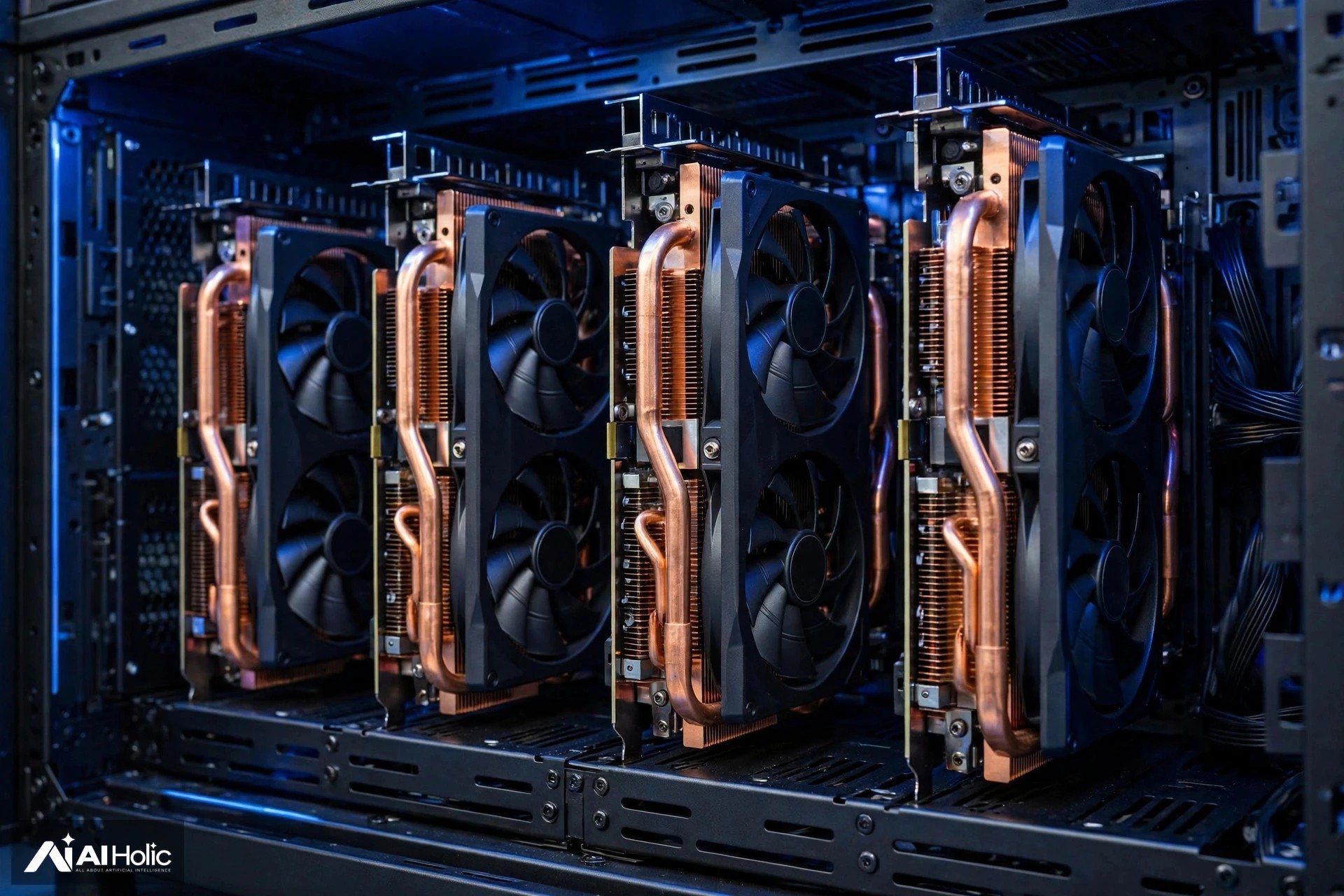
What Sets the AI Servers Price
The GPUs are most of the bill. On an 8-GPU server, the graphics chips and the board that links them take about 72 to 80 percent of the total cost, according to Haink and MillionMiner.
A graphics processing unit is a chip built to run many calculations at once, and AI work needs thousands of them running in parallel. That is why the GPU generation sets the price band more than any other part.
Memory on each GPU is the next driver. An H100 carries 80 GB of memory per chip, an H200 carries 141 GB, and a B300 carries 288 GB.
Larger memory holds bigger models and serves more users at once, so buyers pay more for it. Our guide to the best GPU for AI compares the chips card by card if you want the detail.
The rest of the server is a smaller share. CPUs and system memory take about 7 to 10 percent, network cards take 3 to 5 percent, local storage takes 2 to 4 percent, and the chassis, power supplies, and cooling take 2 to 4 percent.
Integration, burn-in testing, and warranty add another 2 to 5 percent. Trimming memory or storage saves little, while stepping down one GPU generation saves a lot.
Quantity, country, and timing move the quote too. A single server carries the full cost of sourcing, freight, and setup, while an order of 16 or more servers usually costs less per unit.
Freight, duty, and tax add about 3 to 12 percent outside the home market. And a card bought from stock can cost 1.4 to 1.7 times the price of the same card ordered for a documented project, according to Haink.
That is why two quotes for the same server can differ so much. The price belongs to the order, not to the product. A quote far below the market range usually describes a different GPU variant or used parts, so check the exact build before you compare numbers.
Small-Scale AI Servers Price: Home and Office Builds
Not every AI server is a rack machine. A home or office build that runs open models on your own network costs far less, and it suits small teams, developers, and anyone who wants private AI without a data center. The figures below are US street prices from October 2026, reported by Modemguides.
| Build | Parts | Street cost (Oct 2026) | Runs well |
|---|---|---|---|
| Spare-PC upgrade | Add a used Tesla P40 or a new RTX 3060 12 GB to a desktop you own | $300 to $450 | Small models, 7B to 14B class |
| Single-3090 tower | Used RTX 3090 24 GB, desktop board, 32 GB RAM, 750 W power supply | $2,000 to $2,300 | 27B to 32B models at chat speed |
| Dual-3090 tower | Two used RTX 3090 cards, board with two slots, 1,200 W power supply | $3,500 to $4,000 | 70B models held fully in video memory |
| Prebuilt unified memory | GMKtec EVO-X2 128 GB or NVIDIA DGX Spark 128 GB | $3,500 to $6,950 | 70B to 120B models at reading speed |
The used market is where the value sits at this size. A used RTX 3090 with 24 GB of video memory sold for about $1,400 in October 2026, and a used Tesla P40 with the same memory sold for about $275. A new RTX 5090 with 32 GB cost $4,999 new and $3,822 used.
Memory prices pushed home builds up through 2026. DDR5 kits that sold for $100 to $330 in August 2025 sold for $425 to $3,400 in August 2026, a rise of three to nine times. Used GPU prices followed, so the cheapest builds now start from used parts.
A home build also costs little to run. A single-3090 server draws about 80 watts idle and 400 to 450 watts while it writes text.
At 17 cents per kilowatt-hour, that works out to about $14 a month for two hours of use a day. The machine is loud and warm, so a garage or spare room suits it better than a bedroom.
What It Costs to Run an AI Server Each Year
The ai servers price on the invoice is only the start. An 8-GPU server draws 10 to 14.5 kilowatts, which is nearly twice the power of an average data center rack. Power, cooling, software, and support add up fast.
Power is the biggest yearly line. A B300 server costs about $13,000 to $22,000 a year to power at US business electricity rates, according to CHG-Meridian.
That figure uses 80 percent of the rated power around the clock and adds cooling overhead of 36 to 52 percent, measured as power usage effectiveness. US business power averaged 9.64 to 14.47 cents per kilowatt-hour in August 2026, according to the US Energy Information Administration.
Software is the line most buyers miss. NVIDIA AI Enterprise lists at $4,500 per GPU per year, which is $36,000 a year for an 8-GPU server.
Over three years that adds $108,000, about a quarter of the purchase price. Few cost guides mention it, and it applies whether you buy or lease.
Hosting adds the next chunk. Colocation for space, contracted power, and cooling runs about $130 to $380 per kilowatt per month, with energy billed on top at about $0.08 to $0.25 per kilowatt-hour, according to Haink. Hardware support after warranty adds about 3 to 6 percent of the hardware cost each year.
Put together, Haink puts the yearly running cost of one hosted 8-GPU server at about $50,000 to $145,000 for a B300 and $35,000 to $100,000 for an H200, before staff and software licences. CHG-Meridian gives a tighter figure of $49,000 to $58,000 a year for power and software alone.
Resale softens the total. CHG-Meridian estimates that a B300 server keeps about 27 percent of its purchase price after three years.
On a $420,000 server, that returns about $114,000, which brings the net three-year cost to about $454,000 to $481,000 after purchase, software, and power. Wiping and testing the drives at retirement costs only a few hundred dollars per server.
Rent or Buy: The Utilization Test
The ai servers price question comes down to one number: how much of the time the machine will actually run. Cloud GPUs rent for about $2 to $4 per GPU-hour on demand, with lower rates on reserved contracts. An owned 8-GPU H100 server works out to about $1.40 per GPU-hour all-in at 70 percent use, according to MillionMiner.
Above roughly 60 to 70 percent steady use, buying is cheaper. Below it, renting wins, because you pay nothing for idle silicon.
| Case | Owned cost per GPU-hour | Cloud rental per GPU-hour | Winner |
|---|---|---|---|
| H100, 70% use, 3 years | About $1.40, all-in | $2 to $4 on demand | Own |
| H200, 70% use, 3 years | $3.35 | $3.30 blended index, $4.62 settled trades | Roughly tied |
| B300, 70% use, 3 years | $5.69 | $6.80 blended index | Own |
| Any GPU, under 50% use | Full fixed cost, idle or not | Pay only for hours used | Rent |
The table uses Haink figures from September 2026 and MillionMiner figures from 2026. Owned cost covers the server at the middle of its price range, plus 15 percent for fabric and storage, plus yearly running cost, less resale value at 30 percent after three years. Rental rates come from the Silicon Data index and the Ornn Data benchmark, both from late September 2026.
Renting also wins in four common cases. Short or one-off projects do not justify a six-figure purchase. Bursty demand suits pay-per-use billing.
Early teams that are still testing models need the freedom to change. And the newest chips are often allocated and waitlisted, so renting is the only near-term way to reach them.
There is a middle path. Colocation lets you own the hardware and its resale value while someone else handles the power, cooling, and uptime.
Our cloud AI guide explains the rental side, including how cloud GPUs are billed and when they suit a team. If you can honestly forecast keeping a machine busy more than two-thirds of the time for at least two years, ownership almost always wins on total cost.

Used and Refurbished AI Servers
The ai servers price falls fast once a system is used, and the H100 holds its value best. A working secondary market exists for H100 systems, so buyers can capture the same compute for far less than new.
Newer parts such as the B200 barely have a resale market yet, so a used H100 system is often the cheapest way to own serious AI compute today.
Two checks matter before you buy used. First, ask for proof that the GPUs passed a memory stress test, and check that the thermal pads were replaced. Second, confirm the exact GPU variant, because a PCIe card and an SXM module with the same name are different parts.
Leasing is the other route to a lower entry cost. Under a typical lease, you return the server at the end of the term and move to the next generation, while the lessor carries the resale risk. Owners who depreciate servers over five or six years often keep a machine long after a newer generation arrives.
Why Prices Are Rising in 2026
Memory costs are the main driver. In August 2026, Bloomberg reported that NVIDIA told some of its largest customers to expect price rises of more than 15 percent on servers with its AI chips. The memory stacked on each GPU is made by only a few suppliers, which keeps a floor under prices even as chip output rises.
Demand is also outrunning supply. CHG-Meridian reports that buyers are not getting volume discounts on AI servers right now, and ordering ten servers instead of one does not lower the price per server. SemiAnalysis reported in April 2026 that on-demand GPU capacity was sold out, and one-year H100 contract prices had risen almost 40 percent since October 2025.
Prices have eased about 10 percent a year in the past as supply improved, according to MillionMiner. Treat any figure in this guide as a starting point for a quote, not a shelf price.
How to Get a Fair Quote
A good quote starts with a clear workload, not a part number. Name the models you will run, how large they are, and how many users will use them at once. GPU memory follows from those answers.
- Get quotes from more than one seller, since volume and timing move integrated prices by 8 to 20 percent.
- Ask each seller to state the largest model the quoted system can serve, and how many users it can serve at once.
- Get the software list in writing, with the licence cost per GPU per year and the support terms.
- Check the room before the machine: power supply, cooling, and rack space stop more installs than any software issue.
- Price the full three-year total: box, power, cooling, support, staff time, and resale value, against the cloud bill for the same workload.
- Read the delivery timeline in writing, including what happens if the GPUs are allocated rather than in stock.
A server is a computer that provides data or services to other computers on a network, and an AI server is that same idea built around GPUs. The buying rules are the same as for any server: match the machine to the job, count the running cost, and keep the paperwork.
Frequently Asked Questions
What is the ai servers price for an 8-GPU system in 2026?
A mainstream 8-GPU server costs about $250,000 to $470,000 in 2026. An H100 system sits near $250,000 to $320,000, an H200 near $300,000 to $400,000, and a B200 or B300 near $360,000 to $750,000. The exact figure depends on the GPU generation, the memory, and the date of the quote.
How much does it cost to run an AI server per year?
A hosted 8-GPU server costs about $35,000 to $145,000 a year to run, before staff and software licences. Power adds $13,000 to $22,000, software adds $36,000 for NVIDIA AI Enterprise, and colocation adds the rest. The range comes from the GPU generation and the local power rate.
Is it cheaper to rent or buy an AI server?
Buy when use is high and steady, above roughly 60 to 70 percent, for at least two years. Rent for short, bursty, or uncertain work. An owned H100 server costs about $1.40 per GPU-hour all-in at 70 percent use, against $2 to $4 on demand.
What is the cheapest AI server for home use?
A spare-PC upgrade with a used Tesla P40 or a new RTX 3060 costs $300 to $450 and runs small models. The best value for most homes is a tower with one used RTX 3090, about $2,000 to $2,300 complete, which runs 27B to 32B models at chat speed.
How much does a full AI cluster cost?
A 32-GPU B300 cluster with fabric and storage costs about $2.5 million to $3.8 million, and a 128-GPU B300 cluster costs about $10 million to $15 million, according to Haink in September 2026. Fabric and storage add 12 to 25 percent on top of the servers.
Why do two quotes for the same AI server differ?
Quantity, country, end user, timing, and the site all move the figure. A card bought from stock can cost 1.4 to 1.7 times the price of the same card ordered for a documented project. A quote far below the market range usually describes a different GPU variant or used parts.
Conclusion
The ai servers price you should plan for is $250,000 to $470,000 for a mainstream 8-GPU system, plus $35,000 to $145,000 a year to run it. Size the system from your models, count the full three-year cost, and get quotes in writing before you buy.