Pharmacovigilance AI Governance Framework: A Plain Guide for Drug Safety Teams
If you don’t want to read the whole guide or have difficulty reading, you can listen to this guide instead.
Drug safety teams now use AI to read case reports, spot safety signals, and draft regulatory forms. That speed helps, but it also creates a new risk: an AI error can hide a real safety problem or flag a false one. A pharmacovigilance ai governance framework is the set of rules, roles, and checks that keeps AI use in drug safety safe, honest, and ready for inspection.
At AI Holic, we read the leading guides on AI in drug safety and the new international guidance from CIOMS. This guide explains what the framework covers, the seven principles behind it, and a five-stage plan to build one for your own team.
You will learn which decisions must stay human, how much oversight each use case needs, and what regulators in the US and Europe now expect.
What Is a Pharmacovigilance AI Governance Framework?
A pharmacovigilance ai governance framework is a written set of rules, roles, and checks that controls how AI is used across drug safety work. It covers case intake, signal detection, literature review, and regulatory reporting. It names who approves each AI use, what proof is needed before it goes live, and how its work is checked over time.
Pharmacovigilance is the science of finding, assessing, and preventing harmful effects of medicines. AI now helps with much of that work, from reading case reports to ranking safety signals. The framework is what keeps that help under control, so speed never replaces care.
Think of it as the operating manual for AI in your safety team. It does not pick the AI tools for you. It sets the rules those tools must follow, and it records the proof that they did.
Why Drug Safety Teams Need One
A pharmacovigilance ai governance framework matters because a missed safety signal can harm patients, and a false signal can waste weeks of expert time. AI can do both at a scale no human team can match. Without rules, a team may not know which AI output to trust, or who is at fault when one is wrong.
A 2006 review of 37 studies in Drug Safety, by Hazell and Shakir, put the median underreporting rate for adverse drug reactions at 94 percent. Most safety events never reach a formal report, so teams now pull in wider sources such as electronic health records, literature, and patient reports. The FDA adverse event database, FAERS, holds millions of reports, and that volume is exactly why teams turn to AI.
Regulators now ask hard questions about AI in drug safety. They want to see how a model was tested, what data it learned from, and who checked its work. Clinical tools face the same test: our guide to UpToDate AI shows how Expert AI answers only from curated content and shows its sources.
A team with a written framework can answer those questions with records. A team without one has to build the answers under pressure.
The framework also protects the team itself. It stops one person from quietly changing a model, and it stops a vendor from selling a black box nobody can check. Clear roles mean every AI decision has a named owner.
| Part | What it does | Who owns it |
|---|---|---|
| Governance board | Approves AI uses and reviews performance | PV head, data science lead, regulatory lead |
| Risk tiers | Set the oversight level for each use case | Governance board |
| Validation records | Prove the model works before it goes live | Data science team |
| Human review rules | Say which outputs a person must check | PV medical lead |
| Audit trail | Logs every AI decision and human change | Quality team |
| Monitoring plan | Tracks accuracy over time and flags drift | Data science team |
| Training records | Show staff know the rules | Training lead |
The Seven Principles Behind the Framework
The clearest public guide to a pharmacovigilance ai governance framework comes from CIOMS, the Council for International Organizations of Medical Sciences. Its Working Group XIV published guidance on AI in pharmacovigilance on December 4, 2025, after a consensus process with regulators, academics, and industry. The guidance rests on seven principles.
- Risk-based approach: the level of control matches the risk if the AI fails.
- Human oversight: a person stays in charge of safety decisions.
- Validity: the model must work well and keep working as data changes.
- Transparency: the team can explain how the AI reached its output.
- Data privacy: patient data stays protected at every step.
- Fairness and equity: the model must work fairly across patient groups.
- Governance and accountability: roles, records, and checks are written down and followed.
Risk sits at the center of all seven. A drafting tool for internal notes needs light checks, while a system that feeds causality assessment needs heavy ones. The same framework can hold both, because the controls scale with what is at stake.
Our guide to unified AI governance architecture explains how a general governance model is built, and the same structure works here once drug safety rules are added. The seven principles above are the drug safety version of that same idea.

The Core Parts of the Framework
The framework has six working parts. Each one answers a question a regulator, an auditor, or a safety doctor is likely to ask. Together they form the daily routine of governed AI use.
A Governance Board
A small board owns AI use in drug safety. It should hold clinical experts, data scientists, and regulatory specialists.
The board reviews and approves each model before it goes live, and it checks performance after launch. No AI use case starts without the board’s sign-off.
An Accountability Matrix
Every AI task needs a named owner for building, testing, running, and checking the model. The matrix says who answers when an output is wrong. Without it, a failure becomes everyone’s problem and nobody’s job.
Data Rules
AI is only as good as the data it reads. The framework sets rules for data cleaning, standard terms, and full records of where each fact came from. Case reports should use standard codes such as MedDRA, and safety reports should follow the ICH E2B format for electronic exchange.
Validation and Lifecycle Checks
A model is tested before it goes live, then checked again after every update. Performance is tracked against set measures, so drift shows up early. A model that worked last year may fail this year as medical practice changes, so checks never stop.
Explainability
The team must be able to explain why the AI flagged a case or ranked a signal. Tools such as LIME and SHAP can show which facts drove an output. A model nobody can explain is a model nobody can defend in an audit.
Bias Checks and an Audit Trail
Models trained on past data can repeat past gaps. The framework calls for checks that test performance across age groups, sexes, and regions. A signal the model misses for one group is a safety gap, not a small error.
Every AI decision, human change, and model version is logged with a date and a name. The log lets an auditor rebuild any case from start to finish. It also lets the team learn from mistakes instead of repeating them.
Which Decisions Must Stay Human
Some drug safety decisions must stay with people, no matter how good the AI gets. A recent academic framework calls these non-delegable pharmacovigilance functions. Three sit at the top of that list: causality assessment, final medical review, and final sign-off before a report goes to a regulator.
Causality assessment asks whether a drug actually caused the reported event. That call needs medical judgment, patient history, and context an AI cannot weigh on its own. Final medical review and final submission sign-off carry legal and patient-safety weight, so a named person must own them.
Human review also stays in place where the AI is unsure. Field-level confidence scores can flag low-confidence extractions for a person to check. The rule is simple: the AI suggests, and a person decides.
Risk Tiers: How Much Oversight Each Use Case Needs
A pharmacovigilance ai governance framework works best when oversight matches risk. Low-risk uses get light checks, and high-risk uses get full validation and human review. This keeps the team fast where it is safe to be fast, and careful where it must be careful.
| Risk tier | Example use | Oversight level |
|---|---|---|
| Low | Drafting internal meeting notes | Spot-check a sample |
| Medium | AI-suggested MedDRA coding | Human review of every suggestion |
| High | Signal detection and ranking | Full validation, human review, audit trail |
| Highest | Causality assessment support | Human decision only, AI as reference |
Place each AI use in a tier before it goes live. Review the tier when the model changes, the data changes, or the use grows. A tool that started as a drafting aid can drift into a safety decision, and the tier must move with it.
The Regulatory Context: FDA, EMA, and the EU AI Act
Regulators on both sides of the Atlantic now expect a pharmacovigilance ai governance framework, even if they use different words for it. The FDA runs the Emerging Drug Safety Technology Program, where drug makers can discuss AI use in drug safety with agency staff. The program focuses on postmarket safety work, and its meetings are non-binding.
In January 2025 the FDA released draft guidance on using AI to support regulatory decisions for drugs and biological products. It calls for a risk-based check of each model’s credibility. The message is clear: show your work, and show it scales with risk.
In Europe, the EMA and the FDA jointly issued ten guiding principles for AI across the medicines lifecycle in January 2026. Read the joint EMA and FDA principles for the shared view both agencies now hold.
The EU AI Act also sets a firm date: duties for high-risk AI systems apply from August 2, 2026. AI that acts as a safety part of a medical device, or is itself a medical device, falls in the high-risk class.
For the wider picture, see our guide to digital health regulatory environment eu ai act mdr impact pharma, which sorts each system into one of three routes and sets out the 2027 and 2028.
The most detailed guide for drug safety teams is the CIOMS Working Group XIV guidance on AI in pharmacovigilance. It adds a practical test: a governance grid that helps a team judge whether an AI use case is ready to go live. It also calls for subject experts to join at the concept stage, not after the build.
How to Build Your Framework in Five Stages
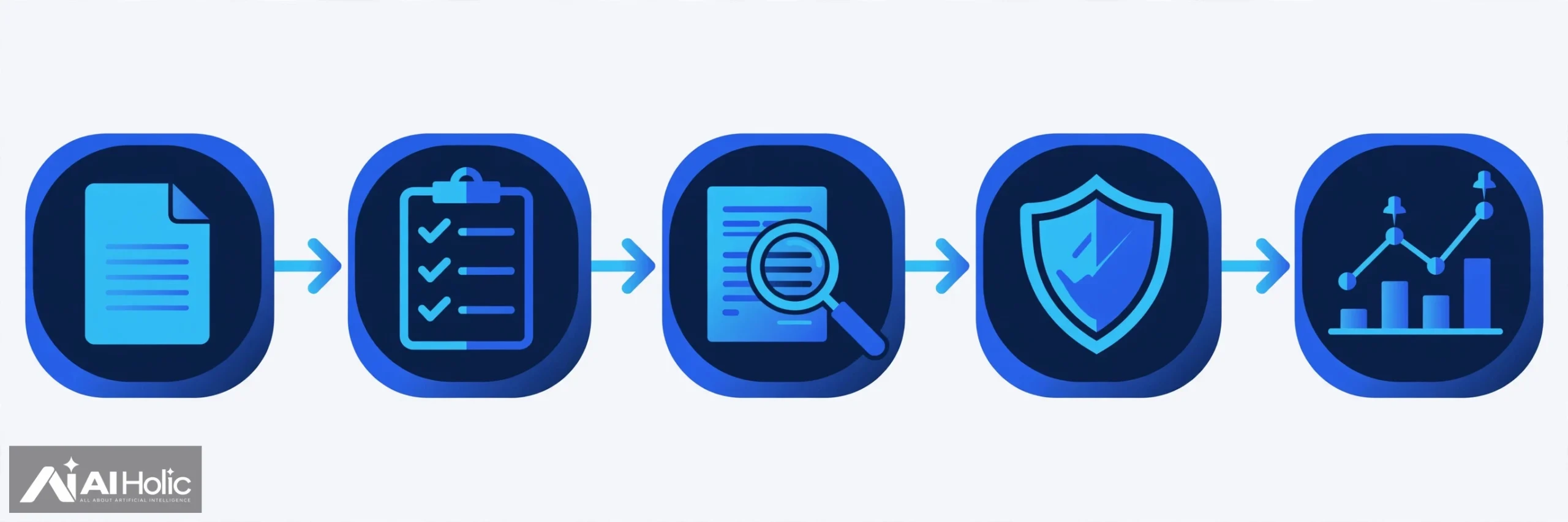
Build your pharmacovigilance ai governance framework in stages, and prove each stage before you start the next. A small team can run the first three stages with a spreadsheet and a shared folder. The plan below fits a team of any size.
Our guide to AI governance quick wins shows how to set up intake, risk tiers, and a model registry, which are the first steps of the plan below.
Stage 1: Map Your AI Uses and Set Risk Tiers
List every place AI touches drug safety work today, from email intake to signal ranking. Give each use a risk tier and a named owner. This list becomes your model registry, the single record of what runs where.
Stage 2: Form the Governance Board
Pick three to five people: a safety physician, a data scientist, a regulatory lead, and a quality lead. Write down what the board approves and how often it meets. The board’s first job is to review the map from stage 1.
Stage 3: Write the Rules and Run a Pilot
Write short rules for data quality, validation, human review, and audit logs. Then test them on one low-risk use, such as duplicate report checks or AI-suggested MedDRA coding. Fix what breaks before you widen the scope.
Stage 4: Validate and Document
Test each model on data it has never seen, and record the results. Keep the test data, the scores, and the sign-off in one file. A model with no test record is not ready, however good its demo looked.
Stage 5: Monitor, Review, and Improve
Track each model’s accuracy every month and log every change. Hold a quarterly review where the board checks the logs and retires weak models. Trust in an AI system must be shown again with each new version, not assumed from the first test.
Mistakes to Avoid
Most of these mistakes come from starting with tools before the rules exist. Each one is easy to fix once you can see it.
- Treating validation as a one-time job: a model is tested once and never checked again. Test after every update and track accuracy over time.
- Letting AI decide alone: an AI output goes straight into a report with no human check. Keep a person in the loop for every safety decision.
- Skipping the audit trail: nobody can rebuild how a case was handled. Log every AI decision and human change.
- Copying a generic framework: a general AI policy is pasted over drug safety work. Drug safety has its own rules, terms, and regulators, so the framework must fit them.
- Hiding the model from regulators: the team cannot explain how the AI works. Keep the test records and data notes ready to show.
- Starting with the hardest use: the team automates causality assessment first. Start with low-risk tasks and build trust step by step.
The same care applies in other health settings. Our guide to AI-generated doctors and patients for healthcare marketing compliance shows how strict the rules get when AI touches patient-facing content.
Frequently Asked Questions
What Is This Framework in Plain Terms?
It is the written set of rules, roles, and checks that controls how AI is used in drug safety work. It covers case intake, signal detection, coding, and reporting. It names who approves each AI use, what proof is needed, and how the work is checked over time.
Who Should Sit on a Pharmacovigilance AI Governance Board?
A safety physician, a data scientist, a regulatory specialist, and a quality lead make a solid core. Add a privacy expert when patient data is involved. The board approves each AI use before it goes live and reviews performance after launch.
Does the FDA Require a Governance Framework for AI in Drug Safety?
The FDA has not issued a rule that names a framework as a must. Its Emerging Drug Safety Technology Program and its January 2025 draft guidance both point the same way: risk-based checks, human oversight, and proof of model credibility. A written framework is the practical way to meet those expectations.
Which Pharmacovigilance Tasks Should AI Never Do Alone?
Causality assessment, final medical review, and final sign-off before a report goes to a regulator must stay human. These carry medical and legal weight that no model can own. AI can prepare the draft and gather the facts, but a named person makes the call.
How Long Does It Take to Build One?
A small team can map its AI uses, form a board, and write first rules in a few weeks. Validation and monitoring take longer, because they run for the life of each model. Start with one low-risk pilot and widen the scope as trust grows.
Conclusion
A pharmacovigilance ai governance framework turns AI in drug safety from a risk into a routine. Start with a map of your AI uses, form a small board, and test one low-risk use first. Keep people in charge of safety decisions, and keep records that prove it.