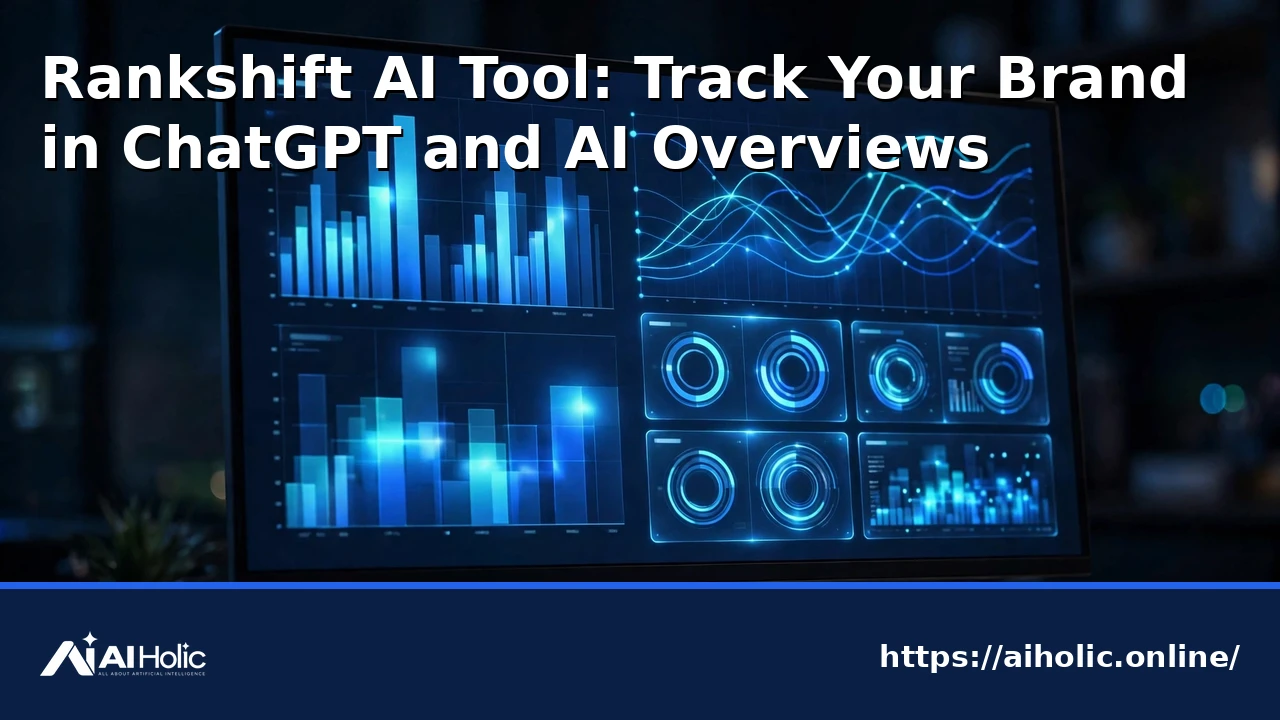
Rankshift AI Tool: Track Your Brand in ChatGPT and AI Overviews
If you don’t want to read the whole guide or have difficulty reading, you can listen to this guide instead.
If your customers now ask ChatGPT or Gemini before they search Google, you need to know what those answers say about your brand. That is the job of rankshift ai tool, a Belgian platform that tracks how your brand shows up in AI-generated answers. It runs the same questions across nine AI engines, records mentions, citations, and sentiment, and then shows you where rivals beat you.
This guide explains what it does, what it costs, and when to skip it.
At AI Holic, we read the vendor pages, an independent agency review, and an independent directory assessment before we wrote this page. We did not test the tool ourselves, and this guide says so plainly where a claim comes from the vendor alone.
Rankshift AI Tool: The Short Answer
In short, Rankshift is a tracker for AI search. You give it a list of prompts about your brand, your products, and your category, and it asks those prompts on ChatGPT, Gemini, Google AI Overviews, Google AI Mode, Claude, Copilot, Perplexity, Meta AI, and Mistral. It then records whether your brand was named, which pages were cited, how the answer described you, and how you compare with named rivals.
The tool does not write your content for you and it does not place you in answers. It measures, and then it points at the gaps. A 30-day free trial needs no credit card, so test it on real prompts before you pay.
Paid plans start at about 69 euros a month when billed annually, so check the current pricing page first.
What Rankshift AI Tool Is
Rankshift is an AI visibility platform built by a Belgian team for SEO and content teams, in-house marketing teams, agencies, and enterprise teams. It belongs to a field called generative engine optimization, the practice of improving how a brand appears in answers from generative AI systems. The term comes from a 2023 research paper that was later presented at the KDD 2024 conference.
A related term you will also see is answer engine optimization, which covers the same idea of shaping content so answer engines can find it and cite it.
The core idea is simple. Classic SEO tracks where your pages rank in a list of links. AI search has no list of links.
The answer itself is the result, so the new questions are whether your brand was named, whether your page was cited as a source, and whether the answer recommended you or a rival. Rankshift tracks those questions across nine engines, on every plan, with no engine held back for a higher tier.
That last point matters because rivals often gate engines by plan. With Rankshift, the Starter plan sees the same nine engines as the Business plan. What changes between plans is how many prompts you can run each day, how many credits you get, and which integrations are switched on.
The vendor says it captures AI answers straight from the user interface of each engine, not from API outputs, so the data should match what a real user sees.
| AI engine | What Rankshift watches | On every plan? |
|---|---|---|
| ChatGPT | Brand mentions, citations, ChatGPT ads | Yes |
| Google AI Overviews | Citations and brand mentions in overviews | Yes |
| Google AI Mode | Mentions, citations, sentiment | Yes |
| Gemini | Brand mentions and citations | Yes |
| Claude | Brand mentions and citations | Yes |
| Copilot | Brand mentions and citations | Yes |
| Perplexity | Citations and source share | Yes |
| Meta AI | Brand mentions and citations | Yes |
| Mistral | Brand mentions and citations | Yes |
One more thing to note: the vendor writes most of the comparison guides that rank for this tool, and its co-founder says so in those posts. Treat those pages as the vendor’s own pitch, not as neutral reviews. The independent sources we found agree on the feature list, but they are few.
G2 shows only one review for Rankshift, so lean on the free trial, not on other people’s ratings.
What It Tracks: Mentions, Citations, and Share of Voice
Rankshift works from prompts you define. You build a set of branded, category, comparison, and problem-aware prompts, then organize them with tags, personas, and scenarios. The tool runs them on a daily or weekly schedule and stores the answers, so you can watch a trend over time instead of taking one snapshot.
A mention means the answer named your brand. A citation means the answer linked to one of your pages, or to a page about you, as a source. The two are different, and Rankshift tracks both.
A brand can be mentioned often yet cited rarely, which usually means the models know the name but do not trust its pages as sources. That gap is the most useful signal in the whole dashboard.
Share of voice compares your visibility with named rivals across the same prompt set. If a rival wins the citation slot on half of your category prompts, you can see exactly which prompts those are and which pages the models cited instead of yours. Sentiment adds a second layer: it shows how the models describe your brand, so you can spot a case where you are visible but linked to an attribute you do not want.
Keep the prompt set stable across reporting periods, or the trend lines mean nothing. If you change half the prompts each month, you cannot tell what caused a move. Pick the set once, run it for a full month, and only then change it.
The same care applies to AI-written content itself: our guide to the AI detection tool explains how to check machine-written text before it reaches your site, which matters when a brief generator drafts content for you.
Crawler Analytics and Citation Sources
The Sources view lists the domains and URLs that AI answers cite most in your category. That list is where any real plan starts. If a review site, a publication, or a community forum keeps showing up as a cited source while your own pages do not, you have a concrete place to study.
Do not read a frequent citation as a promise, though. A cited domain is a research lead, not a guaranteed placement.
Crawler Analytics, which starts on the Professional plan, shows when AI bots visit your site. It covers bots such as GPTBot, ClaudeBot, Googlebot, and PerplexityBot, and it reports which pages they visited and which errors they hit. A crawl is not a citation, and it is not a visit from a user.
Treat it as technical evidence that supports a visibility finding, not as proof that the models will cite you.
The Action Center and the Content Engine
Most trackers stop at the numbers. Rankshift adds an Action Center that gathers every recommended action in one place, ordered by expected impact on your AI visibility. The idea is that a number nobody acts on is worth nothing, so the rankshift ai tool turns each gap into a task.
You still have to do the work, and the rankshift ai tool does not publish anything for you.
The Content Engine has two parts: a content brief generator and an AI writer. The brief generator reads the actual AI answers for a query, plus the sources they cite and the concepts that keep coming up, and turns that into a brief for what to write. The writer then drafts from that brief.
An independent hands-on review called the Content Engine useful for starting briefs but still in beta, and said it needs substantial editing before it is production-ready. Use it to speed up research, then edit every draft by hand before it goes live.
For data access, Rankshift offers an MCP server and a REST API, plus connectors for Looker Studio, BigQuery, and Power BI. All of those start on the Professional plan, not Starter. One independent assessment reports that the API is read-only, so it will not write changes back into other systems for you.
Check the current plan comparison before you promise a client an agent-led reporting workflow.
How It Compares With Other AI Visibility Tools
Rankshift is not the only tracker in this field, and the choice turns on what you need beyond the chart. Profound leans toward enterprise teams and puts some surfaces, such as AI Mode tracking, behind higher tiers. Peec AI caps projects and limits self-serve plans to three of its six models.
Otterly.AI is a simpler and cheaper monitor for a basic baseline, without the crawler data or the action layer.
| Tool | Best fit | Entry price (annual billing) | What sets it apart |
|---|---|---|---|
| Rankshift | Teams and agencies that want all engines plus an action layer | About 69 euros a month | Nine engines on every plan, unlimited seats and projects, Action Center |
| Profound | Enterprise teams with structured workflows | Higher, enterprise pricing | AI search analytics with structured optimization workflows |
| Peec AI | Smaller teams that want a focused workflow | About 85 euros a month | Lower entry price, capped projects and models on self-serve tiers |
| Otterly.AI | Teams that need a simple, low-cost baseline | Lower than Rankshift | Simple recurring prompt monitoring |
Rankshift also differs from a classic SEO suite. It does not track Google keyword rankings, run backlink analysis, or audit your site. If search rankings are still your main service, you will run a dedicated SEO platform next to it. If you want to weigh Rankshift against the full field of AI Mode trackers first, our guide to the rank tracking tool ai mode compares ten tools side by side, with prices, trials, and who each one suits.
Our best AI guide gives a wider view of the tools that cover the other sides of the job.
Costs and Plans
Pricing is where you need to read carefully, because the same plan shows different figures in euros and dollars, and monthly billing costs more than annual billing. The figures below come from the vendor pricing page as checked on 21 September 2026, plus an independent review that recorded the dollar equivalents. Confirm the current figures at checkout, since the vendor reprices often.
The rankshift ai tool plans below are the three self-serve tiers, plus a custom Enterprise plan.
| Plan | Price (billed annually) | Prompts per day | Credits per month | Key extras |
|---|---|---|---|---|
| Starter | 69 euros a month (about $82) | 150 | 9,500 | All nine engines, brief generator, AI writer, unlimited seats and projects |
| Professional | 159 euros a month (about $189) | 350 | 22,000 | Adds crawler analytics, Looker Studio, MCP, API, BI connectors |
| Business | 359 euros a month (about $425) | 850 | 53,000 | Higher capacity and deeper reporting |
| Enterprise | Custom | Custom | Custom | SSO, SLA, dedicated account manager, custom tracking |
Monthly billing costs about 10 percent more than annual billing. Starter is about 77 euros a month on monthly billing, Professional about 177 euros, and Business about 399 euros. The 30-day free trial needs no credit card, and there is no permanent free tier.
Credits are the part most buyers get wrong. A credit is spent when you track one prompt in one model in one locale, so one prompt across nine engines at daily frequency costs far more than one prompt on one engine. The vendor credit calculator charges 2 credits per run on most engines and 5 credits per run on Claude and Copilot.
Model your real prompt set in that calculator before you pick a tier, or a Starter allowance can drain fast. Our guide to the AI search performance tool covers a related way to judge search tools by what they actually measure.
Who Should Use It and Who Should Skip It
Rankshift fits an agency that reports AI visibility across many clients, since unlimited seats and projects make multi-client work easy to budget. It fits an SEO team that wants crawler evidence next to answer data, and a technical team that wants to feed visibility data into Looker Studio or an agent through MCP or the API. The rankshift ai tool buyer should test the Professional plan, not Starter, since Starter hides the integrations that make the workflow work.
It fits less well in three cases. First, a small team that only needs a few prompts and a permanent free tier should pick a cheaper monitor. Second, a team that still needs classic SEO delivery, such as rank tracking and site audits, should keep a dedicated SEO suite and add a tracker only for the AI side.
Third, a team that wants a tool to publish content for it will be let down, since Rankshift measures and drafts but never publishes.

Limits to Know Before You Pay
The credit model is the first limit. Credits depend on which models you run and how often, so two teams on the same plan can burn through their allowance at very different speeds. Run the vendor credit simulator with your real prompt list before you pay, and re-check it when you add engines or switch a prompt from weekly to daily.
The second limit is the Starter gate. Crawler analytics, Looker Studio, MCP, and the API all need Professional, so the entry plan is a monitor only. If your workflow needs any of those, the practical starting price is the Professional tier, not the Starter price on the pricing page.
That is the main warning in the independent agency review we read.
The third limit is what the scores mean. A visibility or sentiment score depends on the prompts you chose, so it is not a universal market ranking. Your score can rise because you picked easier prompts, not because the market changed.
Keep the prompt set fixed, save the raw answers, and judge progress from the same sample over time. No tool in this field can promise you a citation, a recommendation, or traffic.
How to Test It in the 30-Day Trial
- Write 20 to 30 prompts that mirror what your buyers actually ask.
- Run them daily for two weeks and save the raw answers.
- Check which sources the answers cite and whether your pages appear.
- Test the credit burn on your real prompt and engine mix.
- Decide on Professional or Starter only after that test.
Frequently Asked Questions
What Is Rankshift AI Tool?
It is an AI visibility platform that tracks how your brand appears in answers from ChatGPT, Gemini, Google AI Overviews, Google AI Mode, Claude, Copilot, Perplexity, Meta AI, and Mistral. It records mentions, citations, sentiment, and share of voice across a prompt set you define, then turns the gaps into a prioritized action list.
Is There a Free Version?
There is no permanent free tier. You can start a 30-day free trial without a credit card, which is the longest trial in this field. Use the trial to test your real prompts and credit use before you pay.
How Much Does It Cost?
Starter costs about 69 euros a month when billed annually, or about 77 euros on monthly billing. Professional is about 159 euros a month billed annually, and Business is about 359 euros. Dollar equivalents run about $82, $189, and $425 a month.
Enterprise is custom priced.
Does It Track Google Rankings?
No. It tracks visibility inside AI-generated answers, not classic keyword rankings. If you need rank tracking, backlink data, or site audits, you will still need a dedicated SEO platform next to it.
Can It Get My Brand Cited in AI Answers?
No tool can promise a citation. Rankshift shows which sources the models cite in your category and where your pages are missing, so you can fix the gaps with better content and stronger sources. The result is a research lead, not a guarantee.
Conclusion
Rankshift AI Tool gives teams a clear way to watch their brand across nine AI engines, with each gap turned into a task. Start with the 30-day trial, test your real prompts, and check the credit math before you pay.