Who Owns AI? The Short Answer, the Big Companies, and the .ai Domain
If you don’t want to read the whole guide or have difficulty reading, you can listen to this guide instead.
No single person or company owns AI. The short answer to who owns ai is that no one does, because AI is not one thing with one owner. It is a stack of chips, research, trained models, data, and apps, and different owners hold each layer.
At AI Holic, we read the guides that rank for this question and the public records behind the .ai domain. The guides agree on the short answer but disagree on the numbers behind the big companies, so this guide prints structures, not disputed stakes.
You will learn who owns each layer of AI, who owns the biggest AI companies, who owns the .ai domain, and who owns what AI makes. The last part matters most if you use AI at work, because the law there is still being written.
Who Owns AI? The Short Answer
The honest answer to who owns ai is that nobody owns the field itself. AI is a set of ideas, tools, and systems built by many companies, labs, and universities. What companies own are specific pieces: a trained model, a chip design, a data centre, or a product built on top of a model.
That split is why the question has three different answers. Ask who owns the technology and you get one answer.
Ask who owns the companies and you get another. Ask who owns the .ai domain and you get a third, because that question is about a web address, not about AI at all.
| Question | Short answer |
|---|---|
| Who owns AI as a field? | Nobody. The ideas are public and the pieces have separate owners. |
| Who owns the top AI models? | The labs that trained them: OpenAI, Google DeepMind, Anthropic, Meta, and xAI. |
| Who owns the .ai domain? | The Government of Anguilla, with Identity Digital running the registry. |
| Who owns what AI makes? | Often nobody, unless a human shaped the result. |
The Five Layers of AI Ownership
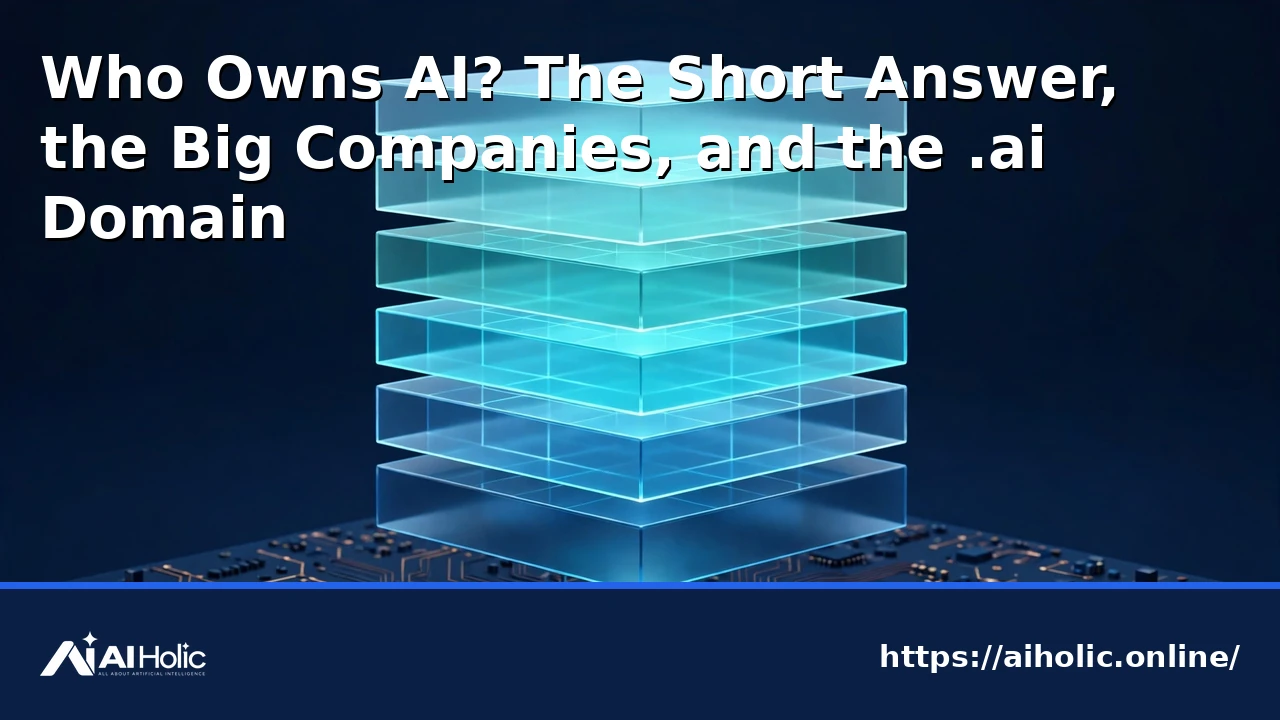
Think of AI as five layers stacked on top of each other. Each layer has its own owners, and the answer to who owns ai changes with the layer you mean. Start at the bottom and the picture gets clear fast.
1. Chips and Compute
Nothing in modern AI happens without massive computing power. Nvidia designs the graphics processors that train and run most large AI models, while TSMC manufactures most of those chips. The cloud providers own the data centres where that compute lives: Microsoft Azure, Amazon Web Services, and Google Cloud.
This layer is the tightest bottleneck in the whole stack. Talent and ideas are spread wide, but access to enough chips and enough power to run them is held by few hands. If you want to know who can build a frontier model at all, start here.
2. Research and Ideas
The core ideas behind modern AI are not owned by anyone. The transformer design that powers ChatGPT, Gemini, Claude, and nearly every other major model was published openly by Google researchers in 2017. Anyone can read the paper and build on the idea.
That openness is why rival labs could build competing models so fast. The idea was free.
What cost money was everything needed to turn the idea into a working product. Our guide to the different types of AI explains what those ideas became in practice.
3. Trained Models
This is where real ownership starts, and it is the layer most people mean when they ask who owns ai. A trained model is a huge file of numbers, called weights, made by feeding an architecture enormous amounts of data and compute over weeks or months. The company that paid for that training owns the weights and decides who can use them.
OpenAI owns the weights of its GPT models and licenses access to Microsoft, its largest investor and infrastructure partner. Google DeepMind owns Gemini and controls it end to end, since Google also owns the infrastructure it runs on. Anthropic owns Claude and trains it with Amazon and Google as major investors and cloud partners.
Meta takes a different path with the Llama family. It releases the weights publicly under its own licence, so anyone can download and run the model.
That licence still restricts some commercial uses, so it is not open source in the usual sense. The weights are shared, but the terms stay in Meta’s hands.
4. Training Data
Training data is where ownership gets most contested. Models are trained on huge sets of books, articles, images, code, and forum posts scraped from the public internet. Almost none of that material was made by the companies doing the training.
The New York Times is suing OpenAI and Microsoft over this exact issue, and Getty Images sued Stability AI. The legal question is whether training a model on copyrighted material counts as fair use or as infringement. Courts in the United States and elsewhere are still working through it, and the answer may differ by country and by type of content.
What is already clear is that the people who made the training data rarely own any part of the model it helped build. A novelist whose books helped train a model owns no share of that model. That gap is the biggest ownership dispute in AI today, bigger than who sits on any company’s board.
5. Applications
The top layer is the one most people touch: the chat window, the app, the coding tool. Thousands of companies build products on models they do not own at all. A support startup may use Claude, a coding tool may use GPT, and a design app may use an image model from another lab.
None of those companies owns the intelligence inside the product, but each owns the product experience wrapped around it. This is also the most open layer, and it is where the question of who owns ai matters least.
You do not need to train a model to build a useful AI business. You need a good idea, a smart integration, and an API key.

Who Owns the Big AI Companies?
Step back from the layers and the question gets simpler: who owns the companies themselves? The pattern is plain. The biggest labs are either owned by a tech giant, controlled by a founder, or backed by the same few giants that sell them compute.
| Company | Main model | Who owns it |
|---|---|---|
| OpenAI | ChatGPT (GPT) | Nonprofit parent controls the for-profit arm, with Microsoft as a large minority investor |
| Google DeepMind | Gemini | Wholly owned by Alphabet |
| Anthropic | Claude | Independent public benefit company; Amazon and Google are major investors |
| Meta AI | Llama | A division of Meta, owned by Meta shareholders |
| xAI | Grok | Privately owned by Elon Musk, merged with X in 2025 |
No single company owns AI, but the frontier is still narrow. Only a handful of groups have the capital to train the largest models, and most of them buy compute from the same giants that invest in them. That is concentration of capital, not a monopoly on the idea.
One caution before you quote any ownership stake you see online. Published percentages for private companies conflict with each other, sometimes by a wide margin.
This guide states the structure and names the owners, because those facts hold up. A stake that changes with every funding round does not.
Ownership and funding shape what a young AI vendor can promise: our getmint.ai company overview covers GetMint, a Paris GEO startup that raised a 4 million euro pre-seed round in December 2025.
Who Owns the .ai Domain?
A second question hides inside who owns ai, and it is about a web address. The .ai domain is the country-code domain for Anguilla, a British Overseas Territory in the Caribbean. It was delegated to Anguilla on 16 February 1995, long before the AI boom gave those two letters their commercial meaning.
The Government of Anguilla administers the domain, and Identity Digital has managed the registry since January 2025. Anyone in any country can register a .ai name, with no local presence needed, and the minimum term is two years. That open rule is what let a small island’s domain become the default ending for AI startups.
The domain has become a real source of income for Anguilla. In 2023 the government made about US$32 million from .ai registration fees, which was over 10 percent of the territory’s gross domestic product. Registered .ai domains passed 1.27 million by June 2026.
Searchers also type who owns .ai, and the answer is the same: Anguilla holds the domain and Identity Digital runs the registry. You may also see the search typed as who own .ai, and the answer stays the same. Buying a .ai name buys you a registration, not a share of the registry.
Who Owns What AI Makes?
The third version of the question is the one most people actually need answered: if AI writes it, draws it, or codes it, who owns the result? In the United States, the short answer is that a work made with no human creative input has no copyright for anyone to own. The rules on AI and copyright turn on how much human choice shaped the final result.
The U.S. Copyright Office has held for years that an author must be human. Its guidance from January 2025 says AI-assisted work can be copyrighted where the human’s creative expression still shows in the result, such as choosing outputs, arranging them, or making expressive changes. Where a machine decides the expressive elements, the work stays uncopyrightable.
The courts have backed that line. In Thaler v. Perlmutter, the D.C. Circuit held that the Copyright Act needs a human author, in a case where the applicant had listed his own AI system as the sole creator of an image. The Supreme Court declined to hear the appeal in March 2026, which leaves that ruling in place.
Other countries answer differently, so check the law where you live. In the United Kingdom, the law treats the author of a computer-made work as the person who made the arrangements needed to create it. That is a broader rule than the American one, and it can give ownership where U.S. law gives none.
At work, the question gets one more layer: your contract. If you made AI-assisted work as part of your job, your employer usually owns whatever copyright exists in the parts you shaped. Our guide to AI tools employee work product ownership copyright walks through work for hire, contractor rules, and the trade secret fallback for work copyright cannot cover.
For writers, the same rule applies in plain terms. A draft you shaped, edited, and rewrote is yours in the parts you shaped. A raw paste from a chatbot is not.
Our guide to AI for writing shows how to use the tools without handing away the parts that make the work yours.

Who Owns AI Inside a Company?
Inside a company, the answer is shared, not single. Marketing, IT, security, procurement, and finance each own part of the AI picture, and no one team sees the whole thing. That is why the question of who owns ai comes up so often in offices: everyone touches it and nobody owns it outright.
A survey by Acquia of 1,075 marketing, technology, and developer leaders found the split plainly. Asked who should lead their next platform decision, 25 percent of chief marketing officers named themselves, 24 percent named the chief information officer or chief technology officer, and 18 percent named the head of digital. No role holds a majority.
The governance side shows the same split. A 2026 Flexera report cited by APMdigest found that 84 percent of organisations call tracking and adopting new AI applications their top combined challenge, while only 31 percent say they have accurate visibility into their AI software. The fix is shared ownership with clear lines: one owner per tool, one register of what is used, and one set of rules for data.
If you run a team, assign ownership by name, not by department. One person owns the tool list, one person owns the data rules, and one person owns the cost. Shared ownership without named owners is how AI spending and risk go unseen.
Three Mistakes People Make About AI Ownership
- “The government owns AI.” Governments regulate AI, fund some research, and invest in sovereign infrastructure, but the leading models are privately owned.
- “Open means owned by everyone.” Open-weight models let you download and run them, but the licence still sets the terms, and the lab keeps rights over branding and some commercial use.
- “Paying for a chatbot means owning the AI.” A subscription buys access, not ownership. You own neither the model, the weights, nor the infrastructure behind it.
Frequently Asked Questions
Who Owns AI in Simple Terms?
Nobody owns AI as a field. Companies own specific pieces: OpenAI owns its GPT weights, Google DeepMind owns Gemini, Anthropic owns Claude, and Nvidia designs most of the chips.
The ideas behind the models are public research, and the .ai domain belongs to Anguilla. Ask which piece you mean and the owner becomes clear.
Who Owns .ai?
The Government of Anguilla administers the .ai domain, which was delegated to the territory in 1995. Identity Digital has managed the registry since January 2025. Anyone can register a .ai name with no local presence needed, and the minimum term is two years.
Does Microsoft Own OpenAI?
No. OpenAI’s nonprofit parent controls the for-profit arm, and Microsoft is a large minority investor and infrastructure partner. Published percentages for that stake conflict across sources, so treat any exact figure with care.
Who Owns the Output of ChatGPT?
It depends on how much human choice shaped the result. In the United States, a work with no human creative input has no copyright, while work where a human chose, arranged, or rewrote the result can carry a copyright in the parts the human shaped. Check the tool’s terms too, since they set the use rights.
Can I Own an AI Model Myself?
You can own a model you train, a fine-tuned version you build, or a product wrapped around someone else’s model. Training a frontier model from scratch needs compute and data that few can afford, but fine-tuning an open-weight model or building an app on an API is within reach for a small team.
Conclusion
who owns ai has no single answer, because AI is not one thing. The models, the chips, the data, and the .ai domain each have their own owners, and what AI makes is often owned by no one. Ask which piece you mean, check the terms, and you will get a straight answer.