AI Tools Employee Work Product Ownership Copyright: Who Owns What You Make at Work
If you don’t want to read the whole guide or have difficulty reading, you can listen to this guide instead.
You write a report with an AI tool on your work laptop, and your boss asks who owns it. The short answer is that ai tools employee work product ownership copyright is not settled by one rule, and the answer changes with how much of the work you shaped yourself. This guide gives you the plain answer for employees and employers.
At AI Holic, we read the leading legal guides on this question. This guide turns that reading into plain steps you can use at work. You will see what copyright protects, what work for hire covers, and what your contract says.
You will also learn what to do when nobody owns the output, and what to check before you use AI on a work task. This guide is general information, not legal advice. For a live dispute or a contract worth real money, talk to a lawyer.
AI Tools Employee Work Product Ownership Copyright: The Short Answer
When an employee makes work with AI tools, the employer usually owns whatever copyright exists in that work. That is how work for hire works for normal employee output. But AI changes what there is to own, because copyright in the United States only protects work made by a human author.
So the real question has two parts. First, does a copyright exist in the work at all? Second, if it does, who holds it?
The first part turns on how much creative choice you put into the result. The second part turns on your job, your contract, and whether you are an employee or a contractor.
Work that an AI tool produced on its own, with no real human shaping, has no copyright for anyone to own. Work where you chose, arranged, edited, and rewrote the output can carry a copyright in the parts you shaped. Your employer then owns that copyright when you made the work as part of your job.
If you remember one line from this guide, make it this one. In ai tools employee work product ownership copyright, only the human-shaped parts can carry a copyright, and work for hire moves those parts to the employer. Everything else in this guide follows from that line.
| Your situation | Does a copyright exist? | Who owns it? |
|---|---|---|
| Employee, AI-assisted work in your job | Yes, in the parts you shaped | Your employer, through work for hire |
| Employee, raw AI output with no real edits | Usually no | Nobody, in a copyright sense |
| Contractor, AI-assisted work | Yes, in the parts you shaped | You, unless your contract assigns it |
| Side project, your own time and tools | Yes, in the parts you shaped | You, unless your contract claims it |
| Anyone, fully AI-made output | No | Nobody owns the copyright |
Why Copyright Needs a Human Author
United States copyright law protects original works of authorship, and the U.S. Copyright Office has held for years that an author must be human. A work made entirely by a machine, with no human creative input, cannot be registered. The Office keeps its current guidance on AI and copyright at copyright.gov/ai, and it is the best place to check the official position.
The courts have backed that position. In Thaler v. Perlmutter, the D.C. Circuit held that the Copyright Act requires a human author, in a case where the applicant had listed his own AI system as the sole creator of an image.
The Supreme Court declined to hear the appeal in March 2026, which leaves the D.C. Circuit ruling in place. That ruling does not settle every AI-assisted case, but it settles the pure machine-made case.
The Copyright Office drew the practical line in its Part 2 Copyrightability Report, published in January 2025. Prompts alone are not enough, because a prompt states an idea but does not control how the idea is expressed. What can count is human creative work that shows in the final result, such as choosing which outputs to keep, arranging them, or making expressive changes to them.
The graphic novel Zarya of the Dawn shows how that line works in practice. The Copyright Office registered the copyright in the human-written text and in the selection and arrangement of the work, but it denied registration for the images the AI tool had made.
The human parts were protected, and the machine parts were not. The same split applies to work you make with AI tools at your job.
| How the work was made | Copyright status |
|---|---|
| AI tool made it alone, you accepted it as-is | Not copyrightable |
| You wrote a prompt and pasted the raw output | Not copyrightable, prompts alone are not enough |
| You picked, arranged, edited, and rewrote the output | Copyrightable in the parts you shaped |
| You wrote the draft and used AI only to fix grammar | Copyrightable, the AI acted as a tool |
That split matters for ai tools employee work product ownership copyright because it decides what your employer can actually claim. A work-for-hire clause can only move a copyright that exists. If the AI-made parts carry no copyright, the clause has nothing to move, and a competitor could copy those parts without infringing.
Work for Hire: What It Covers and Where It Stops
Work for hire is the rule that moves ownership from the person who made a work to the employer. Under 17 U.S.C. Section 101, a work made for hire is either a work prepared by an employee within the scope of employment, or a work specially ordered or commissioned that falls into one of nine listed categories, with a signed written agreement that says it is a work made for hire. You can read the full definition on Wikipedia’s work made for hire page.
For employees, the first track is the one that matters. If you made the work as part of your job, your employer is treated as the legal author and owns the copyright.
That holds whether you typed the draft by hand or used an AI tool to make it. Using AI at work does not change who owns the result, it only changes whether a copyright exists at all.
The second track covers commissioned work, and it is narrow. The work must fit one of the nine categories, which include contributions to collective works, translations, compilations, instructional texts, and tests, and both sides must sign a written instrument that calls it a work made for hire. Most AI-assisted work a company commissions will not fit those categories, so this track rarely helps with AI output.
The employee track is also less automatic than it looks. In Community for Creative Non-Violence v. Reid, decided by the Supreme Court in 1989, the Court held that “employee” under the Copyright Act is judged by common-law agency principles, not by the title in a contract.
The test looks at factors such as skill, source of tools, location of work, length of the relationship, and tax treatment. A highly skilled specialist working on a project basis may count as a contractor even if they work only for your company.
That gap is where ai tools employee work product ownership copyright gets tricky for employers. If the person who made the work is really a contractor, and the work does not fit the nine categories, the work-for-hire label in the contract does not make it so. The company then needs a separate assignment clause, and even that clause can only assign a copyright that exists.
Employees and Contractors Are Not Treated the Same
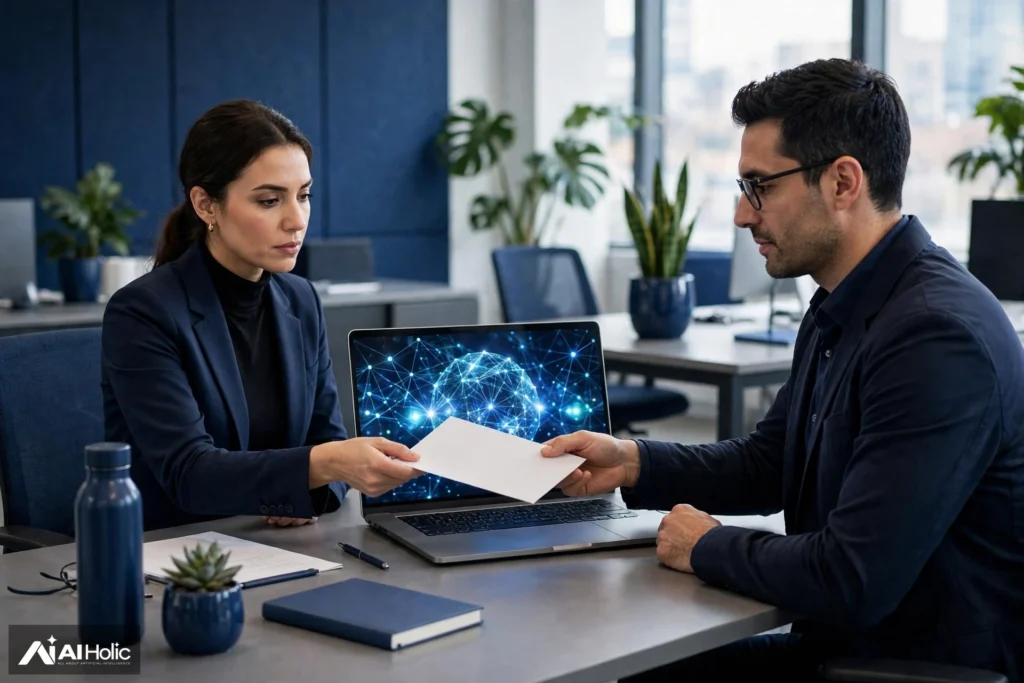
Employees and contractors sit on different sides of the ownership line. An employee who makes copyrightable work in the scope of the job gives the copyright to the employer by law, with no extra paperwork needed. A contractor keeps the copyright in what they make unless a contract assigns it to the client.
For contractors, the assignment clause is the document that matters. A good clause covers the inputs, the prompts, and the deliverables separately, and it assigns all three to the company. It should also require the contractor to say in writing when AI tools were used, and to confirm that no confidential company data went into a public AI tool.
Side projects are the gray area where most disputes start. If you build something on your own time, on your own machine, with tools you pay for yourself, you usually own it.
But a broad IP assignment clause in your employment contract can reach further than you expect. Some clauses claim anything made with company-licensed tools, or anything made during the term of employment, even on evenings and weekends.
That difference is why ai tools employee work product ownership copyright is a contract question as much as a copyright question. Employees give up ownership by law, while contractors keep it until a signed clause moves it. Check which side of that line you sit on before you sign anything.
Read the IP clause in your own contract before you start a side project. Look for the phrases “work product,” “IP assignment,” and “company-licensed tools.” If the clause is broad, you have three real options: ask for a written carve-out before you start, keep the side project on fully personal tools and time, or accept that your employer may claim it. Guessing is the worst option.
What the AI Tool Terms Actually Give You
Most AI tool terms look generous on ownership until you read the fine print. Both OpenAI and Anthropic assign outputs to the customer, but each assignment carries the qualifier “if any.” That qualifier does the real work. A contract can only assign rights the vendor actually holds, and if the output carries no copyright, there is nothing to assign.
Microsoft takes a more open line with Copilot. It does not claim ownership of Copilot outputs, but it also declines to decide whether your output is copyright-protected.
Its documentation flags a problem the other vendors gloss over: because AI tools can give the same or a very similar answer to similar prompts, more than one customer may hold or claim rights in the same content. No assignment clause in a terms of service changes that.
Vendor indemnity programs do not fix the ownership question either. Microsoft’s Copilot Copyright Commitment, for example, covers the case where a third party sues your company for infringing someone else’s copyright by using Copilot output.
That is a shield against incoming claims. It does nothing to help your company stop a competitor from copying your AI-assisted deliverable.
The lesson for ai tools employee work product ownership copyright is simple: do not treat a vendor’s assignment clause as proof that you own a copyright. The clause gives you permission to use the output, and it may give you whatever rights the vendor holds. It cannot create a copyright that the law does not recognize.
That vendor clause is only one piece of a bigger question. Our guide to who owns ai separates the three questions people mix together: who owns the models and the chips, who owns the big AI companies, and who owns the .ai domain, so you can see where your work-product question fits.
When Nobody Owns It: The Trade Secret Fallback
When copyright is out of reach, trade secret law is the fallback that actually works for AI-made work. The Defend Trade Secrets Act has no human-creation requirement. An AI-made analysis, dataset, process, or set of prompts can qualify as a trade secret if it has economic value because it is secret, and if the owner takes reasonable steps to keep it secret.
That second condition is where companies fail. A trade secret claim needs real, documented steps: access controls, confidentiality agreements, and rules about what data may go into which AI tool. A company that drops AI-made work into a shared drive with no access limits, and never mentions it in its NDAs, has likely given up the claim before it starts.
Putting confidential data into a public AI tool is the fastest way to break secrecy. Some tools train on user inputs, and an input that leaves the company may no longer be secret.
Your AI policy should name the approved tools, require enterprise agreements with no-training clauses, and treat use of an unapproved public tool for company data as a policy breach. Our guide to AI agents for cybersecurity compliance auditing explains the controls worth asking about, from access limits to audit logs.
For ai tools employee work product ownership copyright, trade secret law fills the gap that copyright leaves open. It protects AI-made work that copyright cannot reach, as long as you keep it secret and can show the steps you took. That makes how you handle the work as important as who made it.
Trade secret protection also covers the prompts themselves. A well-built prompt set that drives your reports, code, or client work has value precisely because competitors do not have it. Keep it inside company systems, limit who can see it, and cover it in your employment and contractor agreements.
What Employees Should Do Before They Use AI at Work
Most ownership problems start with habits, not with bad intent. A few simple steps before you use AI on a work task will protect both you and your employer. Treat this list as your default routine, not as a one-time fix.
- Use only the AI tools your employer has approved, and never paste confidential data into a public tool
- Shape the output yourself: edit, rearrange, add your own analysis, and keep a record of what you changed
- Save your prompts and version history, so you can show the human choices behind the final work
- Note AI use when you hand work in, with one line saying which tool you used and what you changed
- Keep side projects on your own time, your own machine, and tools you pay for yourself
- Read your IP assignment clause once a year, and ask for a written carve-out before a big side project
Your own notes are the evidence that turns AI output into your work. Commit messages that say what you changed and why, drafts that show your edits, and prompt logs that show your direction all help. A record that only says “AI wrote this” helps no one.
What Employers Should Fix in Contracts and Policy
Employers cannot fix AI ownership with one clause. The fix is a short set of changes across contracts, policy, and tools. Our guide to unified AI governance architecture shows how these pieces fit into one framework, and our guide to AI governance quick wins gives a practical starting point for policy intake, risk tiers, and a tool registry.
- Define AI-generated and AI-assisted work in plain words, so staff can sort their output the same way every time
- Require a short AI-use note at delivery: which tool was used, and what the human changed
- Update contractor agreements to require AI disclosure and assignment of outputs, prompts, and inputs
- Keep an approved tool list with enterprise terms, no-training clauses, and data processing agreements
- Add trade secret handling for AI output: access limits, classification, and NDAs that name AI work
- Set registration practice: disclose AI content in filings and claim only the human-authored parts
Start with the approved tool list and the delivery note, since those two changes close the biggest gaps fastest. A registry of which tools are approved, and for what data, stops most accidental disclosures before they happen. The rest of the policy can follow in the next review cycle.
Frequently Asked Questions
Who Owns Work I Make With AI at My Job?
Your employer owns the copyright in the parts you shaped, when you made the work as part of your job. That is the core of ai tools employee work product ownership copyright and the work-for-hire rule.
But the parts the AI tool made on its own carry no copyright, so nobody owns those parts in a copyright sense. Your employer can still protect the work as a trade secret if it is kept confidential.
Can My Employer Copyright AI Output I Made?
Only the human-shaped parts. The Copyright Office requires applicants to disclose AI-generated content and claim only the human-authored portions, under guidance published in March 2023. A filing that claims the raw AI output as human work is not defensible, and it can put the whole registration at risk.
Do I Own AI Work I Make on My Own Time?
Usually yes, if you used your own time, your own machine, and tools you paid for yourself. The risk is a broad IP assignment clause in your employment contract that claims work made with company-licensed tools or during the term of employment. Read that clause, and get a written carve-out before you start a project you care about.
What If My Contract Says Nothing About AI?
Then the default rules apply: your employer owns the copyright in employee work made in the scope of the job, and contractors keep what they make unless they assign it. But silence on AI leaves the key questions open, such as who owns the prompts and whether raw AI output is covered. Ask for a written AI clause at the next contract review.
Can a Competitor Copy My AI-Made Work?
They can copy the parts that carry no copyright, which is the raw AI output you accepted without shaping. They cannot copy the parts you shaped, since those carry your copyright or your employer’s. That is why editing, arranging, and adding your own analysis matters: it is what turns unowned output into protected work.
Conclusion
For ai tools employee work product ownership copyright, the rule is simple: copyright protects the human-shaped parts, work for hire gives those parts to the employer, and trade secret law protects the rest when it stays secret. Shape your AI output, record your choices, and check your contract.