AI Agents Ecommerce Automation Latest: What Actually Works in Stores Now
If you don’t want to read the whole guide or have difficulty reading, you can listen to this guide instead.
If you run an online store, you have heard the pitch: AI agents that answer shoppers, fix orders, and run ads while you sleep. The short version is that ai agents ecommerce automation latest means software that reads your store, ads, and email together, then takes real steps across them.
It is no longer a chatbot that only talks. The newest tools act, and the question now is which jobs to hand over first.
At AI Holic, we read the top guides on this topic and compared what they agree on. This guide covers the three layers of store AI, the nine jobs that automate well now, and a five-step rollout that starts small. We did not test these tools ourselves, so check the vendor page before you buy.
AI Agents Ecommerce Automation Latest: The Short Answer
AI agents ecommerce automation latest is the shift from chatbots that only talk to software that acts across your whole store. An agent can look up an order, issue a refund, change an ad budget, and log what it did, all in one loop.
The change matters because the work is no longer one reply at a time. It is a chain of steps that runs across your tools.
E-commerce covers the buying and selling of goods and services on online platforms, and agents now work across the whole operation. Most of the AI in a store today still sits inside one platform.
Shopify Sidekick works on your store data. Meta Advantage+ works on your ads. Klaviyo AI works on your email.
Each one is strong inside its own walls and blind outside them. The newest layer reads all three together and acts across them. That cross-tool reach is also where the risk sits, because an agent that can move money or change orders needs limits, logs, and a person who approves the risky steps.
| Layer | Where it works | What it does | Example tools |
|---|---|---|---|
| Platform-native automation | Inside one platform | Automates work inside its own walls | Shopify Sidekick, Meta Advantage+, Google Performance Max, Klaviyo AI |
| Single-surface support agents | One channel, usually support | Answers shoppers and runs set actions | Gorgias AI Agent, Tidio Lyro, Chatbase, Klaviyo Customer Agent |
| Cross-tool AI employees | Across store, ads, and email | Reads all your tools and acts across them | Multi-tool agents and assistants linked by MCP |
The Three Layers of AI in a Store
Ai agents ecommerce automation latest splits into three layers, and most stores already use the first one. Each layer adds reach, and each one adds risk. The smart move is to use the layer that fits the job, not the newest one.
Layer 1: Platform-Native Automation
This is the AI you already pay for. Shopify Sidekick can read your store data, answer questions, and draft product copy. Meta Advantage+ picks audiences and places ads.
Google Performance Max runs campaigns across Google. Klaviyo AI builds segments and drafts email flows.
These tools are safe to start with because they stay inside one system. They cannot see your other tools, so they cannot make a mistake across them.
Treat them as baseline hygiene, not an edge. Every serious store already has them.
Layer 2: Single-Surface Support Agents
This is the most mature commercial layer. Support agents answer shoppers, look up live orders, and run set actions such as refunds or address changes.
Gorgias, Tidio, and Chatbase lead here, and pricing has moved from seats to results. Gorgias lists about $0.90 per resolved conversation on most plans.
The key test is whether the agent can finish the job, not just answer the question. A widget that tells a shopper how to ask for a refund is a chatbot.
A system that issues the refund in Shopify is an agent. Ask for a demo of the exact action before you buy.
Layer 3: Cross-Tool AI Employees
This is the newest layer. A cross-tool agent reads your store, ads, and email together, then takes multi-step actions across them.
It can answer a support email, check the order in Shopify, and check supplier stock in the same loop. Our guide to backend in agentic ai means explains the server-side system that makes this kind of work possible: the planner, the tools, the checks, and the logs.
This layer is also where the term “AI employee” gets abused. Gartner calls rebranded chatbots “agent washing” and estimates only about 130 of the thousands of self-described agentic vendors are real. Test for action across several tools before you believe the label.
Nine Store Jobs Agents Can Automate Now
Ai agents ecommerce automation latest covers nine jobs that already work in real stores. They are ranked below by how much checking each one needs, not by hype. Start at the top, where a wrong result costs the least.
| Store job | What the agent does | Who checks |
|---|---|---|
| L1 customer support | Answers order status, returns, and product questions | Human takes the exceptions |
| Order tracking updates | Sends tracking and flags stuck shipments | Weekly look at the run log |
| Cart abandonment recovery | Sends a timed, personal reminder | Spot-check the copy |
| Returns and refunds | Handles standard cases, escalates the rest | Human approves the edge cases |
| Inventory reordering | Drafts reorders from stock and sales data | Human approves each order |
| Product recommendations | Suggests items from live catalog data | Spot-check against the catalog |
| Review replies | Drafts replies in your brand voice | Human approves before posting |
| Pricing and promotions | Suggests price moves inside set limits | Human approves each change |
| Ad checks and reports | Flags spend changes and drafts summaries | Human reads before acting |
Support is the right first job for most stores. It has the highest ticket volume, the lowest decision risk, and the clearest way to measure results. A large share of a store’s support inbox is the same question on repeat: “where is my order.” That repeat work is what an agent eats first.
Our guide to AI-powered workflows shows the fixed-workflow side of this choice. Fixed workflows suit jobs that never change. Agents suit jobs where the next step depends on what the last step found.
Read, Draft, Act: Set the Permission Before You Buy
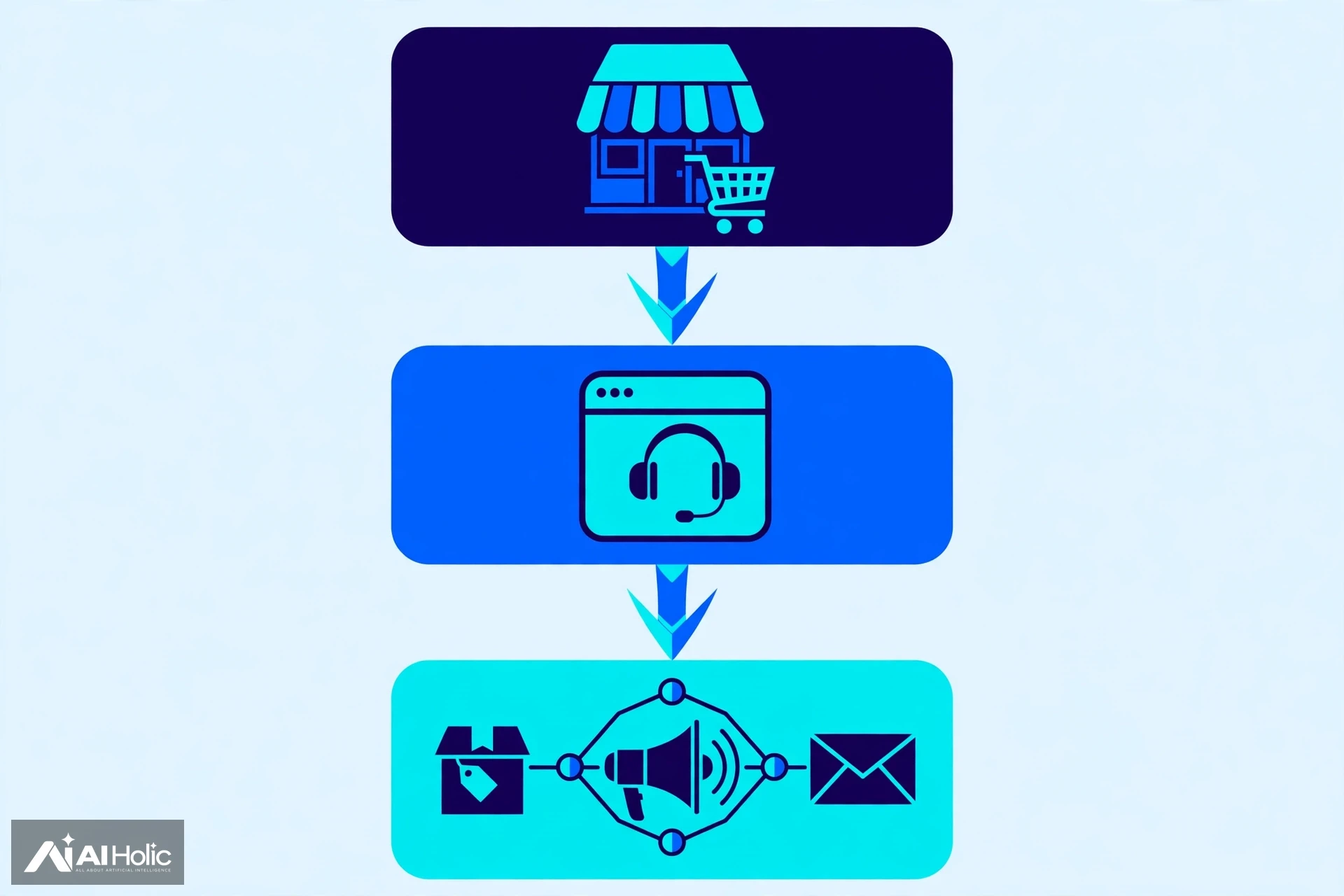
Ai agents ecommerce automation latest fails when a store buys an agent before it sets the permission. Think of the work in three levels, and match each job to one of them before you sign up.
- Read: the agent looks up an order, explains tracking, or reads campaign data. No change happens.
- Draft: the agent prepares an exchange, a product description, or a discount for a person to review.
- Act: the agent runs an enabled change, such as issuing a refund, inside rules you wrote.
A refund agent needs live orders and the authority to change them. Those are two separate capabilities, and a chat widget on your storefront proves neither.
If a tool can answer the question but cannot complete the action, compare it as an assistant. Do not buy it as a replacement for the person who still does the job.
Write the permission down for each job. Name what the agent does alone, what it drafts, and what always goes to a person. That one page is your governance policy, and it matters more than the tool you pick.
What Automates Well and What Does Not
Ai agents ecommerce automation latest works best on jobs that repeat, follow a rule, and fail in private. Recurring reports, email-flow upkeep, bulk catalog edits, and Tier-1 support triage all fit. A wrong draft costs a re-run, not money.
Gartner predicts agentic AI will resolve 80% of common customer service issues by 2029. That number is about common issues, not all issues. The hard half stays with people: angry customers, odd edge cases, and anything where a wrong move costs money or trust.
The Air Canada case shows why the line matters. The airline’s chatbot invented a refund policy that did not exist, and a British Columbia tribunal held the airline liable and ordered it to pay CA$812.02. You own what your AI tells customers, even when the AI made it up.
Gartner also predicts over 40% of agentic AI projects will be canceled by the end of 2027. The usual cause is not the model.
It is missing API access, no governance rules, and messy catalog data. Fix those three before you buy a tool, and your odds improve a lot.
One more warning from the field: only 34% of agentic AI deployments reach full production success, according to an industry report cited by Axeetech. Most of the failures happen before the first agent runs, in the plumbing and the rules, not in the AI.
How to Roll Out Your First Agent in Five Steps
Ai agents ecommerce automation latest is a rollout, not a switch. The steps below take a small store from zero to a live support agent in about five to seven weeks.
Do not skip the first step. It is where most failed deployments go wrong.
- Audit first. List your top five support questions and check API access for every system the agent will touch: your store, your email platform, your helpdesk, and your inventory data. Clean the catalog first.
- Pick one job. Start with L1 support only. Choose a no-code tool if you have no developer, such as Tidio or Gorgias for Shopify. Keep inventory, cart recovery, and pricing for later.
- Build and test in a sandbox. Connect one system at a time and test the edge cases: an out-of-stock question, a return one day past the window, a refund with a missing order number. Set hard escalation triggers before any live test.
- Roll out to 10 to 20 percent of support volume. Watch the escalation rate daily. A healthy rate in the first two weeks is 20 to 30 percent. Above 40 percent means the scope is too wide or the knowledge base is too thin.
- Scale slowly and review every quarter. Expand to 60 to 80 percent of L1 volume only after the agent matches your human resolution rate. Add a second job only after support runs stably for two weeks.
Our guide to building agentic AI applications with a problem-first approach shows how to name one clear job and split fixed work from reasoning work before you build. That method keeps the first agent small, because it only earns the scope its job truly needs.
The New Shopping Agents: Your Store in ChatGPT and Friends
Ai agents ecommerce automation latest also runs on the buyer side. Shopping agents now turn a request such as “running shoes under $120 for flat feet” into a shortlist from product feeds, then send the buyer to your checkout. Your store gets into these agents through clean product data, not through ads.
Shopify moved fast here. Its Fall 2026 update added connectors that link a store to nine AI agents, including ChatGPT, Claude, Microsoft Copilot, Google Gemini, and Perplexity. A Shop.md skill file can turn any AI agent into a personal shopper for your catalog, and Shop Pay checkout now works inside personal agents.
Not every retailer welcomes outside agents. Amazon blocked Meta’s Muse agent from its store, while Shopify, Walmart, and Best Buy welcomed it.
The volume is still small, and the work that pays now is clean feeds, honest reviews, and good measurement. Checkout integrations can wait unless you run Shopify, where they are already on.
An agentic AI system is one that pursues goals, uses tools, and takes actions with some autonomy. That is the line between a shopping search box and a shopping agent.
The agent does not just find the product. It can complete the steps around the purchase.
What It Costs
Ai agents ecommerce automation latest bills in three ways, and the billing unit decides how the cost grows. Some tools charge per seat, some per resolved conversation, and some per month for the platform. Compare the unit before you compare the price.
Tidio lists Lyro from $32.50 a month billed annually, and Gorgias lists plans from $40 a month with its AI Agent. Per-resolution pricing means you pay only when the agent finishes a conversation on its own, which suits a store with uneven ticket volume. Check the vendor page before you budget, because AI pricing shifts often.
Count the review time too. A tool that drafts 200 product descriptions still needs a person to read 200 descriptions. Budget those hours before you pick the tool, because they decide whether the automation saves time at all.
Frequently Asked Questions
What Is the Difference Between an AI Agent and a Chatbot for Ecommerce?
A chatbot answers on one surface. An agent takes multi-step actions across your tools toward a goal, such as looking up an order, issuing a refund, and logging the outcome. The dividing line is action, not chat.
Can AI Agents Run My Store Completely Unattended?
No, not yet. Support agents hand off what they cannot resolve, and platform tools show changes for review before they go live.
Keep a person on refunds, price changes, and public replies. The Air Canada case shows the merchant stays liable for what the agent says.
Which Store Job Should I Automate First?
Start with L1 customer support, usually order status and common questions. It repeats most, fails in private, and gives you clear numbers to judge the result. Add inventory or cart recovery only after support runs well for two weeks.
How Do I Tell a Real AI Agent From a Rebranded Chatbot?
Test for scope and action. A real agent takes multi-step actions across several tools toward a goal.
A rebranded chatbot generates text in one place and wears an agent label. Gartner estimates only about 130 of the thousands of self-described agentic vendors are real.
Is an AI Agent Cheaper Than Hiring a Support Person?
It depends on your baseline. Against US-cost support labor, per-resolution AI is much cheaper on routine tickets.
Against a low-cost offshore assistant, the dollar gap on a few hundred tickets is small, and the real gain is instant round-the-clock replies with no management overhead. Work the math for your own ticket volume before you decide.
Conclusion
Ai agents ecommerce automation latest means agents that act across your store, not chatbots that only talk. Start with L1 support, set read, draft, and act permissions first, and roll out to a small share of tickets. Keep a person on the risky steps, and let the agent earn more scope with each clean month.