AI in Education Adaptive Learning Platforms 2026: How They Work and How to Choose One
If you don’t want to read the whole guide or have difficulty reading, you can listen to this guide instead.
A student who masters fractions moves on to harder problems. A student who keeps missing the same step gets extra practice on that one step. That simple idea sits at the heart of ai in education adaptive learning platforms 2026, the software schools and colleges now use to shape lessons around each learner.
This guide explains how these platforms work in plain words, what the research really shows, and how to pick one without wasting money. You will learn the five kinds of platform on the market, the evidence behind the sales claims, and a 90-day pilot that tests the real thing.
At AI Holic, we built this guide from the live search results and the studies the top guides cite, and we flag every claim we could not check ourselves. We did not test the platforms named here, so their abilities are labeled as vendor claims.
The Short Answer: The Lesson Changes to Fit the Learner
An adaptive learning platform changes what a learner sees next based on a running estimate of what that learner knows. Get three questions right and the next one gets harder. Keep missing the same kind of question and the platform sends easier practice on that exact skill.
That is the strict meaning of the term, and it matters, because almost every learning platform now claims to adapt. Many only recommend a video or a course based on a past click. A real adaptive system changes the sequence, the difficulty, or the timing of practice after every answer.
The idea is old. The technology page for adaptive learning traces it back to the 1970s, when early systems adjusted to a learner’s answers on a computer.
What is new in 2026 is scale and cost. A classroom of 30 students can now get 30 different paths at once, and a teacher can see all of them on one screen.
Our guide to AI in education covers the wider picture, from tutors that explain a problem at midnight to tools that draft lesson plans. This guide goes one step further and looks at the platforms that adjust the lesson itself, hour by hour, for each student.
How AI in Education Adaptive Learning Platforms 2026 Work
Every serious platform among ai in education adaptive learning platforms 2026 rests on three parts that work together. The names sound technical, but the ideas are simple, and you can test each one when you watch a demo.
1. A Knowledge Map of the Subject
The subject is broken into skills and the links between them. You cannot factor a quadratic before you can multiply binomials, and the map records that order. ALEKS, for example, is built on knowledge space theory, which models which combinations of skills a learner can plausibly hold at one time.
The map is the part vendors rarely show you. Ask to see it. If a vendor cannot show how skills connect in one real unit, the platform is probably recommending content, not adapting a path.
2. A Learner Model That Updates After Every Answer
Every answer updates the system’s estimate of what the student knows. A run of right answers on harder items raises the estimate for a skill. A wrong answer on a skill the student supposedly mastered lowers it again.
The methods have names like knowledge tracing and item response theory. The idea behind them is simple: the system keeps score skill by skill, not just as one grade for the whole test.
A wrong answer also tells the system something about the mistake itself. A student who adds exponents when simplifying 2x squared plus x cubed has a specific gap, and a good model spots it.
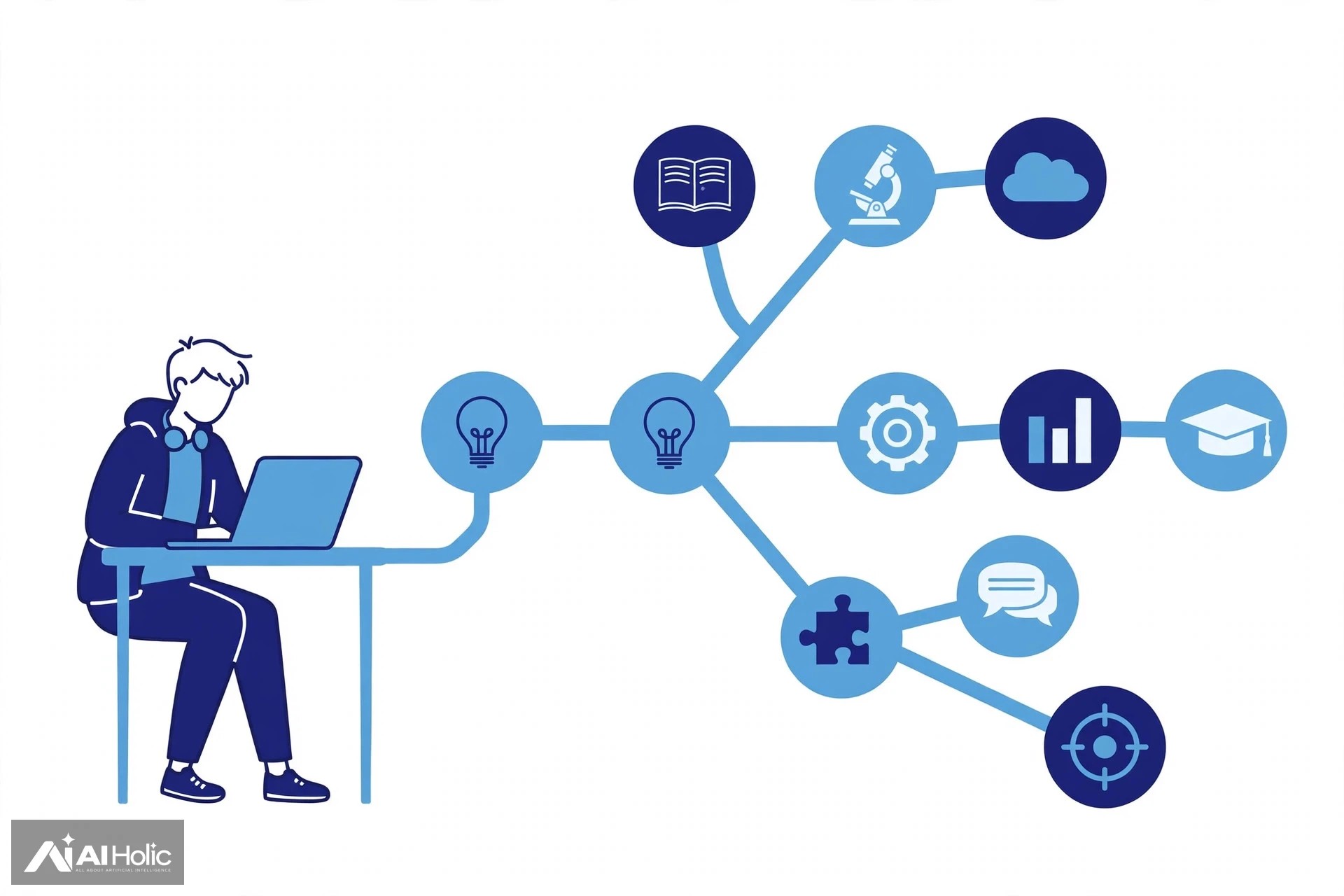
3. A Decision Rule That Picks What Comes Next
Given the map and the estimate, the system picks the next item. It decides when a skill counts as mastered, when to schedule review before the student forgets, and, in the better products, when to hand the student back to a teacher.
That last choice is easy to miss in a demo and hard to live without. A platform that never tells a teacher a student is stuck is only half a tool. Ask the vendor to show you exactly what a teacher sees when a learner stalls for three sessions in a row.
4. The New Layer: A Conversational Tutor on Top
Generative AI adds a fourth layer in 2025 and 2026. A student stuck on a problem can now ask why and get a hint in plain words instead of a canned worked example. Khan Academy’s Khanmigo works this way, and so do the tutors built into several newer platforms.
This layer is valuable, but it is not the same thing as adaptive sequencing. A chatbot that explains well and a system that changes the next question are two different skills, and vendors often blur the two in a demo. When you test a platform, check them separately.
Five Kinds of Adaptive Learning Platform
Not all ai in education adaptive learning platforms 2026 do the same job. The top guides group them into five kinds, and the kind tells you which question to ask the vendor. The table below gives the short version, and the notes after it add the detail.
| Kind | Typical examples | What actually adapts | Best fit |
|---|---|---|---|
| K-12 math practice | DreamBox, ALEKS, MATHia (Carnegie Learning) | Sequence and difficulty of problems, review timing | Supplementing core math teaching |
| Higher-ed courseware | Knewton Alta, ALEKS for college | Assignments and catch-up paths | Gateway courses with high failure rates |
| Whole-curriculum systems | Squirrel AI, Century Tech | Learning path across several subjects | Tutoring centers, blended schools |
| Conversational AI tutors | Khanmigo, custom tutors built on a pedagogy | Dialogue, hints, questions | Homework help, flipped classrooms |
| Corporate adaptive learning | Degreed, Cornerstone, LinkedIn Learning, Coursera | Content picks by skill gap | Onboarding, upskilling staff |
K-12 math is where the evidence is strongest. Math has clear right and wrong answers and a clear order of skills, so the map and the model both work well.
Language learning is close behind. Duolingo adjusts lesson difficulty with a model built with Carnegie Mellon University, and its reports link personalization to higher completion rates.
Whole-curriculum systems promise more, and the proof is thinner. They aim to steer a learner across several subjects at once, which needs a much larger map and much more data. Ask for independent evaluations before you trust that promise, and check whether any study used students like yours.
Corporate platforms are a different purchase. They mostly recommend courses by skill gap rather than re-sequencing a lesson question by question.
That can still save real time, because a new hire who already knows one skill can skip it. Judge them on time to competency, not on how clever the adaptation sounds.
Our guide to AI math tutors looks closely at the math side, where adaptive practice is most mature. If your first pilot is a math class, read it next to this guide.
What the Evidence Actually Shows
The research on ai in education adaptive learning platforms 2026 is more positive than for most classroom technology, but it is still mixed. The gains are real and modest, and they take time. That is the honest picture from the studies the top guides cite.
Start with the broad view. The Wikipedia page on adaptive learning cites a 2023 review of 37 studies, in which 32 studies, or 86 percent, reported positive effects on learning. The review compared adaptive systems with teacher-led teaching, and the positive results clustered in subjects with clear skill ladders, like math.
The RAND Trial: Big, Slow, and Honest
The largest trial is the RAND study of Carnegie Learning’s Cognitive Tutor Algebra I, published in 2014. More than 17,000 students in 147 middle and high schools across seven states took part, with schools assigned at random to the adaptive curriculum or to their existing one.
In the first year there was no measurable effect. In the second year, high school students using the adaptive curriculum outperformed the control group by about a fifth of a standard deviation. Teachers needed a full year to learn how to run the system before it paid off, which is an awkward truth for anyone selling a one-term pilot.
The Harvard Trial: Small, Fast, and Careful
The second study is a randomized controlled trial published in Scientific Reports in 2025. In an introductory physics course with 194 students, a GPT-4 tutor designed around research-based teaching produced median learning gains more than double those of an in-class active learning session, in less time.
The authors are careful about the limits: two topics, two weeks, one course, one university. Treat it as proof that a well-built AI tutor can teach fast, not as proof that it works everywhere. The honest expectation for a well-run deployment at scale sits closer to the RAND result than to the Harvard one.
The Delhi Trial: Adaptation Plus Teaching
The third study is the Delhi Mindspark trial from 2015 to 2016, summarized by J-PAL. In that trial, 619 school students were studied over 4.5 months. Students offered the program made over twice the maths progress of the comparison group, and 2.4 times as much Hindi progress.
One detail matters: the program combined adaptive software with small-group teaching. The software did not work alone. When you read a vendor claim about a trial, always ask whether a teacher was part of the program, because that changes what the result means for your school.
Other numbers in this field come from market research firms and vendor reports, not from trials. One competitor guide cites an adaptive learning platform market of 1.72 billion dollars, projected to reach 5.47 billion by 2032, and an AI in education market of 6.4 billion dollars. We could not check those figures against the original reports, so treat them as market claims, not facts.

The Best-Known Platforms at a Glance
The names below come from the top guides, not from our own testing. We did not test these platforms, and we list no prices except one published figure, because most vendors quote only. Use the table to shortlist the ai in education adaptive learning platforms 2026 that fit your subject, then test the shortlist yourself.
| Platform | Best for | What it does, as the vendor describes it | Watch out for |
|---|---|---|---|
| ALEKS (McGraw Hill) | Math and science, K-12 and college | Maps what a learner knows and fills gaps in order | Subject range is narrow, and the interface feels dated to some users |
| DreamBox (Discovery Education) | K-8 math practice | Adjusts lessons as the child plays and answers | Best for younger learners, with a narrow subject focus |
| MATHia (Carnegie Learning) | Middle and high school math | Adaptive math practice with live tutor help | Needs real teacher training to pay off, per the RAND trial |
| Knewton Alta (Wiley) | College STEM courses | Step-by-step catch-up for gateway courses | Limited room for teachers to shape the path |
| Khanmigo (Khan Academy) | Tutoring and homework help | Conversational tutor that asks questions instead of giving answers | Explains well, but it does not re-sequence a full course |
| Squirrel AI | Whole-curriculum tutoring | Builds a personal path across subjects | Independent evaluations are thin |
| Century Tech | School math, science, English | Personal paths with teacher analytics | Needs steady internet, and it is limited outside core K-12 subjects |
| Duolingo | Language learning | Adjusts difficulty lesson by lesson | Suits beginners and mid-level learners more than advanced ones |
| IXL Learning | Wide K-12 practice | Adjusts question difficulty in real time across subjects | Drill-style practice suits some topics better than others |
| Skillwell Adapt | Workplace performance paths | Lets learners test out of what they know and changes the path as data comes in | Pricing by quote, and it needs clear objectives first |
A name on this list is not a recommendation. Two platforms can both call themselves adaptive while doing very different things. The test in the next section shows you how to tell them apart in one demo.
Conversational tutors deserve a separate look, because they answer questions rather than set a path. Our guide to Claude AI for students shows how one general tutor is used for study help, and the same checks apply: does it ask questions, does it catch a wrong idea, and does it stay on the approved material.
How to Choose: A Scorecard for Schools and Teams
Use this scorecard in every vendor demo, and write the answers down. A platform that scores well on the first three rows and badly on the rest can still work as a pilot. A platform that cannot answer the evidence row should not get a multi-year contract, however good the demo looks, so run this check on every one of the ai in education adaptive learning platforms 2026 on your shortlist.
| Check | Question to ask the vendor | Red flag answer |
|---|---|---|
| Evidence | Which independent studies show learning gains with students like ours? | Only testimonials or engagement numbers |
| What adapts | Does the sequence change, or only the content picks? | Vague talk about AI-powered personalization |
| Teacher visibility | Can a teacher see why the system moved a student forward or back? | A dashboard of scores with no reason given |
| Curriculum fit | How is content mapped to our standards or framework? | Upload your own content is the only answer |
| Student data | Where is data stored, who can see it, is it used to train models? | Training on student data by default |
| Fit with your systems | Does it support LTI and roster sync with our LMS? | Manual file uploads every term |
| Rules | Does the tool steer the learning process for EU users under the EU AI Act? | No awareness of the rules at all |
| Cost and exit | What does year two cost with training, and can we export all data if we leave? | Discounts only for a multi-year lock-in |
The two-learner test is the fastest check of all. Give two learners different answers to the same question and ask the vendor to show what each learner sees next, what data caused that change, and what the teacher can see. If the vendor cannot show that live, the adaptation is probably a label, not a feature.
Price is the hardest part to compare, because most vendors quote only. One vendor in the top guides lists published pricing from 250 dollars a month billed annually, with no setup fee, and that figure comes from the vendor’s own site as checked in October 2026. For the rest, ask for a written quote that covers licenses, setup, content work, training, and year-two costs in one number.

A 90-Day Pilot That Tests the Real Thing
A pilot of ai in education adaptive learning platforms 2026 should answer one question: did learning improve for students like ours. The plan below fits a school, a college, or a training team, and it needs no vendor contract to start.
- Weeks 1 to 2: Pick one subject, one grade or one job role, and two comparable groups. Record the current measure now: test scores, pass rates, or time to competency.
- Weeks 3 to 10: Run with a usage target. Agree how many minutes per week learners should spend on the platform and track it weekly. Low usage is the most common reason pilots fail, because the tool was never used enough to adapt.
- Weeks 11 to 12: Compare the two groups on the baseline measure, read the usage logs, and interview the teachers. Decide to scale, to extend the pilot for a full year as the RAND result suggests, or to stop.
Run the pilot in one subject only. A school that pilots math, reading, and science at once cannot tell which one worked. One subject, one measure, and one honest read of the logs will tell you more than a wide rollout ever will.
If you are comparing three vendors and none of them can answer the evidence question clearly, that is the moment to bring in an independent view before the budget is committed. A short structured review of your setting usually saves a year of the wrong pilot.
Costs, Data, and the Questions Parents Should Ask
Adoption is running ahead of rules. The Stanford HAI 2026 AI Index, cited in the top guide we read, reports that four in five US high school and college students now use AI for schoolwork, while only half of middle and high schools have an AI policy and just 6 percent of teachers describe theirs as clear. UNESCO puts it more bluntly: fewer than 10 percent of schools and universities have formal guidance on generative AI.
That gap is why the policy questions matter as much as the features. UNESCO’s page on artificial intelligence in education calls for a human-centered approach, with inclusion and equity as the test for every new tool. A platform that works well for students with fast internet and quiet rooms at home can still leave others behind.
Parents and school boards should ask five questions before any rollout. What student data does the platform collect, and where does it live. Is student data used to train the vendor’s models, and can the school opt out.
Who can see a single child’s records, and for how long are they kept. How does the system handle bias, so one group of students is not steered onto an easier path by mistake. And what happens to the data if the school leaves.
Teachers need training time in the budget, not as an afterthought. The RAND trial showed that year one produced no gain while teachers learned the system. A school that buys licenses and skips training is paying for the same first year twice.
What to Do When the Budget Is Small
Not every school can buy a platform, and that does not mean its students must miss out. Start with the free tools among ai in education adaptive learning platforms 2026 that already adapt.
Khan Academy offers free practice and a conversational tutor, and Duolingo offers free adaptive language lessons. Both cover the core idea: the next question changes with the last answer.
A teacher can also run a small version by hand. Sort a class into three groups by a short quiz, give each group the next set of problems at its own level, and re-sort every two weeks. It is slower than software, but it teaches the teacher exactly what the software would do, and it costs nothing.
When money does arrive, spend it on one subject and one trained teacher, not on licenses for every class. A single working pilot with real results is a stronger case for the next budget than a school-wide rollout nobody uses.

Mistakes That Waste the Money
Most adaptive learning projects fail in the same four ways. Each one is easy to avoid once you name it.
- Buying the label, not the feature. If the vendor cannot show the two-learner test live, you are buying a recommendation engine, not an adaptive platform.
- Skipping the baseline. Without a measure from before the pilot, no result can prove anything, and the vendor’s numbers will fill the gap.
- Leaving teachers out. A platform teachers cannot read or trust becomes a second job, and usage falls within weeks.
- Judging too soon. One term is not enough to judge a tool that needs a year of teacher practice, as the RAND trial showed.
The fix for all four is the same: one subject, one measure, teachers in the room from day one, and a full year before the final verdict.
Frequently Asked Questions
What is an adaptive learning platform?
It is software that changes what a learner sees next based on what the learner knows. In ai in education adaptive learning platforms 2026, every answer updates the system’s estimate of mastery, and the next question, hint, or review is picked from that estimate. A platform that only recommends videos is not truly adaptive.
Do adaptive learning platforms really improve grades?
The evidence says yes, modestly, and over time. A 2023 review of 37 studies found positive effects in 32 of them.
The large RAND trial found no gain in year one and a gain of about a fifth of a standard deviation in year two for high school students. Expect a real but small gain, not a sudden jump.
Which adaptive learning platform is best for schools?
There is no single best choice among ai in education adaptive learning platforms 2026, because the best fit depends on the subject, the age group, and the budget.
Math practice platforms like ALEKS and DreamBox have the strongest evidence. Conversational tutors like Khanmigo suit homework help. Run the two-learner test and the 90-day pilot in this guide before you sign anything.
How much does an adaptive learning platform cost?
Most vendors quote by school size, so there is no single price to list. One vendor in the top guides lists published pricing from 250 dollars a month billed annually.
Free starting points exist too: Khan Academy and Duolingo both adapt to the learner at no cost. Always ask for a quote that covers licenses, setup, training, and year-two costs.
Can adaptive learning replace a teacher?
No. Every strong study in this guide pairs the software with a teacher.
The RAND trial showed the tool only paid off once teachers learned to run it, and the Delhi trial combined the software with small-group teaching. The platform handles practice and pacing, while the teacher handles the parts software cannot: trust, encouragement, and judgment.
Is student data safe on adaptive learning platforms?
It depends on the vendor’s policy, so check before you buy. Ask where data is stored, who can see a single child’s records, whether data trains the vendor’s models, and what happens to the data if the school leaves. UNESCO calls for a human-centered approach with inclusion and equity as the test, and fewer than 10 percent of schools have formal guidance, so the school’s own policy has to do the work.
Conclusion
AI in education adaptive learning platforms 2026 work best as a teacher’s helper, not a replacement. Pick one subject, run the two-learner test, pilot for 90 days, and judge the results after a full year.