Outsourced Service Provider Operations AI Automation: A Practical Guide For Buyers
If you don’t want to read the whole guide or have difficulty reading, you can listen to this guide instead.
Many buyers now ask a provider not only how many people it can staff, but also how its systems handle routine work before a person ever touches a case. That shift is at the heart of outsourced service provider operations ai automation, where an outside team runs your day to day work with AI handling intake, sorting, drafting, and checks. This guide explains what that model covers, what to automate first, and how to keep quality and control when someone else runs the operation, so you can compare providers on results rather than on promises and spot weak automation before you sign a long contract.
Business process outsourcing means a company contracts a specific business process to a third party service provider, and that definition still fits even when AI does part of the work. You can read a plain account of that model on the Business Process Outsourcing page on Wikipedia.
The change is inside the operation, because the provider now pairs its staff with software that reads, routes, and drafts. You can find more automation guides at AI Holic.
What This Model Actually Covers
Outsourced Service Provider Operations AI Automation is not one tool, and it is not a promise that AI will run your whole business. It is a way of running a contracted operation, such as support, finance tasks, or back office work, where AI handles the repeatable steps and people handle judgment, exceptions, and customer care. The provider still owns staffing, training, and delivery, but its workflow now includes machine steps at defined points.
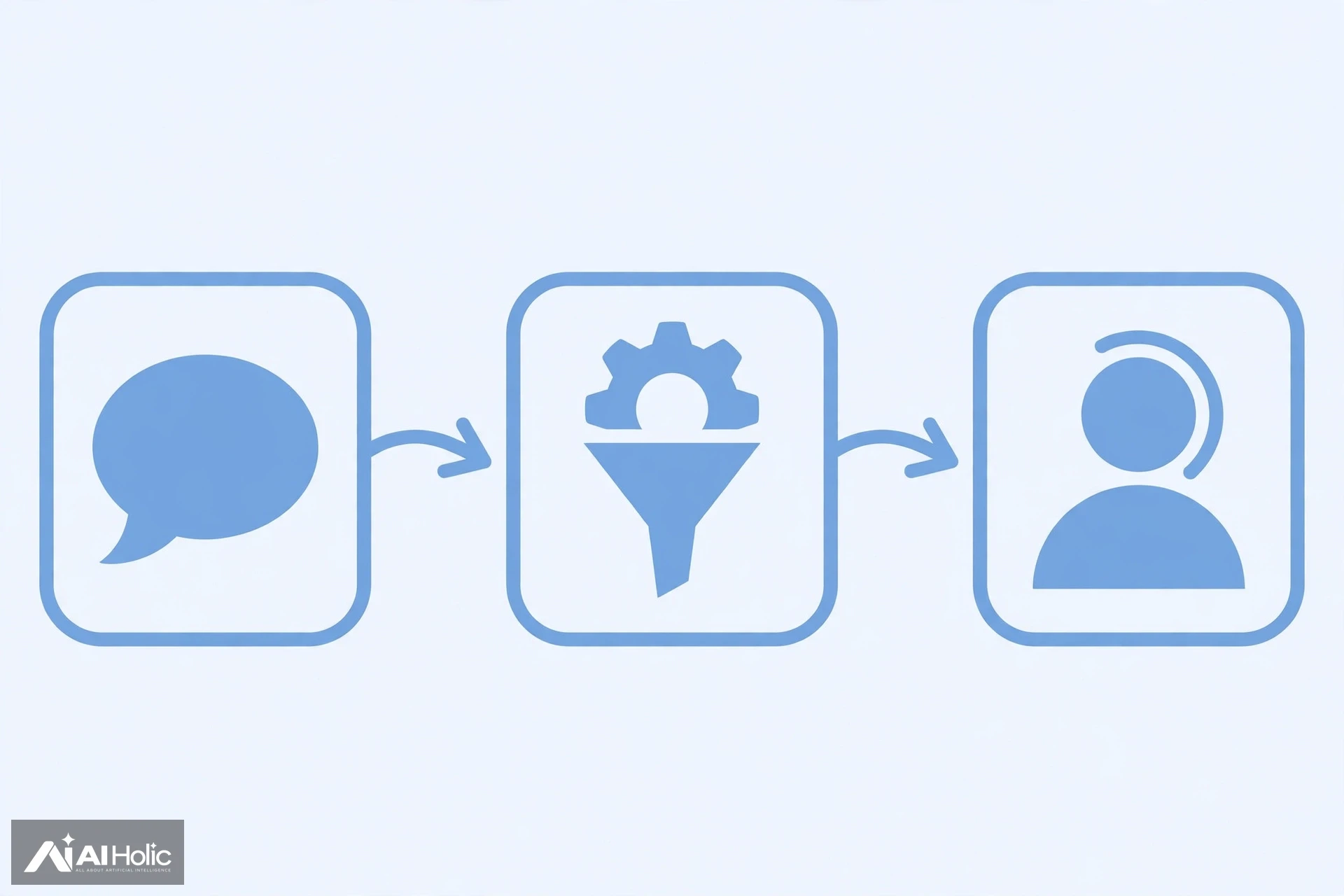
Think of the work in three layers. The first layer is intake, where AI reads a request, pulls the right records, and sorts it by topic and urgency.
The second layer is execution, where AI drafts a reply, fills a form, or runs an approved fix. The third layer is review, where a person checks the result, handles anything unusual, and signs off before the customer sees it.
That split matters because it sets honest expectations. AI is strong at volume, pattern matching, and speed, while people are strong at context, empathy, and edge cases. A good operation keeps both, and it never lets a machine step hide the human who is accountable for the result.
Why The Economics Changed
For years, outsourcing won on labor cost, because a provider could staff a large team in a lower cost location and charge by headcount or by hour. AI breaks that link, because a smaller team with good automation can now handle the same volume that once needed many more people. That is why buyers should judge providers on outcomes per case, not only on the price per agent.
A recent analysis of this shift argues that AI is changing the build versus buy logic for work that was once sent outside as a matter of course, and you can read that argument in the Harvard Business Review article on AI and outsourcing economics. The point for buyers is practical, not academic. When routine work gets cheaper to automate, the value of a provider moves from headcount to process design, quality control, and the ability to improve month after month.
That change also creates a risk. A provider can cut cost by automating badly, and the buyer may only notice when complaints rise or errors slip through. Your contract must therefore measure resolution quality, not only speed, and it must give you a clear view of what the AI did on each case.
What To Automate First
Start with work that is high volume, digital, and easy to check. Ticket sorting, password resets, order status replies, invoice matching, and standard report building all fit that test. Each one has a clear input, a clear correct output, and a simple way to spot a mistake.
Hold back work that needs judgment, sensitive decisions, or delicate customer handling. Refunds above a set limit, disputes, account closures, and complaints about harm should stay with people, even if AI drafts the first version. The pilot below shows how to stage the rollout so the easy wins come first and the risky work stays protected.
| Work type | Automate now | Keep human-led |
|---|---|---|
| Support intake | Sort, tag, and route tickets | Angry or sensitive complaints |
| Replies | Draft status and how-to replies | Final word on disputes |
| Back office | Match invoices and build reports | Approve payments above a limit |
| Knowledge | Summarize cases and update guides | Publish policy changes |
Use that table as a first filter, not as a final rule. Every business has its own edge cases, and a task that looks routine in one company can carry real risk in another. Run the pilot on real cases, count the errors, and only expand automation where the error rate stays below your agreed limit.
Outsourced Service Provider Operations AI Automation: Daily Practice
A strong outsourced operation follows the same loop on every case. AI reads the request and gathers context, the system suggests the next step, a person or an approved rule acts, and the result gets checked before it closes. When that loop is written down, you can audit it, and when it is only in a few heads, you cannot.
Knowledge is the fuel for that loop. If the provider works from old guides, the AI will give old answers at high speed, and customers will notice fast. Insist on one shared knowledge base, a named owner for updates, and a weekly review of the cases where the AI answer was corrected.
Escalation is the safety valve. Every automated step needs a clear path to a person, a time limit for that handoff, and a rule that stops the machine when confidence is low. A provider that cannot show you its escalation paths in writing is not ready for outsourced service provider operations ai automation at scale.
Who Does What: Client, Provider, And AI
Confusion about roles causes most outsourcing problems, and AI makes that confusion worse if no one writes the roles down. The client owns the policy, the brand voice, and the final decisions on sensitive cases.
The provider owns staffing, training, daily quality checks, and the workflow itself. AI owns only the steps it is approved to run, and a person owns every result it produces.
Put that split in the contract in plain words. List which steps AI may run alone, which steps need a human check, and which steps AI must never run.
Name the tools and the data each tool can see, and state who approves a change to that list. When the list changes, both sides sign the change, and the change gets tested before it goes live.
That clarity also helps when something goes wrong. If a customer gets a wrong answer, you should be able to trace the case back through the AI step, the human check, and the guide it used. Without that trace, you cannot fix the root cause, and the same error will repeat.
Quality, Metrics, And Service Levels
Old outsourcing contracts measured speed and headcount, and those measures now mislead. A fast wrong answer is still a wrong answer, and a high deflection rate can hide customers who gave up instead of getting help. Measure first contact resolution, reopened cases, error rate on AI steps, and customer satisfaction for automated and human cases separately.
Ask for a monthly report that splits results by channel and by step. You want to see how many cases AI handled alone, how many needed a correction, and how many escalated.
You also want sample cases, not only averages, because averages hide the worst experiences. If the provider will not share that split, treat that as a warning sign.
Service levels should cover quality, not only time. Set a limit for AI error rate, a limit for reopened cases, and a remedy when either limit is missed.
Tie a part of the fee to those quality measures, so the provider gains when quality holds and loses when it slips. That structure rewards good automation instead of cheap automation.
- Track resolution quality and reopened cases, not only speed
- Split AI handled and human handled results in every report
- Review corrected AI answers every week and update the guides
- Set a clear error limit and a remedy when it is missed
Data Security And Access Control
Automation in outsourced service provider operations ai automation needs data, and that need creates a security duty. Give the provider and its AI tools the least access that still lets them do the job, and review that access every quarter. Customer data should stay inside approved systems, and AI tools should never copy it into personal accounts or unapproved apps.
Ask three questions before you sign. First, where does case data go when AI processes it, and how long is it kept.
Second, is your data used to train models for other clients, and can you opt out in writing. Third, how fast can access be revoked for a staff member or a tool that leaves the project. Clear answers to those questions matter more than a long security page.
Compliance adds a further layer for regulated work. Our guide to AI agents for cybersecurity compliance auditing automation shows how agent work can support audit trails and checks when the controls are set up well. Use that same discipline here, with logs for AI actions, human approvals, and data access, so an auditor can follow any case from start to finish.

Cost Models That Fit Automation
Paying per agent hour fights against outsourced service provider operations ai automation, because the provider earns more when it uses more people. Paying per resolved case, or per outcome with a quality bonus, lines up both sides. The provider then gains from better automation, and you gain from lower cost per good result.
Watch for hidden costs in any quote. Tool licenses, model usage fees, integration work, and the time your own team spends on reviews can all sit outside the headline price.
Ask for one total cost per resolved case, including those items, and compare providers on that figure. A cheap headline price with high hidden costs is not a saving.
Also plan for the work that comes back in house. Some tasks that were once outsourced may now be cheaper to automate inside your own team, and a good provider will say so rather than fight to keep the work. The right question is not whether to outsource, but which tasks belong outside and which tasks your own small team can now run well.
A Pilot You Can Run In Four Weeks
Week one is mapping. Pick one process, list every step, and mark each step as automate, assist, or human only.
Week two is building, where the provider sets up the workflow, the guides, and the escalation paths on a small set of real cases. Keep the scope small, because a small pilot that works teaches more than a large pilot that stalls.
Week three is live testing with a human check on every AI output. Count errors, measure resolution time, and collect customer feedback on the pilot cases.
Week four is the decision, where you compare the pilot results against your old process on quality, cost, and customer effort. Expand only the steps that beat the old process on quality as well as cost.
That staged approach to outsourced service provider operations ai automation also protects your team. Staff on both sides learn the new workflow without a sudden change for all customers at once. If the pilot fails, you lose four weeks, not a full contract term, and you keep the lessons for the next attempt.
Questions To Ask Before You Sign
Ask the provider to show you a live case journey for outsourced service provider operations ai automation, from intake to close, with the AI steps marked. Ask how it measures AI error rate, and ask to see a sample monthly report before you commit. Ask who owns the workflow and the knowledge base if the contract ends, because you do not want your operation locked inside a provider system you cannot take back.
Ask about agent tools as well, since the provider team will use them daily. Our comparison of OpenHands AI agent features versus Devin versus Manus shows how agent tools differ in autonomy and control, and those differences matter when a provider picks tools for your work. You do not need to pick the tool yourself, but you should know how much autonomy it has and where a person steps in.
Finally, ask how the provider improves over time. A good answer names a monthly review, a list of workflow changes, and a test for each change before it goes live.
A weak answer talks only about adding more staff or more tools. Improvement is a process, not a purchase, and your contract should require it.
Watch And Learn More
For a walkthrough of building an AI powered business operating system with agents, workflows, and approvals, watch the video below.
If your operation also uses workflow tools inside your own team, our guide to the Shopify Flow AI assistant prompt guide shows how to prompt an assistant inside a workflow without losing control of the steps. The same habit applies here, with clear prompts, clear limits, and a human check where it counts.
Frequently Asked Questions
Does outsourced service provider operations ai automation replace the provider team? No, it changes the team mix, because AI handles repeatable steps while people handle judgment, exceptions, and care. The provider still staffs, trains, and owns delivery.
What should I automate first? Start with high volume digital work that is easy to check, such as sorting, status replies, and invoice matching. Keep sensitive decisions with people until the pilot proves the error rate is low.
How do I stop automation from hurting quality? Measure resolution and reopened cases separately for AI and human work, and set an error limit with a remedy. Review corrected AI answers every week and fix the guide behind each error.
Who owns my data and my workflow? Your contract should state it, with least access for tools, a ban on training other clients on your data unless you agree, and a clear handover if the contract ends. Get those points in writing before you sign.
Conclusion
Judge a provider on outcomes, not headcount, automate the repeatable work first, and keep people in charge of judgment and quality. That is how outsourced service provider operations ai automation saves money without costing you trust.