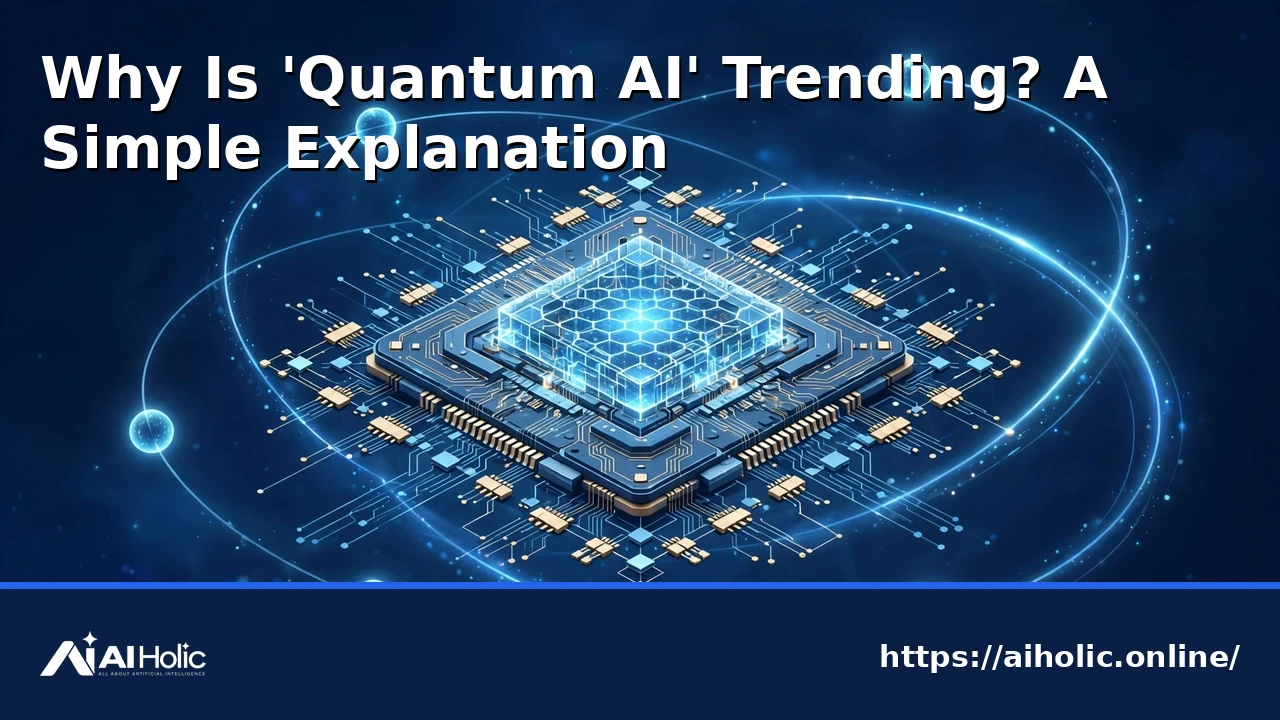
Why Is ‘Quantum AI’ Trending Explanation: What It Is and What Is Real
If you don’t want to read the whole guide or have difficulty reading, you can listen to this guide instead.
You may have seen the words quantum AI in headlines, videos, and social posts lately, and the search why is ‘quantum ai’ trending explanation shows that many people want a plain answer, not a physics lecture. Quantum AI is the meeting point of two big fields, quantum computing and artificial intelligence. This guide explains what it is, why it is in the news now, and what is real and what is hype.
At AI Holic, we read the research and the news behind the trend so you do not have to. You will get a simple definition, the real reasons behind the buzz, a clear hype check, and a short list of what it means for you. No math degree is needed, and no claim here goes past what the sources say.
Why Is ‘Quantum AI’ Trending Explanation: The Short Answer
Quantum AI is trending because two kinds of progress met at the same time. Quantum computers are getting more reliable, and AI keeps hitting limits on power, cost, and compute. People now ask if quantum machines can help AI do jobs that normal computers struggle with.
The trend is also fed by real news, big company plans, and security worries. Google, IBM, Microsoft, and Amazon all work on quantum AI in some form, and governments have put large sums into quantum research. The short version of why is ‘quantum ai’ trending explanation is this: real progress plus real money plus big claims.
What Quantum AI Actually Is
If you search for why is ‘quantum ai’ trending explanation, the first thing to clear up is what the words mean. Quantum AI is the field where quantum computing meets artificial intelligence. It covers two ideas at once, and most confusion comes from mixing them up.
Quantum AI is one of the newer types of AI, and it sits beside machine learning, vision, and language tools rather than above them. It is not a new kind of chatbot, and it is not a replacement for the AI you already use. It is a research field that tries to join two tools that each fix a weakness in the other.
Qubits in Plain Words
A normal computer stores data as bits, and each bit is a 0 or a 1. A quantum computer stores data as qubits, and a qubit can hold a mix of 0 and 1 at the same time. This property is called superposition, and it lets a quantum machine weigh many options at once.
Qubits can also link to each other in a way called entanglement. When two qubits are entangled, a change to one affects the other, even if they sit apart. These two ideas give quantum computers a different way to work, not just a faster version of the same work.

The Two Directions of Quantum AI
The Quantum Insider, a trade publication that covers the field, puts it plainly: quantum AI runs in two directions. The first direction uses quantum computers to speed up certain AI tasks, such as optimization and sampling. The second direction uses AI to design, calibrate, and correct quantum computers, and this side already helps in labs every day.
The two directions move at very different speeds. AI for quantum computing already has practical value, while quantum-enhanced AI is still mostly research and sits about five to ten years from commercial value, according to the same publication. That gap matters, because most headlines talk as if both sides are equally close.
| Direction | What It Does | Where It Stands |
|---|---|---|
| Quantum-enhanced AI | Uses quantum computers to speed up AI tasks | Research stage, years away |
| AI for quantum computing | Uses AI to build, calibrate, and fix quantum machines | In daily use in labs |
Why It Is Trending Now
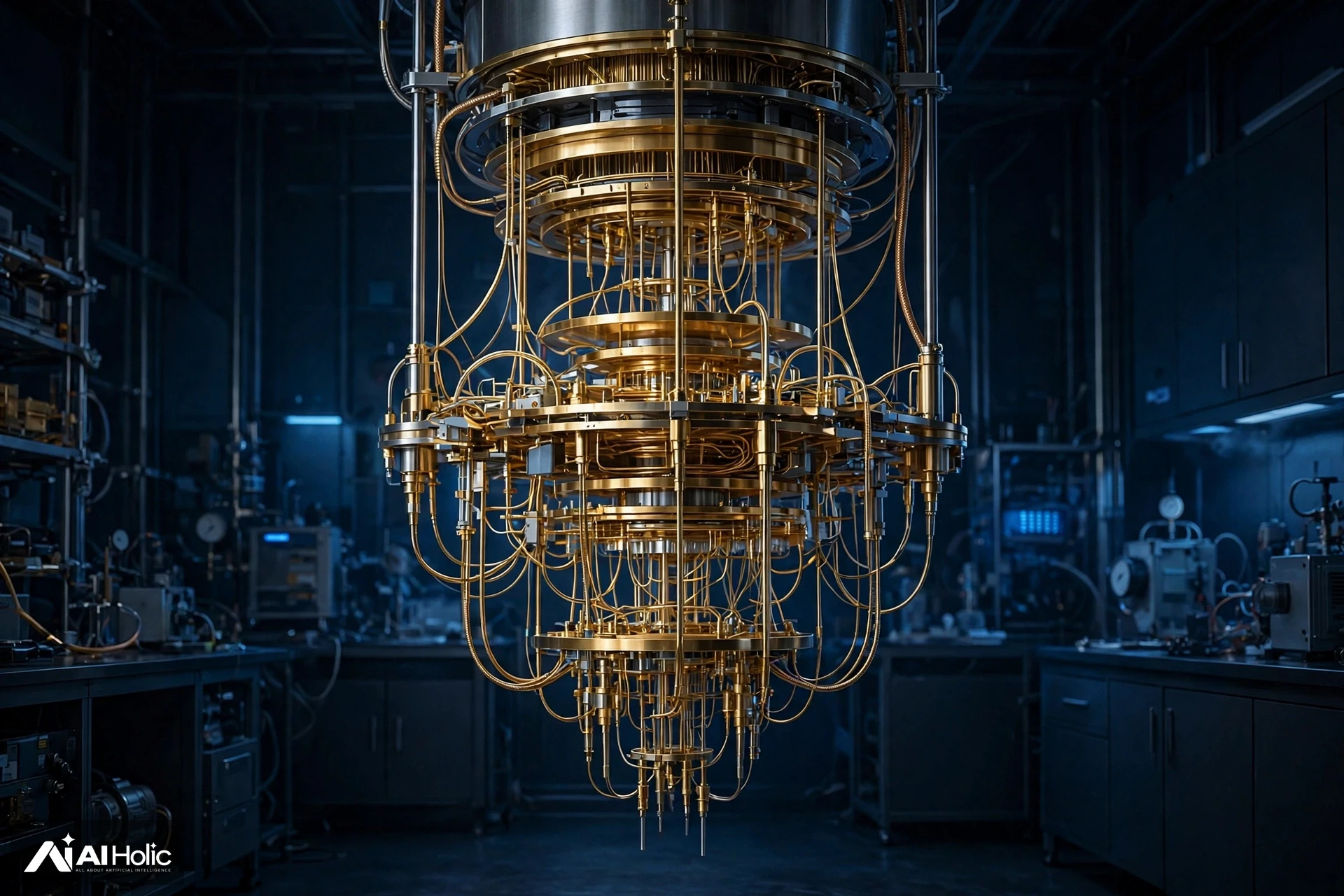
Searches like why is ‘quantum ai’ trending explanation rise each time one of these stories breaks. The first driver is a real hardware milestone: in December 2024, Google’s Willow chip showed error correction that got better as the system grew, a step researchers had chased for about thirty years. The second driver is the wall classical AI is hitting, since training large models now needs huge amounts of power, chips, and cooling.
The third driver is money and attention from large companies. IBM, Google, Microsoft, and Amazon all run quantum programs, and smaller firms such as Quantinuum and IonQ work on the same problems. Global government funding for quantum computing had reached 10 billion dollars by April 2025, according to Wikipedia, which shows that states treat it as a long-term bet, not a fad.
The fourth driver is security. A large quantum computer could one day break the encryption that guards bank logins, messages, and state secrets, since Peter Shor showed in 1994 that such a machine could break RSA encryption, and some groups now collect encrypted data to open later. Firms and agencies are moving to new encryption that can resist quantum attacks, and that risk alone keeps the topic in the news.
The fifth driver is a simple naming mix-up. Google named its quantum research group Google Quantum AI, so many searches for the phrase are really searches about that team and its results. News about the team then reads as news about the whole field, which adds to the buzz.
Hype vs Real: What the Claims Get Wrong
A fair why is ‘quantum ai’ trending explanation has to split the claims from the facts. The table below lines up four claims you will see online with what the sources actually say. Keep it in mind the next time a headline promises a quantum leap for AI.
| Claim You Will See | What Is True |
|---|---|
| Quantum AI will replace chatbots and normal AI | No. It targets narrow math jobs inside AI, not chat or writing. |
| Quantum computers are already faster at everything | No. Current machines are lab tools for special tasks. |
| Quantum AI is ready to buy and use | No. Most uses are research or pilot projects. |
| Quantum AI will break all encryption tomorrow | No. It is a future risk, and new encryption is already in the works. |
The pattern is simple: the science is real, the timing is slow. Quantum computers are still lab machines with few qubits and high error rates, and they sit in the noisy middle stage researchers call the NISQ era. That does not make the field fake, but it does mean most promises sit years out.
What It Could Do One Day
The most cited use is drug discovery. A new drug now takes 10 to 15 years to develop, costs 1 to 2 billion dollars, and succeeds only about 10 percent of the time, according to research in the journal Pharmaceutics from July 2025. Quantum machines could model how molecules bind to targets in ways normal computers cannot, and Merck KGaA and Amgen already work with QuEra Computing on this problem.
Other uses sit in the same class of hard search problems. Banks could test many risk scenarios at once, shippers could plan routes across thousands of stops, and chemists could design new materials on a computer instead of in a lab. Each of these is a real research goal, and each one still waits on better hardware.
These jobs all sit inside quantum machine learning, the study of quantum methods for machine learning tasks. For now, treat them as goals with early test results, not as products you can buy.
What It Cannot Do Yet
Today’s quantum machines are small, noisy, and hard to keep stable. Qubits lose their state fast when they touch heat, vibration, or stray signals, so results carry errors that must be caught and fixed. Most tests still run on toy problems or small data sets, not on real business workloads.
Classical AI has its own limits too, and the challenges generative AI faces with data show why people look for new kinds of computing. But a quantum fix is not around the corner for most teams. The honest timeline for useful quantum-enhanced AI is about five to ten years, and some uses may take longer.
What It Means for You
For most readers, why is ‘quantum ai’ trending explanation matters less as a product and more as a signal. It tells you where research money is going, which skills may pay off, and which security steps are worth taking now. You do not need to buy anything or learn physics to follow it.
- Learn the basic words: qubit, superposition, and entanglement.
- Ask your IT team about post-quantum encryption if you handle sensitive data.
- Test big claims by asking what runs today on real hardware for real users.
Quantum AI is also one part of a wider shift in AI and digitalization, where new tools change how firms work. Follow the trend as a student, not as a buyer, and check back once a year to see what has moved from lab to market.
Watch: Quantum Computing Explained for Beginners
This short video walks through classical, quantum, neuromorphic, and photonic computing in plain words, with the quantum part starting just after the one-minute mark. It is a good next step if you want the ideas in pictures rather than text.
Frequently Asked Questions
Is quantum AI real or just hype?
Both parts are true at once. The science is real, with working machines, peer-reviewed results, and large research budgets behind it. The hype sits in the timing, since most useful applications are still about five to ten years away.
Will quantum AI replace normal AI?
No. Normal AI will keep doing the jobs it does well, such as language, images, and pattern spotting. Quantum AI may help with narrow math jobs inside AI, such as optimization and sampling, and it will work beside normal systems rather than in place of them.
Can I use quantum AI today?
Not in the way you use a chatbot or a phone app. You can run small tests on cloud quantum machines from firms such as IBM, and you can study the field through free courses and videos. Real products for everyday users do not exist yet.
Why do people search for this explanation?
People search for it because the words show up in news and video titles without a plain definition attached. The phrase mixes two hard topics, so readers want one clear answer in plain words. This guide gives that answer: real progress, real money, and claims that still need time.
Should I worry about quantum computers breaking encryption?
Worry is too strong a word, but the risk is real enough that action has started. A large quantum computer could one day break RSA encryption, so firms and agencies are moving to post-quantum encryption now. For most people, the fix will arrive through software updates, not through anything you must do yourself.
Conclusion
In short, why is ‘quantum ai’ trending explanation comes down to real progress, real money, and big claims that still need time to prove out. Learn the basic ideas, watch the hardware milestones, and treat bold promises with care. The field is worth your attention, just not your panic.